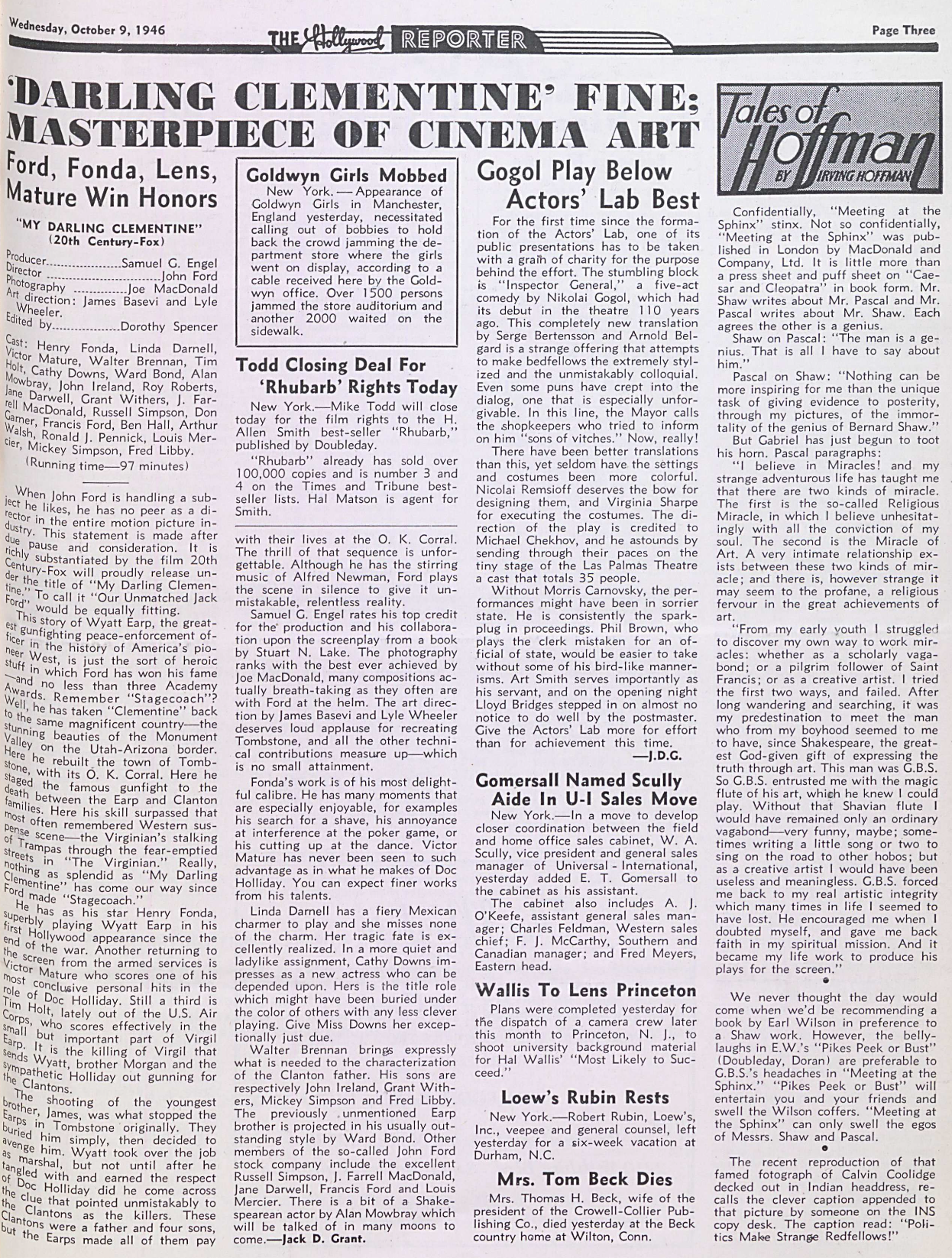
On December 3, 1946, 20th Century-Fox brought John Ford’s Wyatt Earp Western My Darling Clementine to the Rivoli Theatre in New York. The film, a Darryl F. Zanuck production, received high praise from reviewers at the time, including from The Hollywood Reporter, which headlined its review “Darling Clementine Fine; Masterpiece of Cinema Art.” THR’s original review of the Henry Fonda starrer is below:
When John Ford is handling a subject he likes he has no peer as a director in the entire motion picture industry. This statement is made after due pause and consideration. It is richly substantiated by the film 20th Century-Fox will proudly release under the title of My Darling Clementine. To call it “Our Unmatched Jack Ford” would be equally fitting.
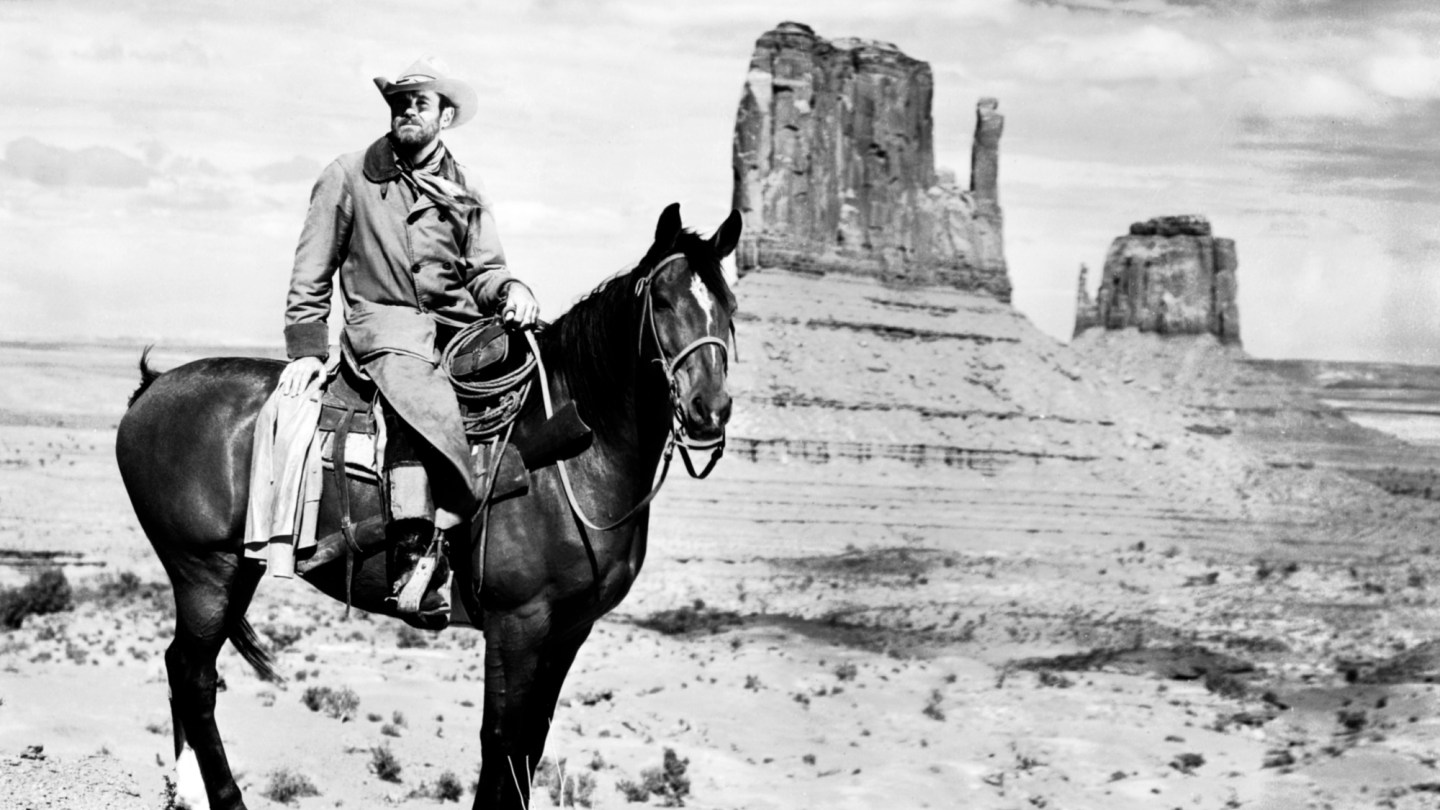
This story of Wyatt Earp, the greatest gunfighting peace-enforcement officer in the history of America’s pioneer West, is just the sort of heroic stuff in which Ford has won his fame — and no less than three Academy Awards. Remember Stagecoach? Well, he has taken Clementine back to the same magnificent country — the stunning beauties of the Monument Valley on the Utah-Arizona border. Here he rebuilt the town of Tombstone, with its O.K. Corral. Here he staged the famous gunfight to the death between the Earp and Clanton families. Here his skill surpassed that most often remembered Western suspense scene — the Virginian’s stalking of Trampas through the fear-emptied streets in The Virginian. Really, nothing as splendid as My Darling Clementine has come our way since Ford made Stagecoach.
He has as his star Henry Fonda, superbly playing Wyatt Earp in his first Hollywood appearance since the end of the war. Another returning to the screen from the armed services is Victor Mature who scores one of his most conclusive personal hits in the role of Doc Holliday. Still a third is Tim Holt, lately out of the U.S. Air Corps, who scores effectively in the small but important part of Virgil Earp. It is the killing of Virgil that sends Wyatt, brother Morgan and the sympathetic Holliday out gunning for the Clantons.
The shooting of the youngest brother, James, was what stopped the Earps in Tombstone, originally. They buried him simply, then decided to avenge him. Wyatt took over the job as marshal, but not until after he tangled with and earned the respect of Doc Holliday did he come across the clue that pointed unmistakably to the Clantons as the killers. These Clantons were a father and four sons, but the Earps made all of them pay with their lives at the O. K. Corral. The thrill of that sequence is unforgettable. Although he has the stirring music of Alfred Newman, Ford plays the scene in silence to give it unmistakable, relentless reality.
Samuel G. Engel rates his top credit for the production and his collaboration upon the screenplay from a book by Stuart N. Lake. The photography ranks with the best ever achieved by Joe MacDonald, many compositions actually breath-taking as they often are with Ford at the helm. The art direction by James Basevi and Lyle Wheeler deserves loud applause for recreating Tombstone, and all the other technical contributions measure up — which is no small attainment.
Fonda’s work is of his most delightful calibre. He has many moments that are especially enjoyable, for examples his search for a shave, his annoyance at interference at the poker game, or his cutting up at the dance. Victor Mature has never been seen to such advantage as in what he makes of Doc Holliday. You can expect finer works from his talents.
Linda Darnell has a fiery Mexican charmer to play and she misses none of the charm. Her tragic fate is excellently realized. In a more quiet and ladylike assignment, Cathy Downs impresses as a new actress who can be depended upon. Hers is the title role which might have been buried under the color of others with any less clever playing. Give Miss Downs her exceptionally just due.
Walter Brennan brings expressly what is needed to the characterization of the Clanton father. His sons are respectively John Ireland, Grant With ers, Mickey Simpson and Fred Libby. The previously unmentioned Earp brother is projected in his usually out standing style by Ward Bond. Other members of the so-called John Ford stock company include the excellent Russell Simpson, J. Farrell MacDonald, Jane Darwell, Francis Ford and Louis Mercier. There is a bit of a Shake spearean actor by Alan Mowbray which will be talked of in many moons to come. — Jack D. Grant, originally published on Oct. 9, 1946.