Agnieszka Holland has a long-running relationship with Franz Kafka.
The acclaimed Polish director first read the prolific writer as a teenager, she revealed at a THR Frontrunners panel about her Toronto-premiering biopic, Franz. Before crafting this beautifully fragmented portrait of the elusive Czech novelist, however, she had dabbled in bringing Kafka to the screen: a Polish TV adaptation of The Trial, made with her then-husband, Laco Adamik, in the ’80s.
Yet it was only when the filmmaker returned to Kafka’s world for Franz that an entirely new depiction of him formed. “When I started to go to Prague and shoot the film there, it became like my second [home] again, and I met that new presence of Franz Kafka in Prague,” Holland, who studied at the Film and TV School of the Academy of Performing Arts in the Czech Republic capital, said at THR Frontrunners‘ inaugural London edition. “It somehow triggered in me the desire to look for him. And I didn’t know if I could find him, but I wanted to really [begin] that process of looking for Franz.”
“[He] was somehow buried by some, on the one hand, very important and very intelligent and very scientific books, biographies and analysis,” she continued about the driving force of Franz. “Especially with the upcoming 100th anniversary of his death […] I had the impression, that fragile figure of that man, just disappeared. And yet he became the main tourist attraction in Prague.”
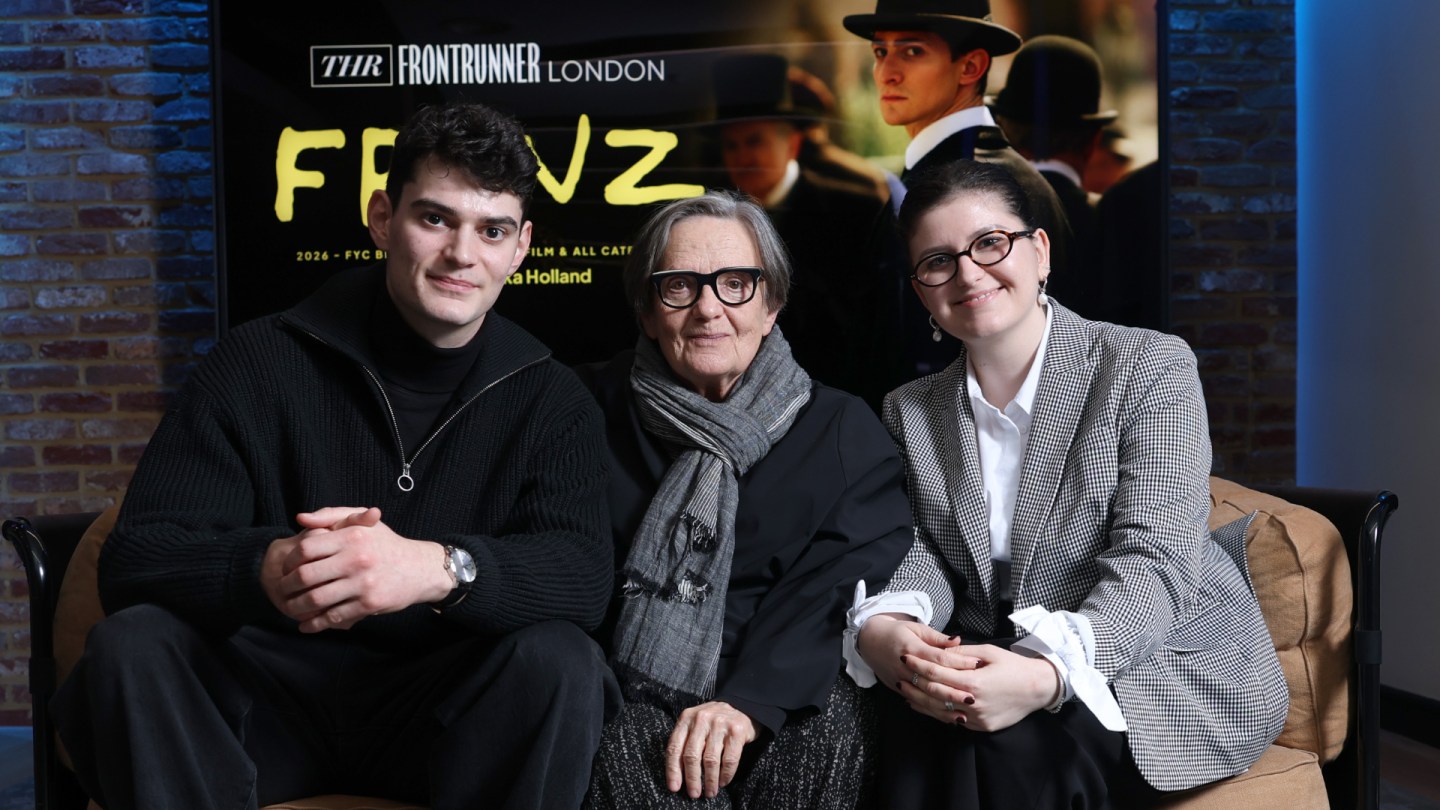
The three-time Oscar nominee — known for her politically provocative work such as Europa Europa (1990) and Angry Harvest (1985) — was joined by Franz actor Joseph Trojan at London’s Dolby Screening Room Soho for the THR Frontrunners event, sponsored by Metro Films.
She prompted laughter from the audience while detailing a key element of Franz: her blending of Kafka’s life with jumps forward to present day. Tourists wind their way through restaurants named in his honor and museums showcasing his letters, juxtaposing the origins of an artist with the jarring commodification of Kafka the brand.
“[In] every place you can find the name of Kafka,” said Holland. “The Kafka burger place [featured in Franz] doesn’t exist anymore. Now it’s falafel. But still, you have plenty of that over-present kitsch, but at the same time very spirited inventions and monuments, like [the Kafka head statue].”
“I started to ask myself the question, if Franz woke up and saw all of that, what would be his reaction? Because he was so shy, and he didn’t want to survive after his death; he asked his friends to burn his writings, his manuscripts. … I’m pretty sure that he would like that sculpture of David Cerný’s, that big turning head,” she mused. “Because he loved the new technology and cinema. And his father will be the happiest man on the planet if he sees it — finally, his son, [who] was the sorrow of his life, [who he saw] as a failure, and suddenly he would see that he is a huge commercial success. I’m sorry that Hermann [Kafka] cannot see it. So we want to bring him back as well.”
Holland does just that in the film. She breathes life back into a host of relatives and friends of Kafka’s who, before now, were shrouded in mystery: Peter Kurth as his aggressively loud and disapproving father, Hermann; Sebastian Schwarz as lifelong friend and publisher Max Brod; Katharina Stark as Ottla, the sister with whom Kafka was said to be closest to. But it is newcomer Idan Weiss, a German stage actor, who steals the show as the titular character with an uncanny resemblance and courageous performance.
“[He was] completely unknown,” Holland said about casting Weiss. “He was in some experimental theater, and he made some short films with his friends from the film schools.” With screenwriter Marek Epstein, Holland had agreed that their puzzle-piece approach was only going to work with the right actor. “I felt that it can work eventually, if we will find not only [the actor] physically relevant to the image we have of Franz Kafka but also some kind of the soul of Franz Kafka.”
“I was thinking here: ‘This is not regular acting,’” she explained, “It is the presence. This is some kind of charisma… So I was thinking that the casting directors have to look for the poets, musicians, somebody from the area of art, but not the comedians.” The film’s German co-producers hired a legend of German casting, Simone Bär, and after a few weeks Holland was sent three actors — including Weiss.
Holland remembers thinking: “It’s not possible. That guy not only looks like Franz Kafka, but also he has that something special, different. And I wrote to Simone asking to organize the meeting, because she was in Berlin — [Weiss] was in Germany. I was in Prague, I think, and she didn’t answer me for one week, two weeks. On the third week, I became a bit nervous and also a bit angry. We were in a hurry! So I called the German producers, and they said to me that she just died. She was sick. She had cancer.”
She added, “But people in the industry didn’t know, and so her collaborators took over and organized the meeting with Idan. But I thought to myself, it’s something slightly metaphysical that Idan was her last gift to us, to cinema.”
Across the 30-minute panel, Holland went into immense detail about her creative processes. She discussed choosing to include in the film a portrayal of In the Penal Colony over Kafka’s The Metamorphosis or The Castle (“you felt uncomfortable watching it? Yes, good”), as well as what the word “Kafkaesque” means to her and whether she feels closer to the writer after making this film.
On why Kafka remains so relevant today, Holland told The Hollywood Reporter: “When Donald Trump won the election for the first time, it was a few books [that] suddenly popped up on the sales of the American Amazon. It was Orwell, it was Philip Roth with The Plot Against America, and it was Kafka.”
“Today, some of his novels, like The Trial especially, are extremely relevant because we’ve been believing for quite a long time in the success of liberal democracy and the state of law and human rights. And now we see that it’s over. Especially with the system and institutions of the law, which are arbitrary and dehumanized, when anyone can be accused and anyone can be guilty.”
Poland has selected Franz as its best international feature film submission at the Oscars next year — a testament to Holland’s search for Kafka.