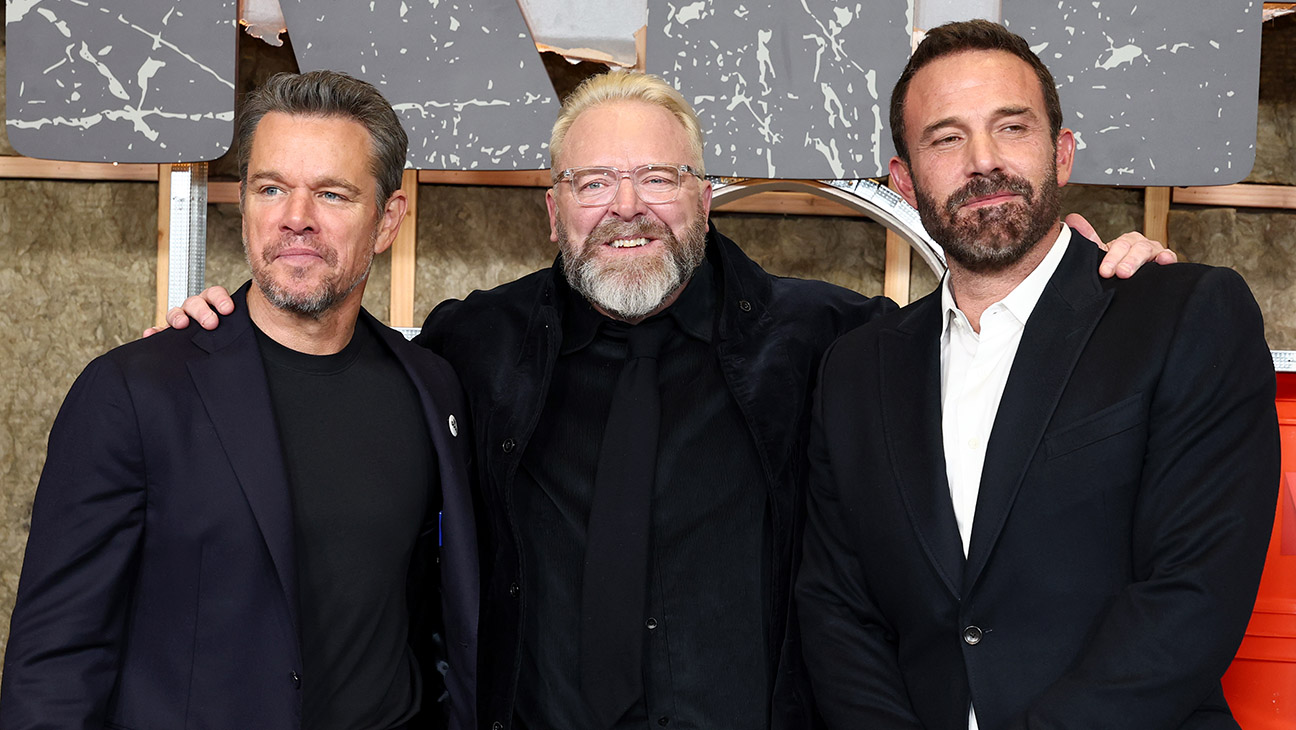
Ever since his breakout film, Narc (2002), Joe Carnahan has been keenly aware that the industry and audience alike have wanted him to helm more hard-hitting cop dramas. So the writer-director finally decided to purposefully deliver on that sentiment, and the result is the Ben Affleck–Matt Damon Netflix chart-topper, The Rip.
The road to The Rip began over a decade ago on Bad Boys for Life. At the time, Carnahan was writing and directing the franchise’s third installment, and despite exiting the project in 2017, he still managed to make a lasting friendship with the film’s technical advisor, a Miami cop named Chris Casiano. He eventually told Carnahan a story about a raid his Tactical Narcotics Team (TNT) once executed, leading to the unexpected discovery of $24 million within the walls of a residential home.
From there, Carnahan and Michael McGrale co-developed a version of Casiano’s story before Carnahan fulfilled the script himself. Along the way, Casiano suffered an unimaginable loss when his 11-year-old son passed away due to leukemia, so Carnahan threaded that personal detail into his own Miami cop character of Lieutenant Dane Dumars. Having befriended Affleck and Damon when working with the former on Smokin’ Aces (2006), the filmmaker then sent his script titled The Rip to their production company, Artists Equity, and he soon found himself with Damon in the Casiano-based role of Dumars and Affleck opposite him as Detective Sergeant J.D. Byrne.
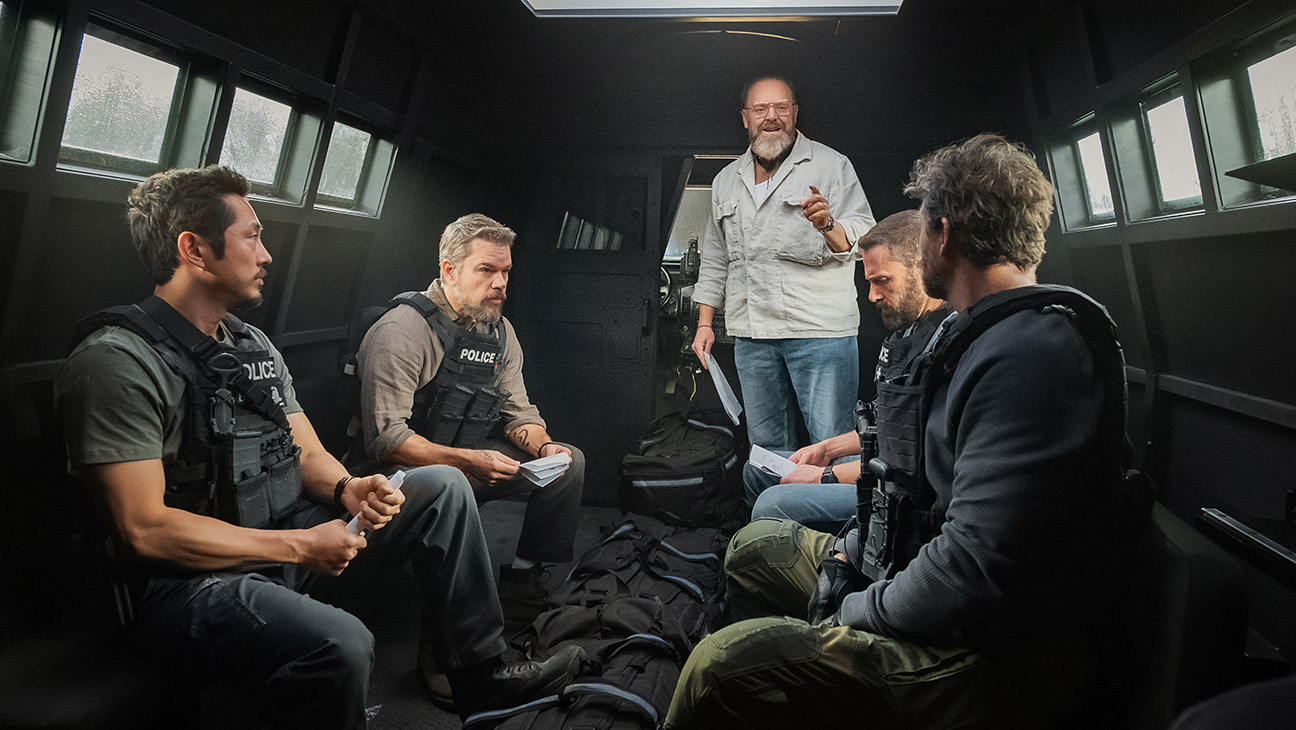
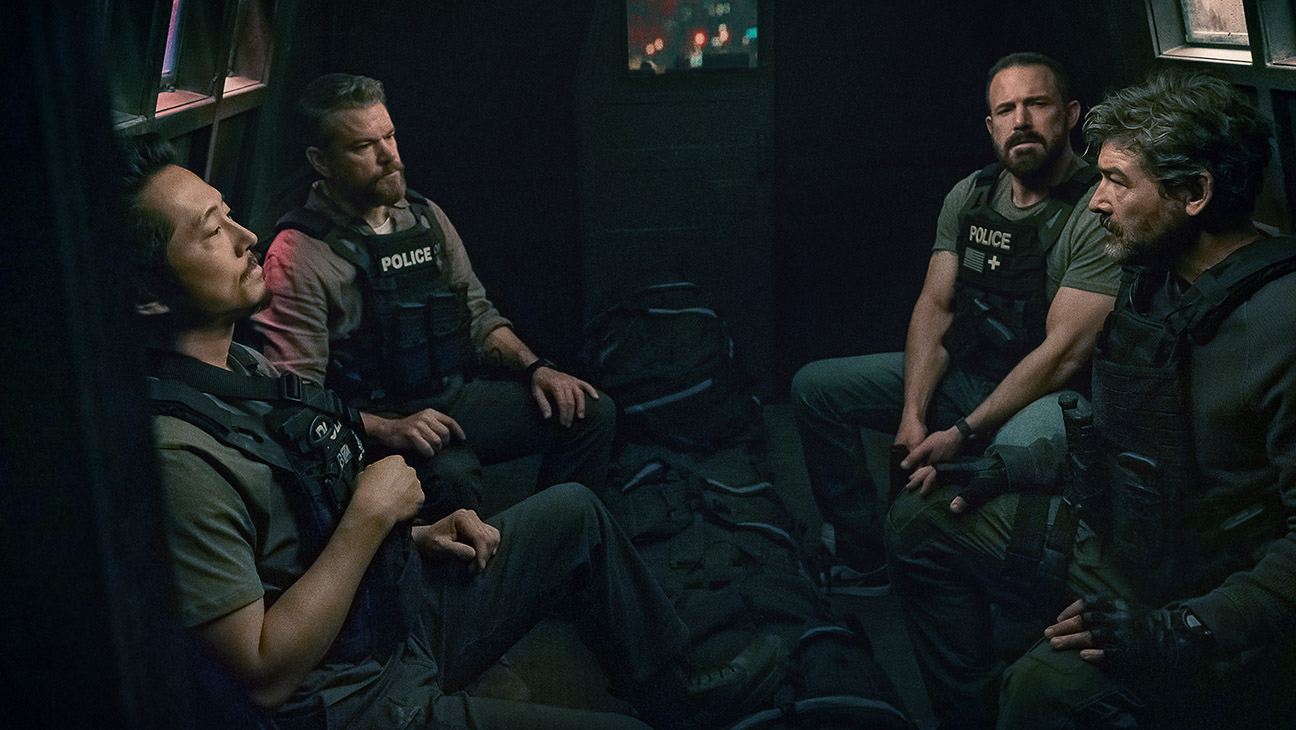
The film centers on a tip Dumars (Damon) receives involving a stash house full of cash. He and his TNT then carry out a raid only to discover that the reported amount of cash turned out to be $20 million, not the sub-$400K figure they were expecting. Dumars insists on following the Miami-Dade Police Department rulebook by counting all the money at the scene, and the thriller quickly becomes a race against time as parties with vested interests in the stash house begin to circle like vultures.
Carnahan is flattered by the warm reception to his latest film, one that includes 41.6 million views in its opening weekend of release, but the approval of one particular audience member, Casiano, mattered most of all.
“I had the biggest knot in my stomach during the screening. I didn’t know how this was going to affect [Casiano], and I haven’t cried that hard in the arms of another man, ever. He was so blown away and so grateful,” Carnahan tells The Hollywood Reporter. “It was my clumsy attempt at giving him a vessel for his grief and his loss and trying to contextualize it and build something as a sign of his son’s brief time on this earth.”
The DGA also aided Carnahan’s tribute to Casiano’s late son, Jake. “The Director’s Guild of America is pretty shrewd about their rules and their guidelines, and when I asked them for a waiver so that Jake’s name would be the first name you see in the closing credits, they didn’t even hesitate,” Carnahan adds.
The aforementioned Artists Equity was founded by Affleck and Damon in order to ensure that everyone involved in the production of a movie gets backend participation in some way, shape or form. That business model is especially challenging in the streaming era because there is no box office gross to help determine profit sharing. Instead, streamers like Netflix will pay a more exorbitant upfront fee to the major players involved in a streaming release. But that solution doesn’t include the blue-collar crew, and so Damon and Affleck negotiated a performance bonus with five different tiers. To put the payout structure into perspective, The Rip’s 90-day viewership numbers would have to rival those of KPop Demon Hunters for the crew to unlock the fifth tier’s maximum compensation.
Carnahan hopes that more stars push for the precedent that Damon and Affleck have established.
“Everyone should want this. If not, you just create this gulf. [The stars] are all going to get paid, but what about us?” Carnahan asks in reference to the crew. “These people break their backs to make movies, and they should be compensated [in success] for their time and energy. When you do that, it gives a movie a true communal sense. We’re all rowing in the same direction, hopefully, and if something does well, we all win. How can you root against that?”
Below, during a conversation with THR, Carnahan also discusses why The Rip doesn’t have a true protagonist for much of its runtime, as well as his nagging issue in regard to Copshop (2021), his well-reviewed Gerard Butler-led action thriller.
***
Would you say The Rip is the closest you’ve come to revisiting the tone and spirit of Narc?
100 percent, brother. My career would’ve been much better if I had just made movies like that. You want to do a bunch of different things, but there’s always that [sentiment], “Oh, good. He’s doing a cop movie.” So I understand that there’s some level of branding or what have you, but The Rip is absolutely a spiritual cousin to Narc.
Were you originally going to tell a version of this story in Bad Boys for Life?
No, the Bad Boys for Life script that I wrote was very Martin Lawrence-centric. It was very much about these old guys who didn’t have their explosive, youthful step anymore. It was an exploration of that and the sins of the father. There were studio people at the time that read it and said, “The end made me cry.” Will’s character confronts this version of himself that he was unaware of until he sees this guy’s eyes and he’s like, “That’s my son.” It was really great.
So it was different, but it had the same interpersonal connective tissue that is so vital now because of the deluge of giant superhero, giant monster, giant what-have-you movies. If a movie is not infused with this sense of humanity or the human condition or the human fragility, then that’s just something I don’t want to watch. Maybe it’s because of my age that I don’t have the same abiding patience for it. So I’m just trying to make stuff that I would want to watch and then watch again.
At the beginning of that film, the cartel prince character is tasked with recovering his dad’s stashed-away money in Miami, so that’s why I wondered if The Rip began there.
I did meet Chris Casiano on that movie, so there may have been some [influence]. I only saw that film one time at the premiere, and my recollection is that it was not that. But there was a long period of time where I did not work on that story, so it could have been infused into the body of it.
Matt Damon’s The Rip character is based on Chris. He’s a real-life Miami cop who had a similar experience involving a stash house with $24 million. The loss of his 11-year-old son, Jake Casiano, to leukemia also inspired the grief that Matt’s character is shouldering. How emotional was Chris’ first screening of the movie?
Oh, it was the most emotional experience. It was a heavy duty, dude. I had the biggest knot in my stomach during the screening. I didn’t know how this was going to affect him, and I haven’t cried that hard in the arms of another man, ever. It was a really, really cathartic and deeply emotional release. He was so blown away and so grateful. It was my clumsy attempt at giving him a vessel for his grief and his loss and trying to contextualize it and build something as a sign of his son’s brief time on this earth.
The Director’s Guild of America is pretty shrewd about their rules and their guidelines, and when I asked them for a waiver so that Jake’s name would be the first name you see in the closing credits, they didn’t even hesitate. They were like, “Absolutely.” They got it on the first bounce, which is so great, man. But, yeah, it was something else showing Chris the movie.

Ben and Matt can literally do anything they want, so what was the key to your pitch?
I think they read the script and just got it. They understood it. We’re all around the same age, and we all grew up being inspired by the same filmmakers and the same movies. They’ve got two little gold guys for writing. They’re not slouches when it comes to the finer points of screenwriting. So the material spoke to them, and they didn’t have a ton of notes. The most notes were on the day, like, “Do we need this? Probably not.” I was dealing with really high-level guys that can execute with a specificity and expertise, and you’re lucky to have that on set.
The mission of their company, Artists Equity, is to make sure that the cast and crew have skin in the game, and they went above and beyond to ensure a performance bonus on The Rip. Could you tell on set that the crew had an extra spring in their step because of it?
Everybody was happy to show up to work, and they knew that they’re actually being looked out for. If this does well, the caterer, the gaffer, the best boy and the dolly grip are going to see some extra dough. So I credit Matt and Ben for taking a really strong stance in that direction. They understood that the traditional residual structure doesn’t apply to streaming and that something needs to be implemented to start that ball rolling. I also give Netflix credit, man. They get it. This is a sign of the times and a shift in the way that their traditional business is done so that people are incentivized. If something does well and it racks up hundreds of millions of streams, then you are being compensated thusly. So I think it’s great for everybody.
Every once in a while, there will be a story about Keanu Reeves gifting Rolexes to his stunt team, or Tom Cruise making sure his crew was paid throughout the pandemic. (Fun Fact: Cruise, as producer, helped secure Narc’s theatrical release, leading to Carnahan’s 15-month stint as writer-director during Mission: Impossible III’s development.) But movie stars making an arrangement like this one on The Rip is unheard of for the most part. Would you like to see more people follow Ben and Matt’s lead?
Yeah, everyone should want this. If not, you just create this gulf. [The stars] are all going to get paid and get residuals and so on and so forth, but what about us? You’re talking about people that show up two hours before the actors get there and stay two hours after they’re gone. These people break their backs to make movies, and they should be compensated [in success] for their time and energy. When you do that, it gives a movie a true communal sense. We’re all rowing in the same direction, hopefully, and if something does well, we all win. How can you root against that?
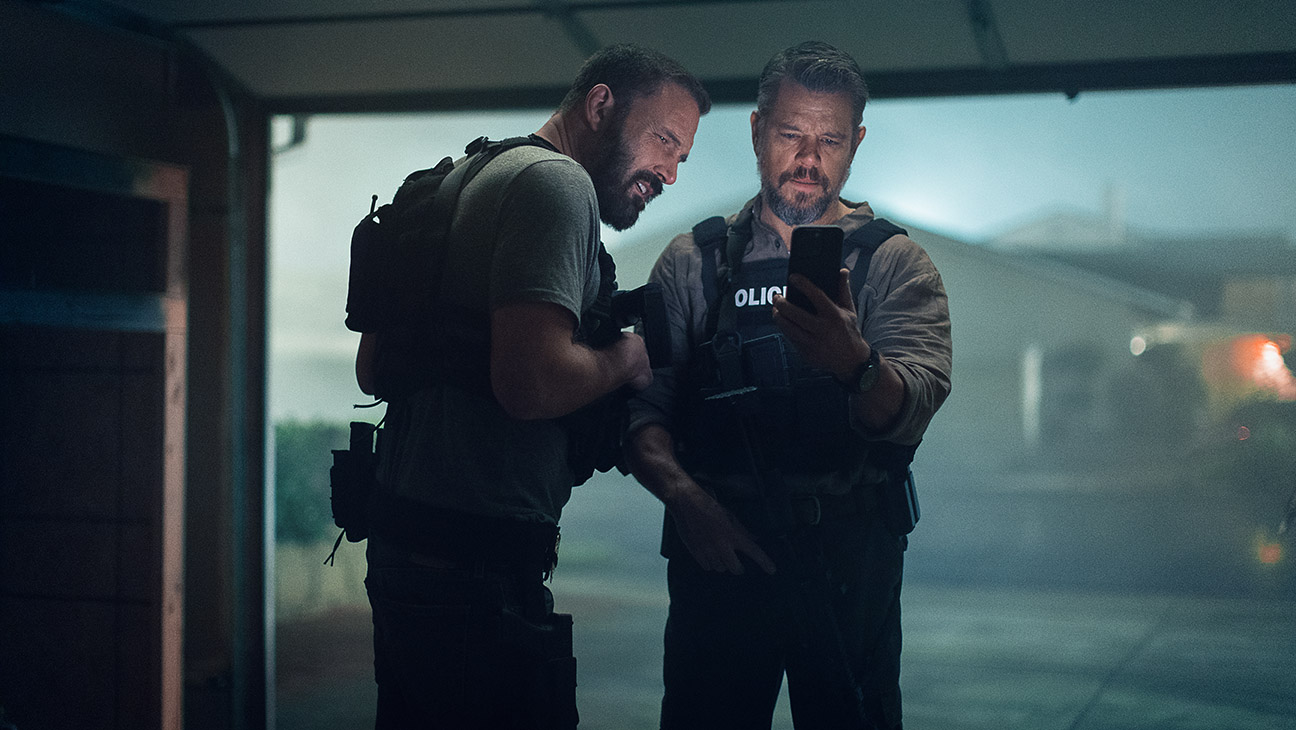
Ben and Matt’s characters throw hands at a certain point in the garage. Did they indicate at the time that they’d scrapped before in some capacity?
We did a show together yesterday, and they said that they’ve never actually been in a physical altercation. They endlessly berate and ridicule each other, which is funny as shit, but things have never really gotten out of control, physically. That’s amazing given how long they’ve been friends and what the ups and downs of any 40-plus-year friendship might be.
So I think they’d say, “Our stuntmen beat the shit out of us.” That scene is a dirty fight between brothers, and that’s how it would be. It’s formless, ugly and violent, and it’s over in an instant. So they enjoyed watching their doppelgangers beat the shit out of each other.
The Rip is one of those movies where you can’t trust anyone. Thus, I contend that there is no protagonist until the reveal of the movie establishes who the protagonist is. Am I off-base here?
No, I think you’re very accurate. You’re not quite sure what the hell is going on, and keeping the audience on uneven terrain is part of the process of the movie itself. That is what you need to do to sell the larger context of what’s happening. Then the reveal gives the audience exactly what they want. It’s that whole thing of giving the audience what they want in a way they least expect, and I think this film does a really good job of that.
It’s similar to Narc where you think you know what the character dynamics are, but then the movie completely recontextualizes itself in its closing moments.
Right, it’s very similar in that way. You don’t see these things coming because you’ve been led to believe it’s A when it’s actually Z. But that’s always the trick, man. You’re trying to pull off that genuine moment of, “Oh wow. I didn’t see that coming at all. ” With The Rip, I’ve yet to have anybody say to me, “Oh, I knew what it was going to be.” No one sees it coming. That’s a testament to Mike McGrale and the work he did with me on the script and how much we really fleshed that stuff out. You always want the Hitchcockian, twisty elements to actually land.
You’ve probably been asked about the ending of Narc a thousand times, but do you definitively know what Tellis (Jason Patric) did next?
What’s funny is I shot a scene where he showed up at the house of Anne Openshaw’s widow character, Kathryn Calvess, with a handful of spaghetti from the tape that he had pulled apart. You realized he was showing her that he had destroyed all the evidence. But I thought it was so unnecessary. It was the one scene in the movie where I thought, “This is goofy. It just doesn’t work.” So it made more sense to end on that tape recorder turning off, and then the viewer can extrapolate in whatever direction. Did he cover it up? Did he not cover it up? So that’s the end of the movie, and it’s similar to TheGrey. Once Liam Neeson’s character makes his decision, “I’m going to die on my feet,” that’s the end of the movie. The choice has been made. I like the ambiguous nature of those endings. It’s cool.
Based on the post-credit tag, I always assumed Liam’s character and the wolf died via draw.
Yeah, [Open Road Films CEO] Tom Ortenberg let me put that Easter egg in there, and I was really happy with it because they basically played to a draw. It’s the two of them united. You see the wolf breathing, you see Liam laying there and that’s it. It didn’t matter that it existed in a separate plane; I just wanted it there at the end. The movie was over, but that was when everybody was really fond of the Easter egg. You could take it however you wanted; I just wanted it there at the end. You didn’t see the fight, but you saw the denouement or the resolution that they played to a draw.
But I didn’t want The Rip to be ambiguous — beyond that little karmic kiss from the cosmos at the end. I didn’t want that ambiguity. I wanted people to know exactly what they did, why they did it and what it meant. And I think it works.
I also love ambiguous endings, unlike Stranger Things fans. Sorry, Netflix.
(Laughs.) All I’ve heard is how my nieces didn’t like it. I don’t know what the ins and outs were, but I know a lot of people were pissed off. But hey, that’s life in the big city, man. It’s a huge show.
I enjoyed Copshop a great deal. Gerard Butler has been able to pull off some unlikely sequels, but is that one too far out of reach now?
Honestly, I appreciate that version of the movie, but I have a fantastic version that’s 15 minutes longer and much better. So I think [a sequel] is highly unlikely. It’s more likely that I get my version out. I’d really love to have a Copshop director’s cut that maybe my fine friends at Netflix could put on the air. I really enjoy that movie, but I think we made a critical error in not releasing the longer cut. It’s much more nuanced and much more deeply felt. I think it’s Butler’s best performance and my best performance, hands down. I know he gets lauded for the performance that’s in there, and while it’s still quite good, it wasn’t as emotional and weighty as the version that we had originally created.
***
The Rip is now streaming on Netflix.