Swiss-Italian writer-director Petra Volpe made a box office and critical splash with Late Shift, her Swiss international Oscar submission starring Leonie Benesch (The Teacher’s Lounge) as an overworked yet tireless nurse navigating an overstretched hospital ward. In her new film, Frank & Louis, her English-language debut, she zooms in on another often-overlooked care issue: the care needs of the aging incarcerated.
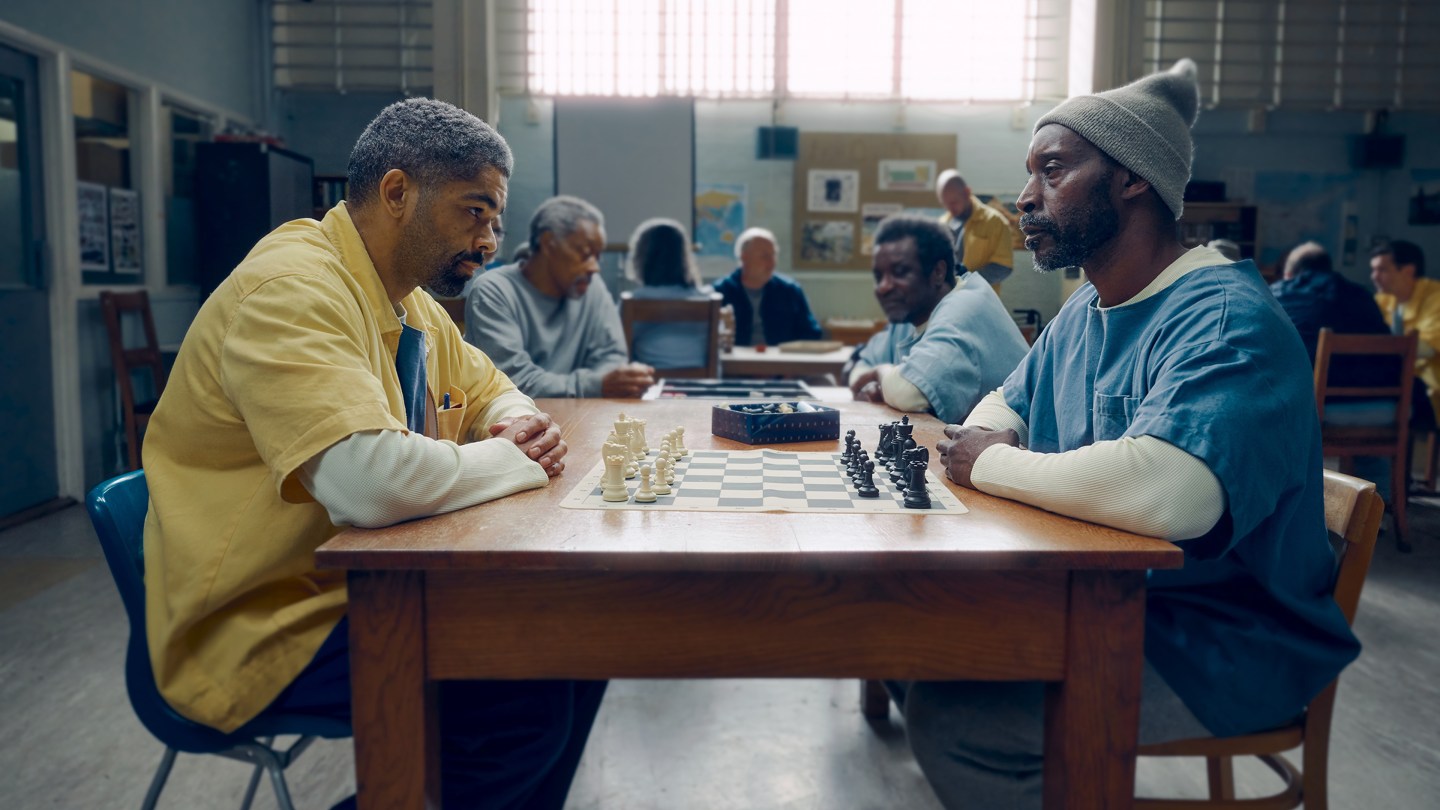
Set within the walls of a U.S. prison, Frank & Louis follows Frank (Kingsley Ben-Adir), who is serving a life sentence and takes on a caretaking role for aging inmates suffering from memory loss. Rob Morgan stars as one of those inmates, Louis.
Inspired by the “Gold Coats” peer support program at the California Men’s Colony state prison in San Luis Obispo, Frank & Louis, which world premieres in the Premieres lineup of the Sundance Film Festival on Jan. 25, explores the potential for rehabilitation through caretaking.
“The theme of care and caretaking, what that means and how we all need it, is such an important societal issue,” says Volpe about her motivation for the film. “We take for granted that there are people who take care of us. It’s also a taboo, because nobody wants to think about being old and sick and needy. And especially in the context of prison, we never really think about it deeply.”
In researching the topic, the filmmaker met inmates to discuss the Gold Coats initiative and found out that care often goes both ways, with caring also becoming a form of self-care. “A lot of the men I encountered when doing the research said that the care work made them feel human again, and that really stayed with me,” Volpe recalls. “It became my guiding light for this project. The question is: What makes us feel human in any environment, and especially in an environment like a prison, where you are dehumanized from the get-go.”
Ben-Adir’s character initially agrees to take on the care role with the hope that it will help his case for an early release. “The long years in prison have left him hollowed out, frozen and emotionally checked out, probably also to protect himself,” Volpe explains. “The work with Louis helps him to defrost. It’s something all of the men I interviewed said: the work with the people they took care of really opened their hearts and started a process of self-healing and reconnecting to themselves, to their families, to their own guilt.”
So, while the movie may be set in a U.S. prison, the director sees the underlying themes as much bigger and more universal.
The cast, which also includes René Pérez Joglar, Indira Varma and Rosalind Eleazar, each came to the project with their own personal connections to the story. Volpe says, “Either they had elderly people in their families, or incarceration was something that they wanted to talk about. All that was very much a driving force for them. That’s the most wonderful gift for a director, because then the making of the movie is very much driven by this existential need of everybody in the film to tell a story that they really care about.”
One decision the creative team behind Frank & Louis made early on was not to go for naturalism. “We wanted to show almost a metaphor, a prison that is a universal prison, and what incarceration does to the souls of people, and how they can break out of that,” the director, who worked with cinematographer Judith Kaufmann, notes. “So we were focusing more on these kinds of questions rather than authenticity. I wanted the movie to feel emotionally authentic, but in the depiction of prison, we tried to avoid certain tropes.”
The fact that Volpe made two care-centric movies, Late Shift and Frank & Louis, in close succession is mostly a coincidence, but she doesn’t feel finished with the topic yet. “It took 10 years to make this movie, and it was actually my co-writer, Esther Bernstorff, who had read about the Gold Coats program,” she tells The Hollywood Reporter. “I was fascinated by it, because it seemed such a contradiction, especially going against all the cliches we have in our heads. Prison is seen as a place of toxic masculinity, a place of violence. But I was interested in the idea that it can also be a place of care and compassion.”
After Late Shift and Frank & Louis, Volpe has also been developing another movie about caretaking. “I would love to make three movies about this topic, because especially in the world we live in right now, it’s such an important issue,” the filmmaker explains. Indeed, there is a project that is “more about palliative care” that she has been working on for years.
Outside of this, Volpe is working on a remake of a comedy she wrote called Golden Years. Seemingly noticing the interviewer raising his eyebrows, she asserts, ”Yes, I also like doing comedies, not just dramas.” There is also a television show about the story of chocolate in Switzerland. She says, “As a filmmaker, you always have to have a lot of irons in the fire and a lot of things going on. So, I don’t really take a break. I also feel that the time you have to make movies is limited, and I want to make use of that.”
As for Sundance, where the film is seeking distribution, Volpe says premiering her latest film at the Park City fest “was my wildest dream.” She adds, “It’s a place where cinema still gets really celebrated, and you find real aficionados who think deeply about cinema and who enjoy complex stories. So, it’s super-exciting to go there for me, but also for my whole team and also the actors.”