In her delightful 2017 directing debut, Booksmart, Olivia Wilde brought insouciant freshness and a sensibility both sweet and dirty to the well-worn coming-of-age comedy. That kind of originality was precisely what her slick but hollow second feature Don’t Worry Darling lacked, though the 1950s-set feminist freakout was at least admirably ambitious. In Wilde’s more assured third outing as director, The Invite, the elements are closer to alignment even if you can hear the gears cranking as it shifts from comedy of bad manners into scalding pathos.
When it’s cooking, which is most of the run time, this is a smart, sophisticated and incisively acted adult entertainment that savages the crumbling institution of marriage, dangles the promise of sexual rescue and then brings the walls crashing down in a bitter reckoning that seems irreversible — until a window of hope and healing gets cracked open. That closing note is so lovely, and its visual handling so graceful, that it retroactively smooths the bumps.
The Invite
Well worth RSVPing.
The quick-witted script by Will McCormack and Rashida Jones was adapted from Spanish writer-director Cesc Gay’s 2020 comedy Sentimental, based on his own play and shown in English-speaking territories as The People Upstairs. That property has become a virtual cottage industry, already spawning French, Italian, Swiss, Russian, Czech and South Korean remakes.
Wilde had very clear ideas about how she intended to make her version, beginning with a generous rehearsal period during which the writers and the four impeccably matched principals workshopped the material, adjusting the fit of their characters and relationships. It was then shot sequentially on a single studio set — much like a theater company staging a play.
There are weak patches in which a stiff theatricality creeps in, along with a trace of glibness, recalling Roman Polanski’s starry but leaden stage-to-screen vehicle, Carnage. But more often, Wilde and her actors keep it buoyant, with a crackling energy that makes the endless streams of overlapping talk play like jazz.
The director’s playfulness is in evidence from the start, with Seth Rogen’s goofy Beavis and Butt-Head laugh heard over shaky cellphone video of his character Joe and wife Angela (Wilde) doodling at a piano in younger years. French pop singer Fabienne Delsol’s jaunty ‘60s-style “I’m Confessin’ (That I Love You)” plays over a gorgeous multi-panel montage of happy moments from their lives together before a smash cut to Joe sitting alone in an auditorium, his dead-eyed face a mask of misery.
Rogen has never been better. Joe is an associate professor at a respectable enough Bay Area music school, though it’s not top-tier, one of many personal shortcomings that eat away at him like cancer. The awkward physical comedy as he attempts to get his collapsible bike out of the hall and home up the hilly streets of San Francisco is the sole scene that takes place outside the roomy apartment Joe inherited from his parents — another thing that tags him as a failure, in his eyes. Then there’s the demise decades ago of his band, once the promise of a minor hit had evaporated.
From the moment Joe gets in the door and collapses on the floor with chronic back pain, it’s clear that Angela is too busy preparing for the evening to pay much attention to her husband’s numbingly familiar complaints. The barely contained hostility between them simmers and frequently boils over as she bustles about readying for a dinner party with the neighbors, an occasion Joe indignantly claims she planned without his knowledge. Hence his arrival home without the wine he was supposed to pick up.
Wilde is a keen observer of her eager-to-please character’s manic sense of purpose and her mortifying fear of seeming uncool to the attractive couple upstairs, Hawk (Edward Norton) and Piña (Penélope Cruz). She seems especially in awe of the Spanish Piña: “She has presence.”
Angela gushes over how sweet and patient they have been about the noise from their apartment renovation. But Joe scoffs, instead fuming about the neighbors owing them an apology for the nightly aural assault of their raucous sexual congress, notably Piña’s ecstatic orgasms. He’s also not a fan of Hawk’s intrusively friendly chatter in the elevator, while Angela finds him charming and sparks up some very studied feminist outrage while declaring that she would never impinge on another woman’s right to vocalize her hard-earned pleasure.
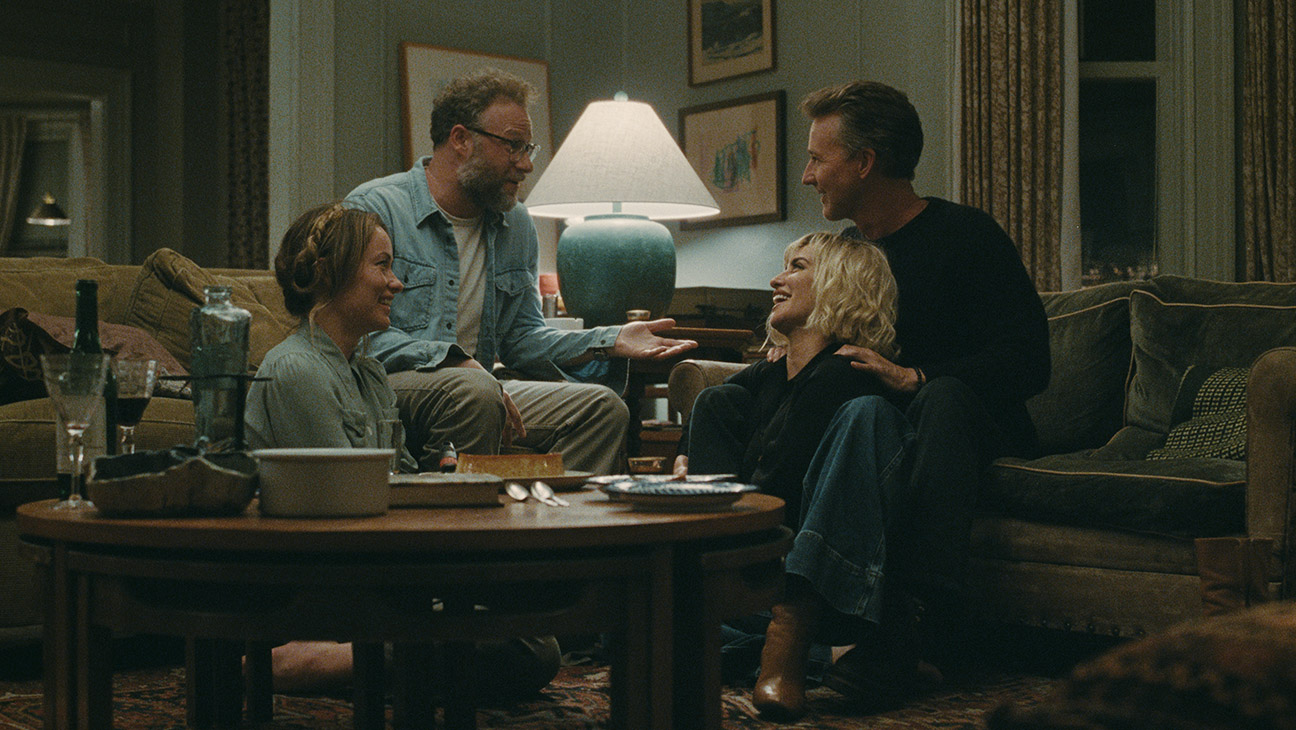
Hawk and Piña arrive just as their hosts’ argument reaches its loud crescendo. Rather than politely saying nothing, Hawk enthuses, “We love a contentious environment!” That seemingly patronizing comment makes it open season for curmudgeonly Joe, who removes the passive from their passive-aggressive banter, while Angela looks like she wants to crawl under the sofa cushions with embarrassment. The promise of consequences in her irritated double-takes after each of her husband’s barbs is priceless.
The neighbors remain remarkably Zen through all this, with retired firefighter Hawk oozing New Age sincerity while self-possessed Piña, a psychotherapist and sexologist, appears to sit back making an unspoken professional evaluation of the other couple’s issues. Now and then, Hawk and Piña exchange a few words of commentary in Spanish, another thing about them that enrages Joe.
Pretty much everything that could go wrong does, from a ruined souffle to a drinks crisis to Angela proudly displaying her spread of cheeses, crackers and jamón — in honor of Piña’s heritage — only to learn that her neighbor doesn’t eat meat, dairy, gluten or sugar. She’s spared one more tiny humiliation when Piña tells Joe, out of his wife’s earshot, that she thinks the jamón looks more like prosciutto.
That detail is shared when she follows Joe into his chaotic home office to smoke a joint while Angela gives Hawk a tour of the apartment. This interlude of deeper acquaintance, flirtation and flattery among the reshuffled couples would appear to indicate new allegiances and battle lines being drawn, in the tradition of The Invite’s obvious North Star — Edward Albee’s play (and Mike Nichols’ film), Who’s Afraid of Virginia Woolf? But the scenario is full of surprises, which Wilde and the writers deploy with mischievous glee.
Just as Joe is readying to lay into the neighbors about their operatic bedroom performances — with Angela hilariously shoveling spoonfuls of Piña’s “famous” flan into his mouth to shut him up — Hawk and Piña catch him off guard by voluntarily offering an apology.
The less you know about what follows, the better, but suffice it to say the upstairs neighbors’ candid explanation for their tendency to get carried away during sex puts the whole evening in a new light and radically changes the interactions moving forward. This is all very funny, providing the actors with space to stretch their characterizations in droll new ways.
The shift that follows — as sexual frisson dissolves into old resentments and the marital gloves come off — could have been more fluidly introduced and risks seeming forced. But the actors are so terrific and so fully at home in their characters’ skins that they ride over the rough patches, uncovering genuine pathos, not just in Joe and Angela’s devastating takedowns but in Hawk’s tender confession of the circumstances that led him to rebuild a new life for himself with Piña. The whole ensemble is excellent, but Rogen and Norton are clear standouts.
The most nagging problem I had with this highly entertaining movie is that it’s too long. Gay’s original Spanish feature ran a fleet 82 minutes and most of the remakes have kept it under 90, which is what the material seems to dictate. Wilde has added north of 20 minutes to the template, and if I had to guess, I’d say it’s the result of the filmmakers deciding the psychology of marriage, relationships, love and sex lacked sufficient depth.
Bringing on Esther Perel — the American psychotherapist and author known for her Where Should We Begin? podcast and books on “erotic intelligence” — as a consultant probably seemed a savvy idea on paper. But it gives The Invite a whiff of didacticism, especially since it doesn’t take much scholarly analysis to arrive at the conclusion that our gripes with our partners are more often anger and regret over our own choices.
But this is a nitpicking criticism of an immensely pleasurable film. Despite the confines of its single setting, the movie packs cinematic life into every scene, thanks to the meticulously planned spatial dynamics of production designer Jade Healy’s soundstage build and the careful thought behind cinematographer Adam Newport-Berra’s framing choices, with lots of low angles, shots through windows, doors and hallways and people often captured in mirrors.
Hawk talks pretentiously about the exceptional physical energy of his hosts’ living room while praising the delighted Angela’s emotionally attuned decorating instincts. (This causes Joe’s eyes to roll like slot machine symbols.) But physical dynamics are a big part of why the film works, the way the characters negotiate one another’s space saying almost as much about them as their loquacious chatter.
After the disproportionate bashing Wilde took on Don’t Worry Darling, her new movie should silence the doubters. At this point it’s hard to deny she’s the real deal as a director.