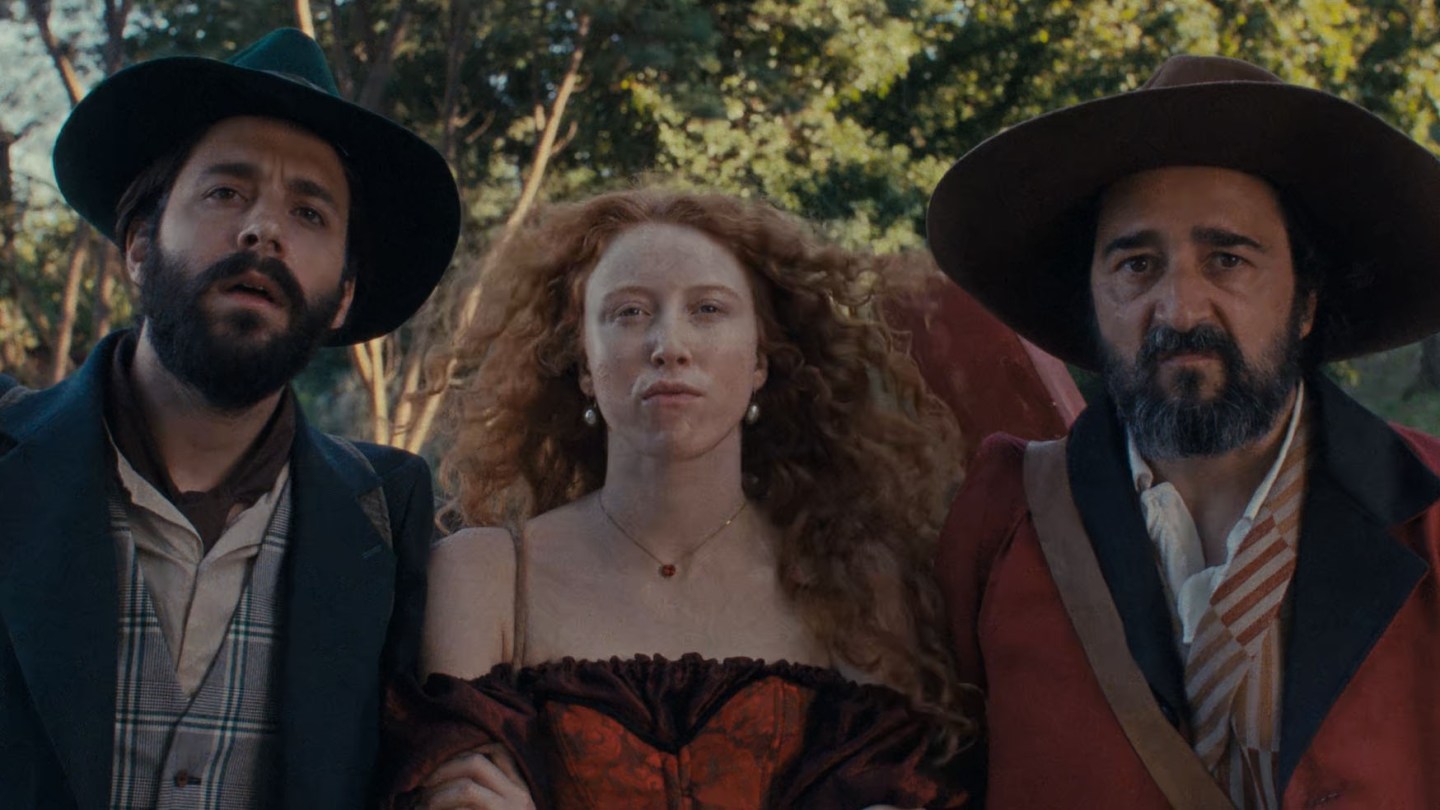
The 55th edition of the International Film Festival Rotterdam (IFFR) kicked off Thursday evening with the world premiere of Providence and the Guitar, the new movie from Portuguese filmmaker João Nicolau (Technoboss) that is an ode to artists, as well as an opening speech that was a reminder of the violence in such places as Iran, Gaza and the U.S., courtesy of ICE, and a global backlash against women’s rights. The opening comments also put a spotlight on cinema as a unifying force and included an appeal to protect the freedom of the arts at a time when U.S. President Donald Trump has been reshaping the John F. Kennedy Center for the Performing Arts, including by renaming it the Trump-Kennedy Center.
Vanja Kaludjercic, festival director at IFFR, and Rotterdam managing director Clare Stewart were on hand for Thursday’s opening night festivities. In her welcome remarks, Kaludjercic made a passionate plea to protect human rights, lives and the freedom of the arts.
Amid all the “tumultuous events and shifts of power” across the world in recent years, “it is understandable that anyone might feel overwhelmed, perhaps feel alone, … feel a desire to turn inwards, even become cynical or indifferent,” Kaludjercic said. “This is precisely why we need the arts, and, in our case, cinema. Cinema allows us to gain perspective as a collective. It connects us to the past. It helps us imagine ideal futures that are worth striving for, and more than that, it reminds us how much we share —the common ground that brings us together rather than dividing us in so many ways.”
She quoted comments by John F. Kennedy about the role of the arts and culture in society when he kick-started a fundraising campaign for the Kennedy Center, citing his line that “behind the storm of daily conflict and crisis, the dramatic confrontations, the tumult of political struggle, the poet, the artist, the musician continues … building bridges of experience between peoples, reminding man of the universality of his feelings and desires and despairs, and reminding him that the forces that unite are deeper than those that divide.”
Kaludjercic concluded that this echoes “the endeavor and the adventure that is IFFR. The festival has always sought to create a space where people from all over the world can meet and engage through a program whose totality expresses our concerns about how we live now.”
The fest boss touched on various news and conflicts that have featured in news headlines and discussions around the family table worldwide. Sharing that she came across Kennedy’s speech while researching the history of the performing arts center, “and while reading reports about how the Trump administration has been actively dismantling it, a venerated institution long considered a space apart from party politics, sustained for decades by bipartisan care and goodwill. It’s now under threat. It is always disturbing to see how easy it is to destroy something, knowing how difficult it was to build and how much harder it will be to reconstruct.”
Lauding Kennedy’s words for “their generosity of spirit,” Kaludjercic said that “they feel far removed from the cynicism and vitriol that dominate so much public speech today, where moral certainty too often hardens into authoritarian tone and demeanor. Democracy cannot be defended through such a stance, even when it is claimed to be in the name of a good cause, because too much gets destroyed in that way, and too much is lost.”
The Rotterdam boss also pointed out a sad truth of her work. “Every year, as I open this festival, another crisis joins the long list of our collective worries, and few, if any, have been resolved,” she said. “Russia continues to wage war on Ukraine and to illegally occupy parts of its territory. In Gaza, genocidal violence has unfolded in full view of the world, expanding the war and drawing much of the Middle East into overlapping conflicts. Civil wars in Myanmar and Sudan have taken tens of thousands of lives and displaced millions. However, unlike other conflicts and crises, they remain … absent from sustained global attention.”
Iran and ICE also featured in Kaludjercic’s speech. “Just weeks ago in Iran, people once again rose up to protest an oppressive government and were once again met with violent repression, resulting in what now appear to be tens of thousands of deaths,” the Rotterdam festival director highlighted. “In recent weeks, there were moments when we could not … communicate with fellow colleagues from Iran to just know whether they were safe or whether they would be able to join us here at the festival. And you know that uncertainty is just not exceptional. It is symptomatic of the conditions under which people in Iran are forced to live and work.”
Kaludjercic emphasized that some of these events may seem far away, but she encouraged everyone to think again. “Who knows how the ripples of these events may yet reach our shores after the Trump government has demonstrated, through its attacks on Venezuela and the killing of innocent civilians within its own borders by mass government assailants, a blatant disregard for national and international law, treaties and institutions.”
Towards the end of her comments, the festival head highlighted some focus programs at IFFR 2026, including a focus on women’s cinema in honor of the 60th anniversary of the National Organization for Women (NOW). “We return to that moment when feminism emerged,” she said. “Women’s rights are once again under attack. Too many hard-fought victories and freedoms are being rolled back, dismantled or annulled, and we felt compelled to look again at feminism as a force of resistance, but also as a source of imagination.”
But the program is not what some may have expected. “The core of this focus is deliberately unusual. It is developed through ideas and practices rooted in animation,” Kaludjercic emphasized. It is “proposing a feminism with popular roots, fanciful, playful and formally inventive and determinedly different in its attitudes from much of what surrounds us today.”
Concluded the Rotterdam boss: “All these trends and many more come together in the celebration of cinema that we are delighted to share with you over the next 11 days. … It is a program shaped by curiosity and by a belief in cinema’s many forms.”
The choice of this year’s opening film itself was unusual. Salvador Sobral, who became Portugal’s first-ever Eurovision winner in 2017 with the song “Amar pelos dois,” written and composed by his sister Luísa, is one of the leads in Providence and the Guitar, which is loosely inspired by a story by Scottish writer Robert Louis Stevenson (Treasure Island, Strange Case of Dr Jekyll and Mr Hyde). Pedro Inês and Clara Riedenstein star with Sobral and other members of an ensemble cast. Nicolau wrote the screenplay with Mariana Ricardo.
Rotterdam organizers described the film, whose original Portuguese title is A providência e a guitarra, as “an ode to artists following their creative passions” and a “tale about the importance of art in everyday life.” It tells the story of 19th-century traveling singers and actors Léon and Elvira who must keep believing in their art despite financial, bureaucratic and other challenges. Shellac is handling sales on the movie from production firm O Som e a Fúria.
On Friday, Cate Blanchett will add her star power to the Rotterdam fest activities. She is in town for the world premieres of the first five short films made by directors of Iran, Syria, Afghanistan, Somalia and Ukraine with grants from the Displacement Film Fund, a scheme unveiled last year by the star and IFFR’s Hubert Bals Fund. The grant recipients are Iranian auteur Mohammad Rasoulof (The Seed of the Sacred Fig), Maryna Er Gorbach, the Ukrainian director known for Klondike, Somali-Austrian filmmaker Mo Harawe (The Village Next to Paradise), Afghan filmmaker Shahrbanoo Sadat, who fled to Germany, and Syria’s Hasan Kattan (Last Men in Aleppo).