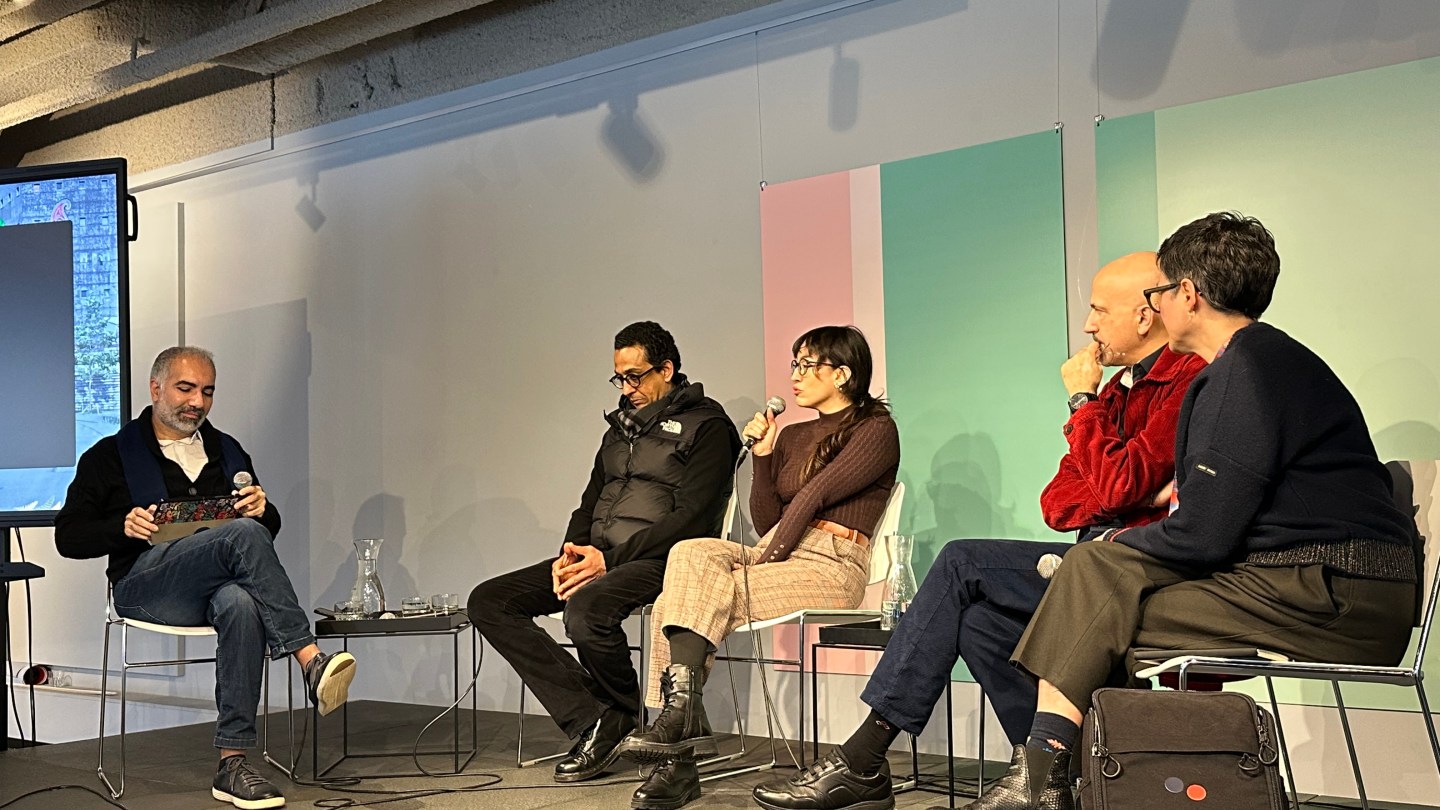
The 55th edition of the International Film Festival Rotterdam (IFFR) put a spotlight on “Arab Cinema in Motion” on Monday, a panel discussion featuring The Arab director Malek Bensmaïl from Algeria, Home Bitter Home director Marie-Rose Osta, who is Lebanese, and Egyptian director Marwan Hamed, who is the focus of an IFFR retrospective this year.
The IFFR Pro panel was designed to explore “the present realities of the film industry in the Arab world,” a preview of the event had highlighted. “Filmmakers from across the IFFR 2026 selection join industry guests to examine distinct modes of production across disparate Arab cinemas – from blockbusters to independent works – and the shifting sources of financing shaping their production.”
Among other topics of debate were the pros and cons of streaming platforms. “Streaming now is, in a way, a big chunk of the revenue,” accounting for 50 percent-plus of a movie’s revenue, Hamed said. Streaming also helps extend the lifetime of films, he highlighted.
Osta’s focus was different. “I’m lucky to have started before the [streaming] platforms, so I can mentally think that I can defeat studios. Studios are in America, they’re very far from me, I’m not threatened by them, and I can have my own world, and I can co-produce with Europe when I’m lucky, and I can co-create with my friends at home when I’m lucky,” she explained.
Things have changed, though, affecting other filmmakers. “Then the studios came inside our homes, and they became the [streaming] platforms, and then they became very, very difficult to fight, to combat,” she offered. “And I think they are very, very big threats [including with] how they perceive our region, and the norms they’re setting.” Oscar suggested that “the moment they smell something is controversial, the moment they smell something is not what they think a nice person sitting at home scrolling” would want to watch, that content will get passed over. She concluded: “This is not cinema.”
Asked if the fact that her work is catering to arthouse audiences, especially in Europe comes with its own restrictions, Osta offered: “I am the freest person ever because of this, and I love it, and I really think that this will not stop me.”
She also expressed hope for the outlook of film as art created in full artistic freedom. “People create the demand,” she said. “I have faith in the new generation, and I do have faith that people will someday get bored with the repetition, the remakes, and platforms.” Concluded Osta: “And cinema is going to be worth, I don’t know, 100 bucks [for a] tickets …, because that will be art, and I’m gonna be happy.”
Bensmaïl, whose French comments were translated by an interpreter, shared that in Algeria, “during the colonial time, there was almost no film with an Arab character. … Noone showed the daily life of Algerians.”
Nowadays, “either you make a movie, a propaganda film funded in Algeria, or you go and find funding elsewhere, but then you’re accused of helping the former colonial [power].”
He also mentioned the Algerian Civil War, known in the country as the Black Decade or The Dirty War, which was fought between the Algerian government and Islamist rebel groups from 1992 until 2002.
During that period, “we stopped all screenings in cinemas and production,” said Bensmaïl. “Today, new, young filmmakers take the camera and try to find new topics and films to make, but it’s very difficult to [get] them produced.”
Concluded the Algerian filmmaker: “The easiest path would be to go to France, because they have lots of funding and they do support cinema.”