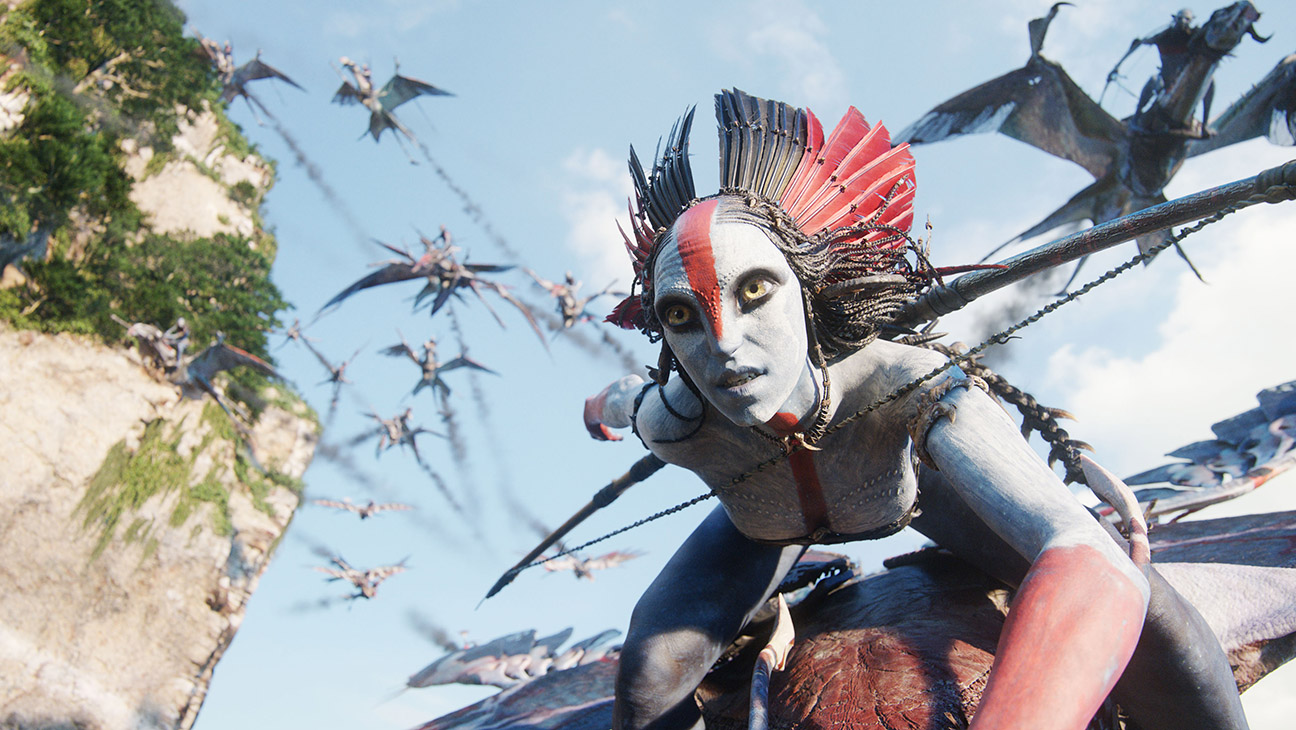
James Cameron and costume designer Deborah L. Scott have partnered since the 1990s, when they worked on Titanic. Scott, who won an Oscar for her work on that film, has since collaborated with Cameron on the Avatar movies and has earned her second nomination for the third installment in the franchise, Avatar: Fire and Ash. Like almost everything in the film set on the distant habitable moon Pandora, the Na’vi characters she dressed are computer-generated renderings of motion-captured performances. In a very strict sense, what you see on screen isn’t tangible. The costumes may be virtual, but Scott insisted on crafting every garment by hand as a first step.
“When the first Avatar came along, it was a brand-new world and there wasn’t a concept that every costume had to be made, because we thought we could just do it in the computer from a drawing,” Scott tells The Hollywood Reporter. “They were into live action when I got called to help out and I finished a year and a half later. Costumes were hand-built because the pipeline demanded that quality. I’m the only department that makes finished products for everything you see in the film, from costumes to hand props and hair grooms, as well as performance capture suits for live action, which are white duplicates made in materials that behave the same way as the real sample, which is really important to Jim.”
Below, Scott spoke with THR about the significance of her Oscar nomination and details the costume-making process in a VFX world.
How would you compare digital costumes to the tangible ones nominated in the same category?
That’s tough. I mean, it’s amazing. I feel really grateful. It’s this concept that costume design doesn’t just have to be live action. We have a seat at the table through post-production and we’re working daily or weekly with the VFX team. This is real costume design work. So it’s like a door opening to a new era to have that nominated and recognized as an alternate way of designing costumes. Quite frankly, I don’t think the movie got nominated for the live action costumes. That’s not what people are talking about. They’re not nominating for the process, but for the result.
Can you explain the difference in the process?
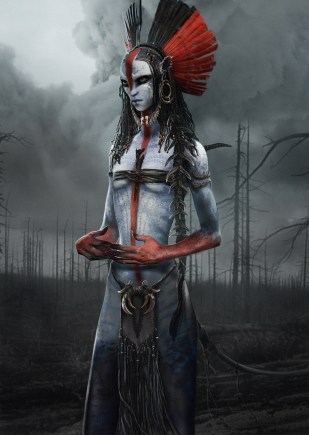
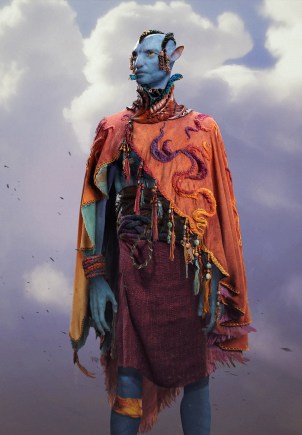
When you design for live action, the actor puts on the costumes and acts the scenes and then you’re kind of done. You’ve decided what that costume is before the scene happens. When we are designing, we have a big space of time to alter and evolve the costumes completely to respond to the motion of the performance. I see Varang [Oona Chaplin] coming out of her yurt, swaying her hips, and I want to compliment that with a battle headdress. Paylek [David Thewlis] had a mangy cloak when we first shot, but I later changed it to a colorful cloak with more stature after seeing how he strutted across the gondola. It’s a gift to be able to sculpt my designs to each performance as Jim is building the movie.
Walk us through, step by step. Do you start design on paper?
The first step is research and designing. I’m working on the most technically advanced movie of all time and I draw my sketches old-school, with a pencil on paper. We have almost 20,000 designs on paper from the last two films, because they evolve. Then I work with a group of artists from Los Angeles and Wētā Workshop in New Zealand, who draw in computers for a phase. Then we have a sampling period with Wētā. There are some 3-D printed pieces, fewer than I imagined, because you start to lose the organic nature and have to go back in and paint. We have thousands of boxes of different feathers, shells, acorns, beads, twine, and colors and weights of leathers. It’s important we don’t have to make two samples because there’s a lot of free form to Wētā’s incredible hand-craftsmanship that is impossible to recreate. We build each piece, from a loin cloth to a necklace, to human scale and deliver it to Wētā FX. They scan it and their artists start to model it. Then we virtually fit samples to a nine-foot-tall blue body, making the costume a second time in a virtual fitting room. Then you can manipulate it. Maybe my human sample needs to be a little longer on my blue person. Then they’re on to modeling and texturing, based on the road map of the sample.
Why is it so imperative to have a physical sample?
If you just hand over a design on paper to a VFX company, which is usually what happens in normal animation, they take it from there and determine the materials without knowing the nuances. A leather chest plate moves a different way on your body than a necklace. Some animated projects have designers, but they’re not involved in building. You can’t compare it to animation, as our focus is on realism. All departments are breaking new grounds on Jim’s films. VFX may have a simulation for somebody wearing a T-shirt, but costumes for the last two Avatars are made out of materials they don’t have a program for. Items are weathered and beaded and braided, so they need to see and understand all the pieces.
Are you free of some challenges of making live action costumes that go aerial or aquatic, such as fabric tethering and material degradation?
No, we film tests of every piece involved in dancing or swimming or flying and turn them over to the animators and simulators, so they understand how the costumes move in water or wind, because that’s the caliber and demands that Jim has. As a scientist, proof of concept is incredibly important to him.
Any other major challenges?
Virtual lighting is my least favorite part of the process. It’s been one of the hardest things for me to understand. When Jim lights a scene virtually, you’re not on a real set. So you can put light coming from wherever you want and it can be a bunch of different colors reacting to the colors of the clothing in different ways. To simplify it, let’s say you have a pair of jeans, but you say, “That doesn’t look like denim.” They say, “Yes it does.” You say, “Your lighting’s off.” They say, “No, it’s not.” In live action, you put a pair of jeans on someone and no matter what lighting they’re in, you know that those are jeans. But virtual lighting can change a garment to the point that it’s not recognizable. So sometimes you have to back up and figure it out.
Were costumes for the Ash People and Wind Traders, introduced in this film, inspired by particular indigenous communities?
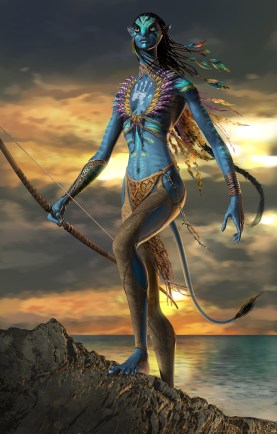
Costumes for The Na’vi are inspired by indigenous people all over the world, based on their environments, and Fire and Ash is a burnt-out volcanic landscape. Varang’s feathered headdress, as a signifier of her stature as tsahik of the clan, was the first defining element Jim wanted for her. Body paint, scars and piercings define the Ash People. A gift of working with Jim is that I get to head all these aspects that complete a whole character. Ten clans or more gather at the end of the movie. Some aren’t as big, but they all have unique garments.
Do the actors interact with the garments to help get into character?
That’s an interesting process, as sometimes their costumes haven’t been all the way designed. For the most part, they look at the art. Kate Winslet and Sigourney Weaver came into what I call my library in Los Angeles, where I keep samples, to see smaller prop pieces, which gives them an idea of the complexity of the world. Oona really liked looking as the designs emerged; I think we inspired each other. And what do kids know about a loin cloth? We dressed them in modified versions of their costume so they could run around and understand them.