On Feb. 5, 1989 during the 9 p.m. hour, CBS unspooled the first episode of its epic Western series Lonesome Dove, starring Robert Duvall and Tommy Lee Jones. The eight-hour miniseries ended up taking home six wins at the Emmy Awards as well as kicking off a slew of Larry McMurtry adaptations, Western sequels and spinoffs. The Hollywood Reporter’s original review is below:
The western — that all-American, heavy-hoofed, six-gun totin’, boot-heeled, suede-and-leather creature — has hit the entertainment trail so many times it long ago attained archetypal status, a codified way of meeting life rivaled only by the dominant religions of the world.
The Westerner, with eyes narrowed and speech slowed by a drawl, has become a venerated figure to people far removed from the species’ native habitat, the American range of yesterday that today doesn’t exist and, more to the point, save for artistic revisionist accounts, never did. After the cowboys’ home had yellowed to memory, illustrators such as Frederic Remington set about romanticizing the Westerner, a process vigorously seized upon by the chieftains of Hollywood. (In fact, one of the earliest filmed stories is an 11-minute strip about the risks rampant in the old sod-bustin’ days, a movie called The Great Train Robbery.)
Larry McMurtry’s huge western work, the novel Lonesome Dove, as interpreted by the eight-hour miniseries on CBS, is as much about a state of mind as it is about a place in time.
Using the cattle drive, a device that is to Western legend as prohibition is to that other staple of pop American theology, the gangster fable, TV’s Lonesome Dove creates a moving (in both senses of the word) depiction of the never-never-land/once-upon-a-time West of reconstructed recollection.
In addition to the push north, more subplots sprout up in this sage saga than needles on a barrel cactus.
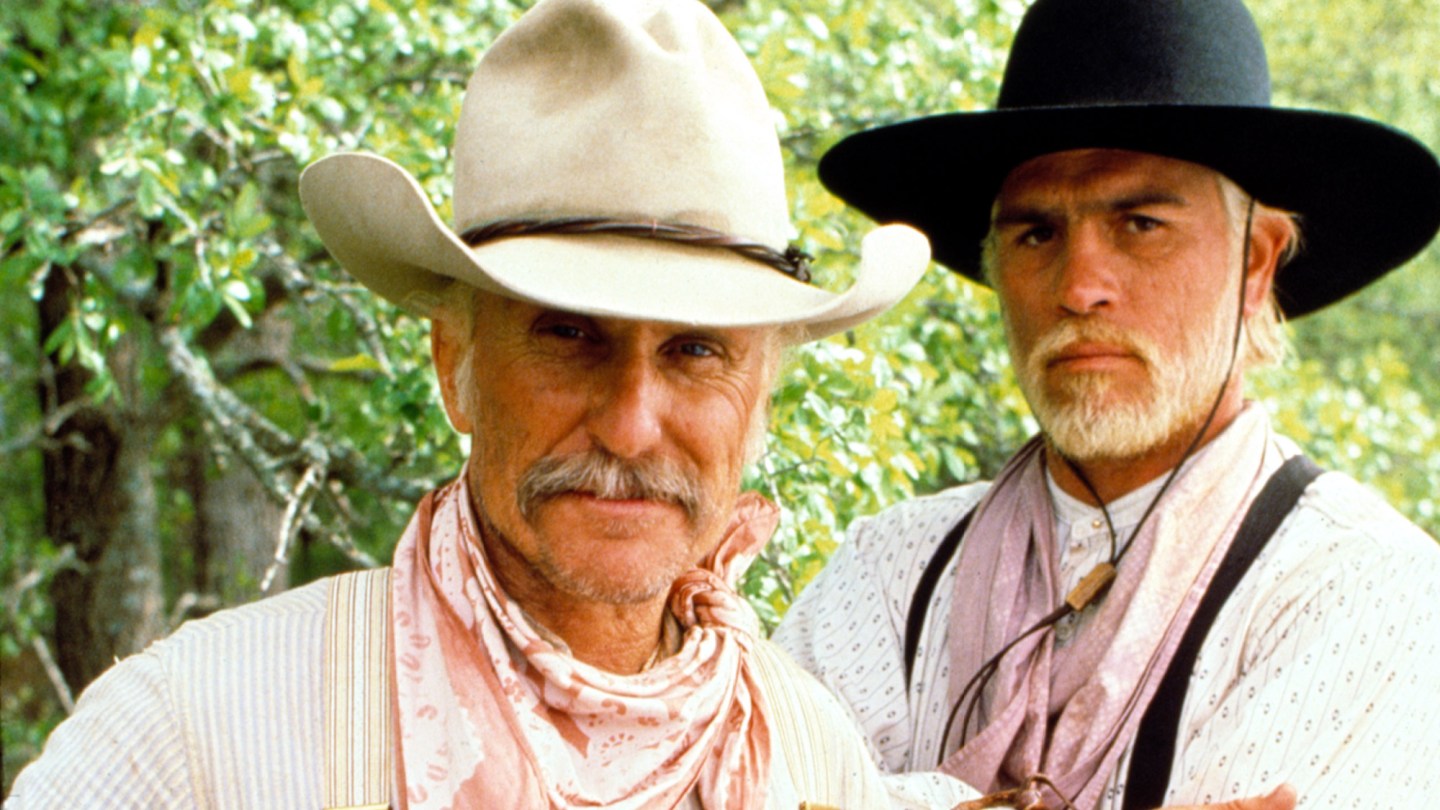
Within the grand, great adventure that is Lonesome Dove, all manner of time-honored, stock Westerners roam. For instance, among the miniseries’ stars are Robert Duvall as wisecracking Gus McCrae and Tommy Lee Jones as taciturn Woodrow F. Call, two former Texas Rangers who have made the choice to quit their dusty spread in Lonesome Dove, Texas, and ride off with a purloined herd of cattle to claim a parcel of land 2,500 miles away in the Montana wilds. (However, McCrae later reveals he has undertaken the trip to find his old, true love.)
Others galloping in during this four-night miniseries are Robert Urich as Jake Spoon, a man ambushed by fate; Danny Glover as skilled scout and tracker Joshua Deets; and Ricky Schroder as a boy who grows into a man, his maturation increasing in proportion to the time and miles logged in with McCrae and Call on their long ride North. Diane Lane as Lorena Wood is another tried-and-true western figure, a femme de joie looking to put her profession behind her. There’s also Frederic Forrest as a revenge-lusting renegade named Blue Duck, an avowed enemy of McCrae and Call; D.B. Sweeney as Dish Boggett, who has signed onto the perilous cattle drive and is heartsick over the love of Miss Lorena. And Anjelica Huston appears as Clara Allen, McCrae’s lost love.
Armed with these durable stereotypes, this Western braves primetime in an outsized production magnificently scripted by Bill Wittliff (“If you want only one thing in life you’re likely to be disappointed,” McCrae tells Miss Lorena after she despairs of ever getting to San Francisco) and flawlessly directed by Simon Wincer. Moreover, in texture and sweep, production designer Cary White and director of photography Douglas Milsome have stunningly captured the look and feel of the frontier of fable and dream, as enveloping a vision as realized by Benjamin West.
With the sweet, stirring score provided by Basil Poledouris, Lonesome Dove more than soars.
Among those in this vast sterling cast who triumph are Duvall as the world-wise McCrae and Jones as the iron-willed Call. Their journey through this American Beowulf is unerringly true, the very definition of sustaining acting. There’s also the good, sure work of Chris Cooper as an honest man struggling against adversity, and the reserved but effective portrayal rendered by Schroder.
Lonesome Dove on TV roams the well-trod dramatic range of western cliche, but dang if that ain’t the point. Yet what is surprising about this TV presentation is its power to suddenly break into hyper-high reality, a sharp, stabbing knifing to the conscience. Moreover, Lonesome Dove brings to bear a classical judgment of humanity as hostage to circumstance destiny, in the end, exerting its will with certainty, a grip that no man, however spirited, ever eludes.
Director Wincer and scenarist Wittliff have created a big-hearted epic that sits tall in the saddle, a vivid video display of cowboy iconography that’s got the Emmy brand all over it, and that thrillingly shows how the West can be magnificently won by Hollywood. — Miles Beller, originally published on Feb. 3, 1989.