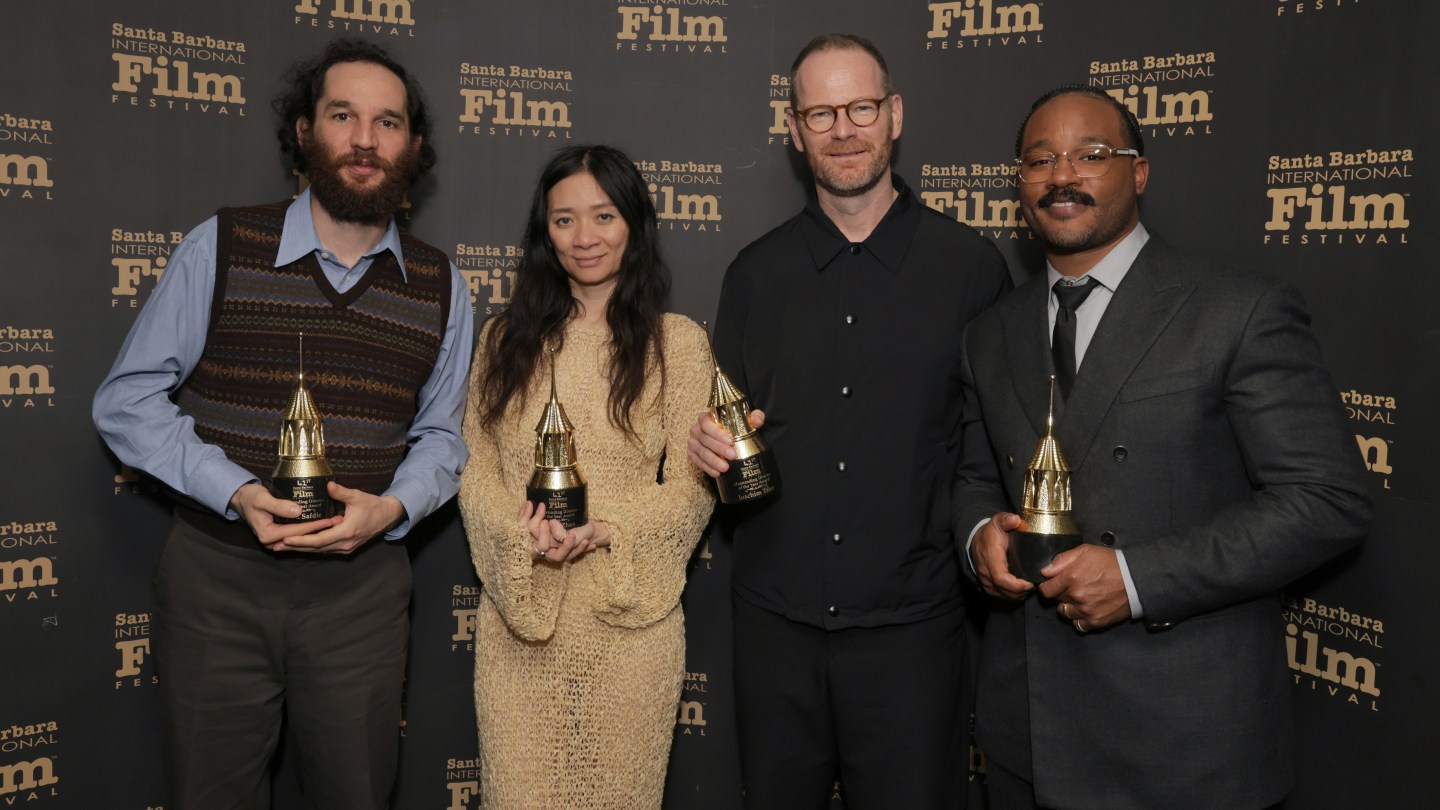
Four of the five filmmakers who are up for best director at the Oscars made the trip to Santa Barbara on Tuesday to take part in a special directors tribute.
Ryan Coogler (Sinners), Josh Safdie (Marty Supreme), Chloé Zhao (Hamnet) and Joachim Trier (Sentimental Value) joined The Hollywood Reporter’s Scott Feinberg at the Santa Barbara International Film Festival, as they each spoke separately about their nominated films and then came together for a group discussion at the end; Paul Thomas Anderson (One Battle After Another), the other filmmaker in the Oscar category, was not in attendance.
During the group chat, Coogler and Zhao reflected on first meeting in the Sundance Screenwriters Lab program in 2012, where Trier happened to be their advisor; that began a longtime connection between the trio, with Trier noting that he gave Coogler editing notes on his 2013 movie Fruitvale Station.
The filmmakers opened up about the best (getting to know their fellow nominees) and worst (being away from their families) parts of awards season and mused what they would be doing if not behind the camera: Safdie an architect, Coogler selling coffee, Zhao a private detective and Trier a therapist.
They also discussed whose opinions they most value when releasing a project, as the Sentimental Value director noted, “It’s complicated because in a way a film becomes a commodity in the world and you need critics to like it,” but as the saying goes, he continued, “to ask an artist how they feel about a critic is like asking a lamppost how they feel about dogs.”
Zhao, though, said she looks to the more online critics: “I care about my Letterboxd curve, I do, because it’s an audience. I also care about Rotten Tomatoes but I shouldn’t. I actually go on Letterboxd and I read the reviews because these are audiences. They go out there and no one pays them to do that — some of them should do standup because they’re hilarious. I would screengrab them and send them to [Hamnet stars] Jessie [Buckley] and Paul [Mescal] because they don’t go online, those two.”
Feinberg asked the group about Quentin Tarantino’s ethos to retire early because of his belief that directors get worse at making movies as they get older; Safdie responded, “I hope I die working. I think maybe he meant they they get too comfortable — that’s a problem when you get too comfortable, and you have people around you who are embracing the comfort. That could be a problem but man no, work sets you free.”
Coogler also cited Michael Haneke’s 2012 film Amour as “a film only an elder filmmaker could make and it made me look at life differently. I think about that movie probably every day so I hope elder people don’t stop making movies, they’ve got a lot to teach us.”
The night closed with each director commending a film that hadn’t gotten its awards season due, with Coogler shouting out Hedda, Trier celebrating Sorry Baby, Zhao saying animated film Little Amélie (“I had to stop that film multiple times and just sob uncontrollably and start again”) and Safdie acknowledging his brother Benny Safdie’s film Smashing Machine as “a special movie.”