

In the career of French acting icon Isabelle Huppert, stretching over 50 years and more than 120 films, it’s impossible to draw a through line. If there is a link between her characters — the repressed music professor of The Piano Teacher (2001), the rape-survivor of Elle (2016), the horny mother superior in The Nun (2013), or the uptight spinster aunt of 8 Women (2002) — it’s Huppert’s infinite ability to defy expectations.
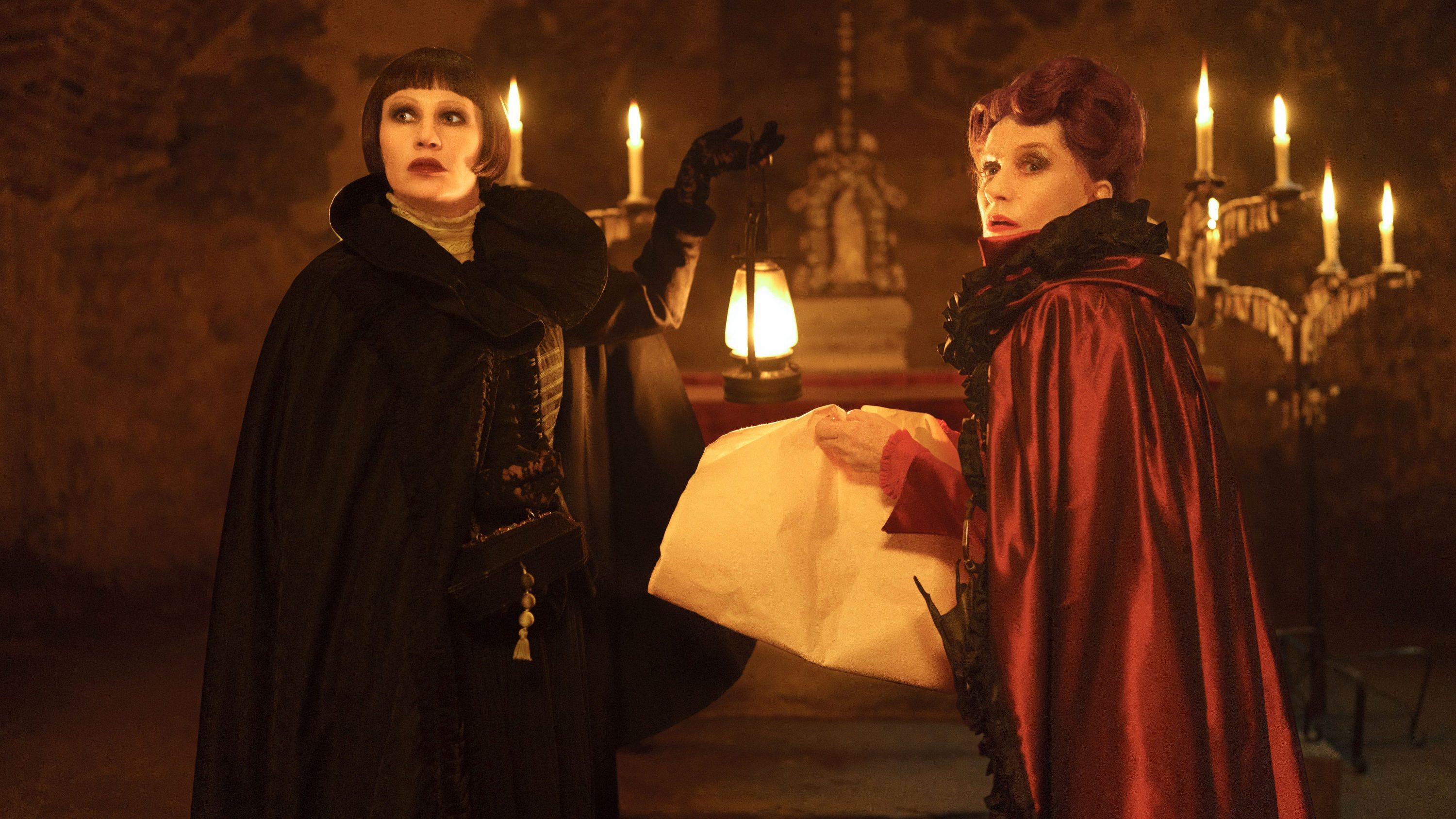
But even veteran Huppert watchers will be in for a shock with The Blood Countess. Her latest feature, directed by octogenarian avant-gardist Ulrike Ottinger (Joan of Arc of Mongolia, Ticket of No Return), sees Huppert go full camp playing the legendary vampire Elizabeth Báthory, a Hungarian aristocrat with a centuries-old appetite for virgin blood. The character, based on a real-life serial killing 17th-century countess, has been a staple of artsy horror for a while now, from Julie Delpy directing herself as Báthory in The Countess (2009) to Nicholas Winding Refn’s Neon Demon (2016), whose cannibal supermodels are directly inspired by the supposed blood-bathing Báthory.
The Blood Countess, however, is something else again. The feature is a celebration of anti-arthouse trash cinema. In the opening scene, set in the canals deep below Vienna, Huppert arrives floating on a barge draped in crimson, looking like an ’80s rock video directed by H.R. Giger. Huppert’s performance as the Countess is gleefully OTT, not so much chewing the scenery as biting deep and sucking it dry. She’s clearly having a blast.
“It doesn’t happen so often, for me, to get offered a role like this, so unusual,” says Huppert, speaking with The Hollywood Reporter ahead of the world premiere of The Blood Countess at the Berlin Film Festival. “Whenever it happens, it’s nice, it’s a nice little parenthesis [to my film career], like the films I’ve done with François [Ozon]: Mon Crime (2023) and 8 Women (2002) [two crime comedies]. The Blood Countess is a nice link to 8 Women, because we brought that one to Berlin too.”
Huppert’s history with the Berlin Film Festival goes way back. Her first feature, The Bar at the Crossing (1971), premiered there, back when there was still a wall between East and West Berlin and the Berlinale was a summer affair. “Was The Bar at the Crossing the first time? I honestly can’t remember, there have been so many,” she says.
In total, Huppert has had a dozen features, including The Blood Countess, screen in Berlin across all sections. Scrolling through her Berlinale performances feels like the discovery of an alternative timeline of her career, roles that remind us of Huppert’s astounding range as a performer, providing diversions and counterpoints to the better-known provocations in her deep filmography.
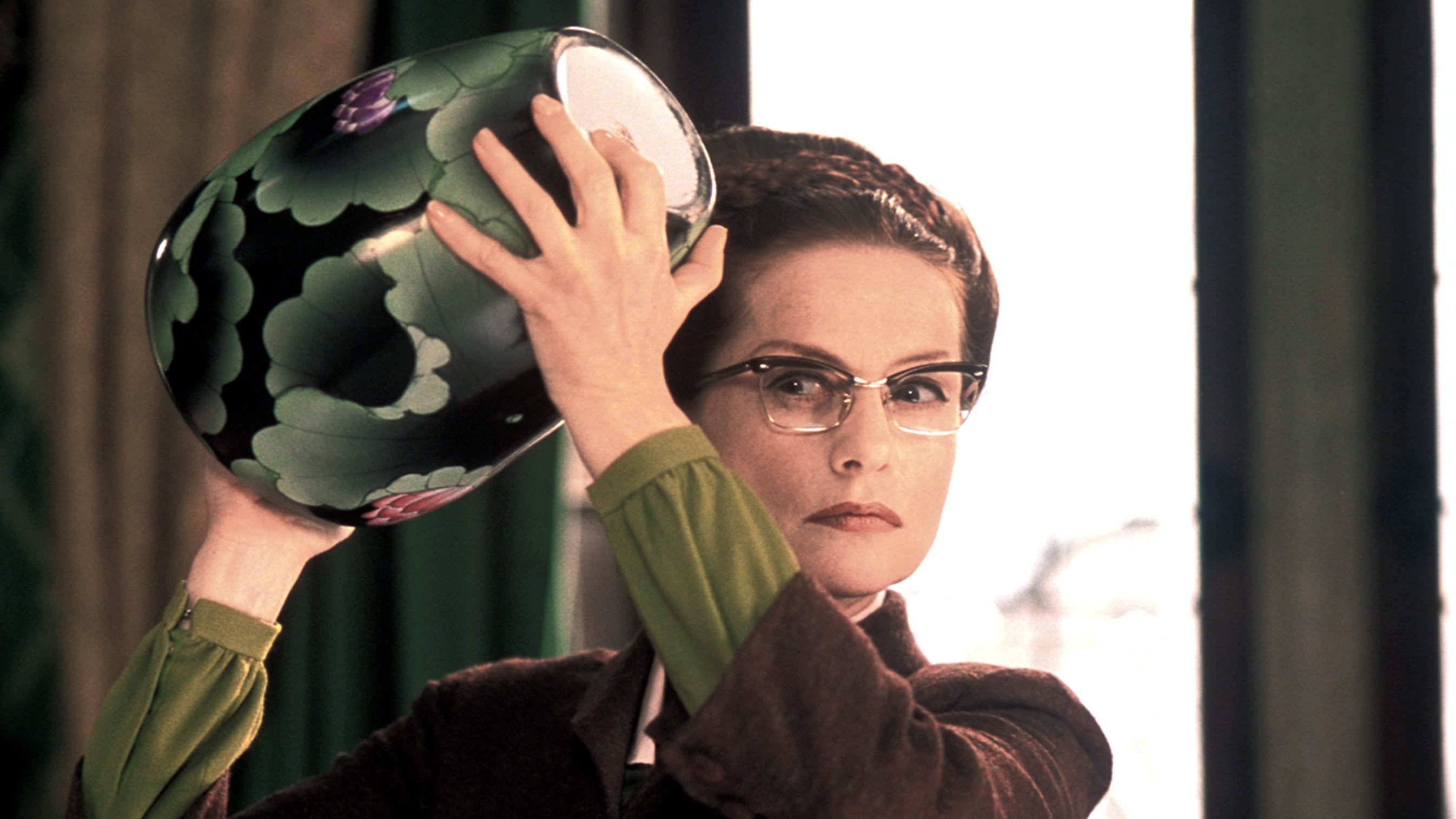
8 Women, which screened in Competition in 2002 and won a Silver Bear for its ensemble cast (François Ozon’s candy-colored Agatha Christie–style murder musical is a who’s who of French acting divas, including Catherine Deneuve, Fanny Ardant, and Emmanuelle Béart alongside Huppert), is a showcase for largely untapped comic genius behind Huppert’s stiff upper lip. If Michael Haneke’s The PianoTeacher had fixed Huppert in the global imagination as the face of erotic repression, 8 Women let her weaponize that neurosis for laughs. As a pinched, lovelorn aunt, she teeters between fragility and farce, finally bursting into song (and dance) in her musical number about her own nervous breakdown.
Berlin embraced the film’s high camp, and Huppert’s turn suggested that the severity audiences read as hauteur could flip, with the slightest adjustment, into deadpan burlesque.
Two years later, Huppert was back in funny mode with David O. Russell’s I Heart Huckabees, screening as a Special Presentation. Anglo-American critics were divided — one review famously wondered whether the film was “wacky” genius or espresso-fueled overload — but there was little disagreement about Huppert’s cameo as the chain-smoking French philosopher peddling “sexy nihilism” to a very willing young environmentalist, played by Jason Schwartzman. It’s a slice of sly self-parody: European arthouse cinema’s most famously cerebral and severe performer giving a deadpan caricature of European intellectualism.
“Whenever I have the opportunity to do a good comedy, I do it,” she says. “I like Huckabees precisely because it is very funny but is also very substantial. And David O. Russell is a wonderful director. So I took that opportunity.”
Mia Hansen-Løve’s Things to Come, which premiered in the Berlin competition in 2016 and won the Silver Bear for Best Director, sees Huppert in a performance both quintessential and quietly radical. As Nathalie, a philosophy teacher navigating divorce, professional displacement, and the slow attrition of middle age, she appears in nearly every scene, maintaining the barely-scrutable hauteur that has become brand Huppert. As a professor caught up in the world of ideas and estranged from human affection, Nathalie could be a cousin of the über-repressed Erika Kohut in Haneke’s The Piano Teacher. But where Haneke lets that icy demeanor explode into violence, here Huppert is warmer, more lighthearted.
When Heinz (André Marcon), Nathalie’s husband of 25 years, informs her that he’s seeing another woman, she’s not furious, just annoyed. “Why did you tell me that?” she snaps. Far more upsetting than the infidelity, for Nathalie, is having to divide up the couple’s once-shared bookshelf.
Riding home on the bus, after leaving her senile mother at a care home with its “smell of death,” Nathalie briefly breaks down. But when she spots her husband on the street with his new girlfriend, her sobs become an ironic gulp of laughter.
In most Isabelle Huppert films, life is existential agony. In her Berlinale selection, it’s also pretty absurd. The Nun, Guillaume Nicloux’s update of Denis Diderot’s classic novel, which screened in Berlin in 2013, is another comic turn for Huppert, who plays a mischievous mother superior with some questionable methods of teaching devotion. At the very least, noted THR’s review at the time, “Huppert can now add the role of ‘Horny Lesbo Nun’ to her long and illustrious resume.”
All of which makes The Blood Countess less an outlier than it first appears. Berlin has seen Huppert flirt with campy excess before.

The comedy roles, in particular, shine light on the hidden humor in Huppert’s harshest turns, like the quips and one-liners throughout Elle or, in The Piano Teacher, the deadpan delivery detailing the sexual torture she wants to endure.
Perhaps it shouldn’t surprise that both The Piano Teacher and The Blood Countess were co-written by Nobel Prize–winning Austrian novelist Elfriede Jelinek. Even if it’s hard to imagine a Michael Haneke film including, as pops up in Blood Countess, a musical number by Austrian drag queen, and Eurovision song winner Conchita Wurst.
“There’s this very dark, biting form of humor in Austrian literature, think of Thomas Bernard or Karl Kraus,” says Huppert, “and Jelinek, of course. Like the whole film, it feels very Vienna.”
That sense of stylized cruelty — irony sharpened to a blade — has long been part of Huppert’s artistic vocabulary. It is also something she honed not only on screen but on stage, particularly in Germany and Austria, where she has spent decades moving between film sets and some of the most exacting theater directors in Europe.
“I did a lot of stage work in Berlin, that’s part of my best memories of the city,” she says. “There was a time most of my plays would travel through Berlin.”
In 2005, Berlin audiences saw her in Sarah Kane’s 4.48 Psychosis at the Berliner Festspiele, in Claude Régy’s austere staging of the late playwright’s final monologue. A year later, she returned with Heiner Müller’s Quartett, stepping into Müller’s distilled chamber piece of erotic power games. Both productions demanded a near-musical control of breath and rhythm, stripping performance down to voice and presence — an approach that would echo, in very different keys, in her Berlinale films.
Her German ties run deeper still. She worked with the late Peter Zadek on Shakespeare’s Measure for Measure, absorbing a psychological intensity that sits alongside the formal rigor of directors such as Régy and Robert Wilson, with whom she toured the solo piece Mary Said What She Said. That immersion in German theater — its precision, its abstraction, its taste for extremity — feeds directly into the heightened artificiality of The Blood Countess. Ottinger’s film, with its baroque tableaux and deliberate camp, often feels closer to performance art than conventional cinema.
The film also re-teams Huppert with Lars Eidinger, the Berlin Schaubühne regular and longtime Thomas Ostermeier collaborator, cast here as a vampire-skeptic psychotherapist. Their paths have crossed repeatedly in European theater circles and at the Berlinale, including in Laurent Larivière’s About Joan, which premiered in Berlin in 2022.
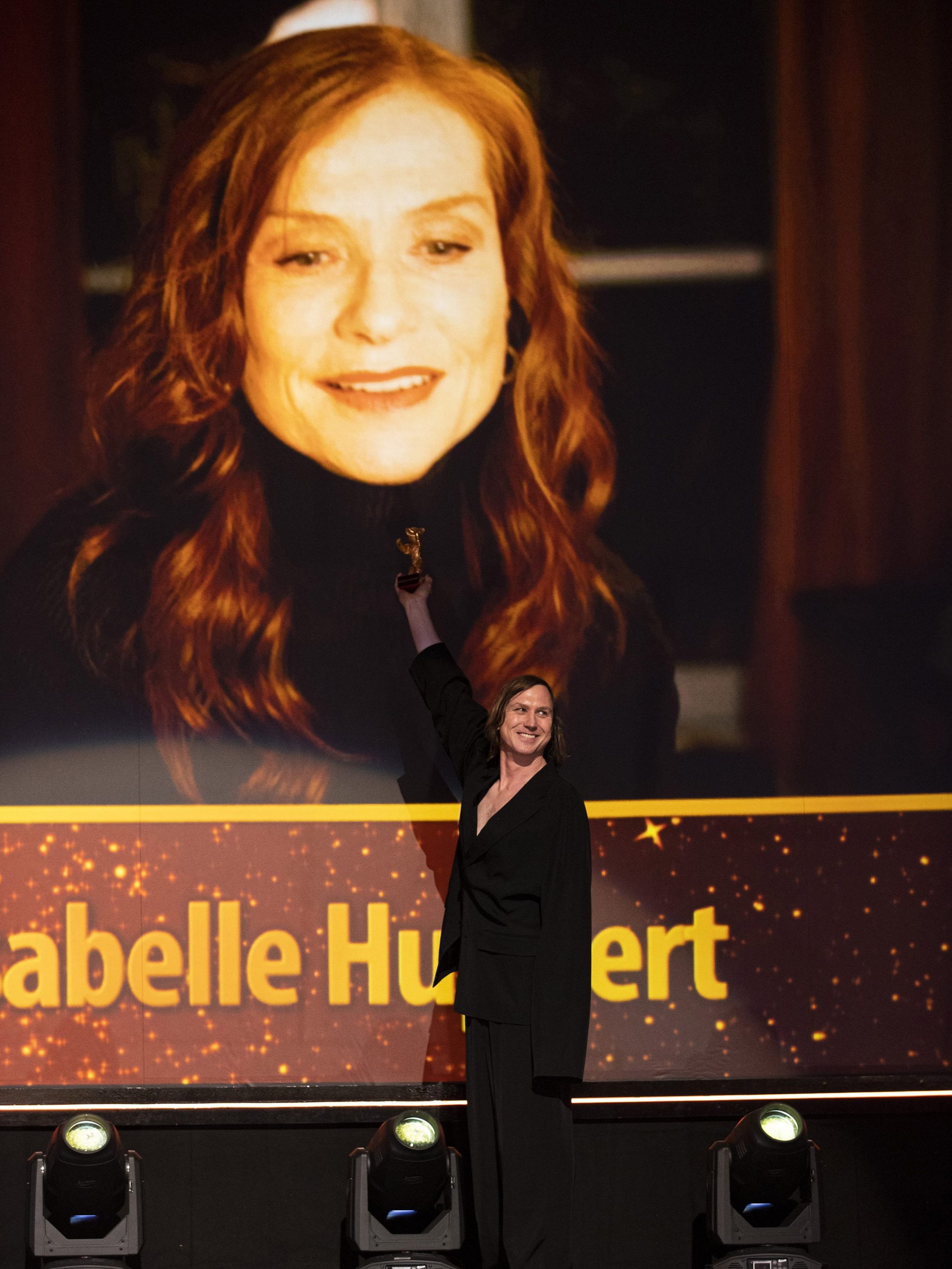
That same year, Huppert was honored with a Golden Bear for lifetime achievement, an accolade she had to accept remotely after testing positive for COVID.
Eidinger delivered the laudatio, toasting her video image. Huppert, he said, appears to do nothing while simultaneously conveying “the whole range of ambivalence, hate, love, life and death, hope and hopelessness in a single look.”
It is that paradox — stillness charged with volatility — that he called the essence of her craft.
It is also, in many ways, the quality Berlin has consistently recognized and rewarded in her work: the ability to hold extremes in perfect suspension. When the camera cuts back to Huppert, she gently shifts the spotlight away from herself and onto the city that has framed so many of those extremes.
“A festival also reflects the soul of the place where it takes place,” she says. “Berlin is a very inspiring city with strong cultural influence… the atmosphere and the vibration are very, very strong. The Berlinale is a wonderful festival. It was always strong and welcoming to me. As a festival it is so important, for movie buffs, for the industry of cinema, and for the love of cinema.”
Across five decades, Berlin has given Huppert room to oscillate between severity and excess — from icy repression to baroque camp, from chamber-piece austerity to vampiric spectacle. The city’s theatrical discipline and appetite for risk suit her; its audiences understand that doing “nothing” can mean everything.