There’s a gentle thread running through the work of filmmakers Kelly O’Sullivan and Alex Thompson, about characters filling an emptiness and stumbling onto a course-correcting sense of self-worth. In Saint Frances, an unplanned pregnancy and consequent abortion expose a young woman’s feelings of failure for not having figured out where her life is headed. In Ghostlight, a middle-aged construction worker struggling to get past the death of his teenage son impulsively joins a local theater company doing Romeo and Juliet, finding strength in community.
The co-directors’ new and arguably best film, Mouse, centers on an insecure teenager stranded with no place to shelter when the incandescent best friend she always hid behind is suddenly removed from the picture. It’s a funny-sad drama about loss, solitude, unexpected connections, coming of age and — in a disarmingly casual way that stitches it into the fabric of growth and change with minimal fuss — coming out.
Mouse
Unassuming and lovely.
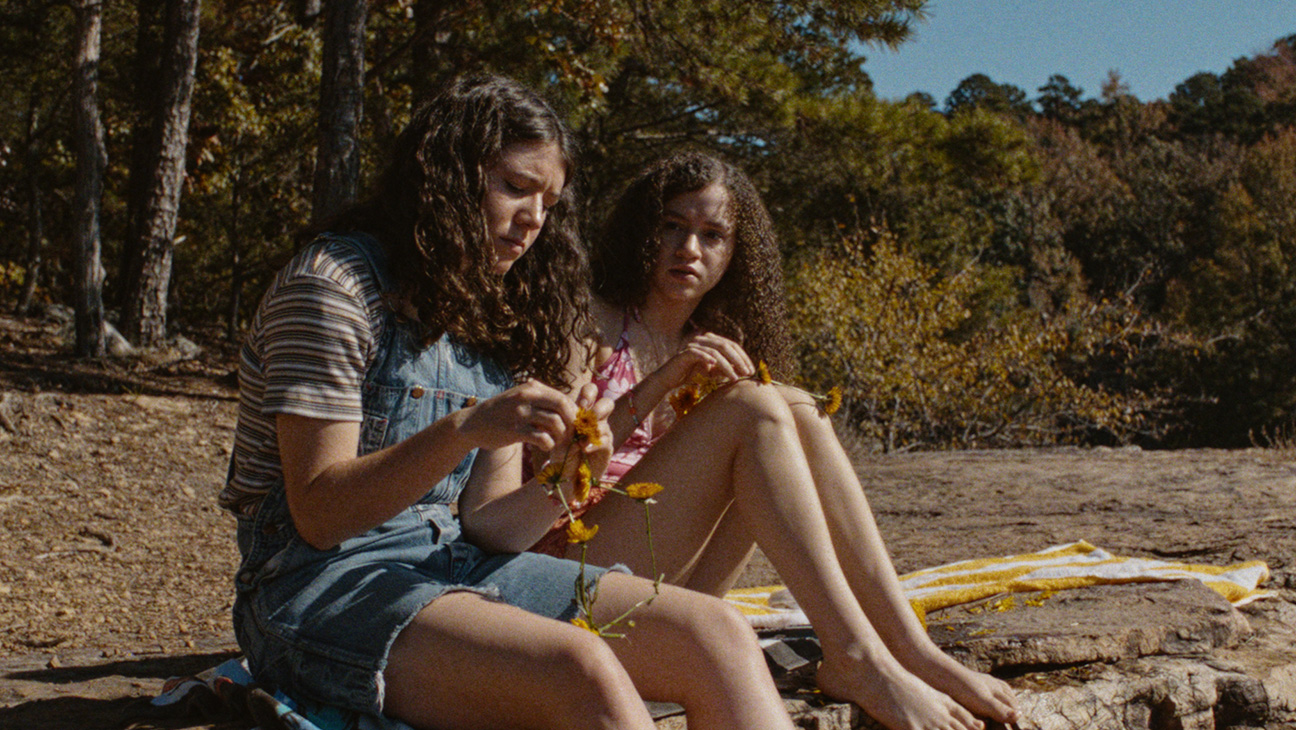
Doing a complete 180 from her volatile theater geek in Ghostlight, Katherine Mallen Kupferer plays 17-year-old Minnie, whose passive demeanor early on is suggested by Masha’s line from The Seagull: “I drag my life around behind me, like a dress with an endless train.” She’s not exactly a Chekhovian figure, but Minnie does wear a light cloak of melancholy as she stays in the shadow of her longtime pal Callie (Chloe Coleman), who is as charismatic and popular as Minnie is withdrawn.
It’s summer 2002 and Callie and Minnie are wrapping up their senior year at North Little Rock High School in Arkansas. Callie has snagged the lead in every school musical and co-hosts the in-house video-casts with her floppy-haired, blond dreamboat boyfriend Brad (Beck Nolan).
Amusingly, Callie has her whole life mapped out in her head down to the last detail — a move to New York City, full scholarship to Juilliard, a forgettable affair with a director, a slow-starting stage career that explodes when she goes on for a lead with a torn meniscus, multiple Tonys and a lifetime achievement award. She dreams big.
Minnie predicts she will lead a small life, though her mother, Barbara (Tara Mallen), thinks she will find herself in college. Others have less faith in her, like fellow seniors Cara (Audrey Grace Marshall) and Brandi (Addisyn Cain). In a sleepover truth game, Cara offhandedly admits she usually forgets Minnie is there.
O’Sullivan, who wrote the script and co-directed with Thompson, sticks to understatement, only very subtly suggesting that while Minnie and Callie’s close friendship is both genuine and fully reciprocal, a whisper of jealousy lingers in Minnie’s subconscious.
Part of that is the unflattering comparison of Minnie’s home life — subsisting on fast food and TV dinners with a sometimes crassly plainspoken veterinarian technician single mom who fills their rundown apartment with hard-luck pets presumably passed up for adoption — with Callie’s spotless middle-class home and ample parental attention.
Callie’s dad Mark (Christopher R. Ellis), at least from Minnie’s perspective, is cool and easygoing, but the main attraction is her mother, Helen (Sophie Okonedo), who has an aura of cultured sophistication, treating Minnie almost as one of the family while whipping up delicious meals.
Since it happens so early in the film and shapes everything that follows, it’s hard to avoid the massive spoiler that tragedy abruptly takes Callie out of the lives of both Minnie and Helen, fueling disbelief, anger, crushing sadness and flailing attempts to move forward. Or stay rooted to the spot.
Mallen Kupferer is terrific as Minnie tries to figure out her position in the school landscape without Callie for cover, barely containing her fury when Cara and Brandi scramble for the podium in what she later calls “the Olympics of grief.” This also allows for a performance as rich in emotional insightfulness and sensitivity as it is in deadpan humor from the invaluable David Hyde Pierce as their drama teacher, Mr. Murdaugh, who serves as peace-keeping mediator in their disagreements.
(There’s a sweet in-joke in one of the students mentioning the sad story of Mr. M’s failed acting career, getting as far as a final callback for Hello, Dolly! on Broadway — Pierce co-starred with Bette Midler in the blockbuster 2017 revival of that show, among many other illustrious stage credits.)
When Cara makes the unilateral decision that the senior year variety show will be a memorial to “her best friend,” Minnie embarks on a misguided quest to stake her claim on that event, rather than be shoved to the margins.
The real heart of the story, however, is the exquisitely observed blossoming of a surprising friendship between Minnie and Helen. The interplay between Mallen Kupferer and the brilliant Okonedo is a transfixing exchange of mutual comfort that dissolves into awkwardness when Minnie oversteps the boundaries and Helen pulls back. Both characters are given empathetic depth and complexity that keeps you in their respective corners even when their sharp edges show.
Minnie’s adolescent emotional turmoil gets an extra shot of upheaval when friendly video store clerk Kat (Iman Vellani) reveals her attraction to her. A sad but flirty scene in which they share experiences of grief and Kat offers a supportive shoulder should Minnie need one is gorgeous. The filmmakers keep the exploratory steps of this fledgling relationship on a low flame, but Vellani’s natural spark makes every moment count. It’s refreshing to see queer awakening played with such an absence of anxiety.
That development also helps Minnie soften toward her mom, who feels her daughter has been taken away from her and mistakenly lashes out at Helen in a wrenching clash between two mothers, beautifully played by both actors.
Mallen in a sense is the movie’s secret weapon as Barbara, at times clumsy but always well-meaning and stirringly proactive when she finally comprehends her daughter’s pain. A scene in which she asks for Minnie’s help while euthanizing an ailing dog at the veterinary clinic is deeply touching. But the movie never drifts into sentimentality, perhaps in part because it’s grounded in O’Sullivan’s own memories of high school.
What’s especially lovely is the spirit of generosity and forgiveness that the filmmakers breathe into their satisfying concluding scenes, without pushing too effortfully into “healing” territory. Even the awful Cara, a self-absorbed performative Christian with a flair for bitchiness, gets redemption in an unexpectedly moving scene played out to Cyndi Lauper’s acoustic duet with Sarah McLachlan on “Time After Time.”
Even scenes that should be corny land with a light touch (one earlier moment with Cara excluded) in an ultra-naturalistic movie warmed by the summer sun. With grace and restraint, Mouse plants the seed for Minnie to break out of her seemingly preordained “small life,” without fanfare or parades or euphoric epiphanies, but with the aching rewards of lived experience and newfound emotional maturity.