When people talk about an actor with range, they usually mean the wide variety of roles they can play. De Niro going from Travis Bickle to Jake LaMotta. Brando going from On the Waterfront to Guys and Dolls. Pacino playing both Michael Corleone and Tony Montana, two gangsters with diametrically opposed approaches to criminality.
The same holds true for Robert Duvall, a tremendous screen actor who died on Monday at the age of 95, and whose credits — over 150 in a career spanning six decades — include everything from a Texas Ranger (Lonesome Dove) to a Texas outlaw (True Grit); a sinister TV boss (Network) to an enlightened L.A. cop (Colors); an ex-con pulling off one last job (The Outfit) to an aging rancher protecting his land (Open Range); a conniving sports journalist (The Natural) to an editor-in-chief seeking redemption (The Paper) to a Soviet dictator (Stalin).
There are a hundred other examples in Duvall’s vast filmography, which lasted all the way till he was over 90, when he held his final roles as a seasoned practitioner of black magic (The Pale Blue Eye) and the owner of the Philadelphia 76ers (Hustle). Like many actors who hailed from a generation trained under the Method — in Duvall’s case, with the legendary Sanford Meisner — and who cut their chops in the burgeoning years of television, Duvall was extremely prolific and willing to try out any part at least once.
But he had a gift few performers have ever showcased to such an extent: a range that not only spread horizontally, shifting through characters across the board, but vertically, allowing him to be a big, bellowing, destructive man in one movie, and then a small, discreet, vulnerable one in the next. This extreme pendulum of human temperament meant Duvall could go from boiling hot to ice cold within a single film or even a single scene. It helped him to fully embody people at either end of the spectrum, in a series of iconic roles that made him one of the greatest.
Let’s start with the famous ones: For The Godfather, Francis Ford Coppola always wanted Duvall to play the soft-spoken Corleone consigliere Tom Hagen. In the director’s previous feature, The Rain People, the actor was terrifying as a nutso highway patrolman who tries to rape the film’s heroine. It was the polar opposite of Hagen, but Coppola knew Duvall had the range for both parts.
What makes the actor so formidable in The Godfather is how Hagen always sits in the shadows, serving as both strategic advisor and silent moral compass to a corrupt family. An adopted son to Don Corleone, and therefore not a blood brother, Tom Hagen is a perpetual outsider who at one point becomes the Don himself. This happens during a memorable scene between Duvall and Pacino in The Godfather: Part II, after the Corleone’s Lake Tahoe compound gets ambushed. Duvall plays a man of few words, so when he looks at Pacino and says, “I always wanted to be thought of as a brother by you, Mike. A real brother,” it carries the weight of the world, and tons of contained emotion.
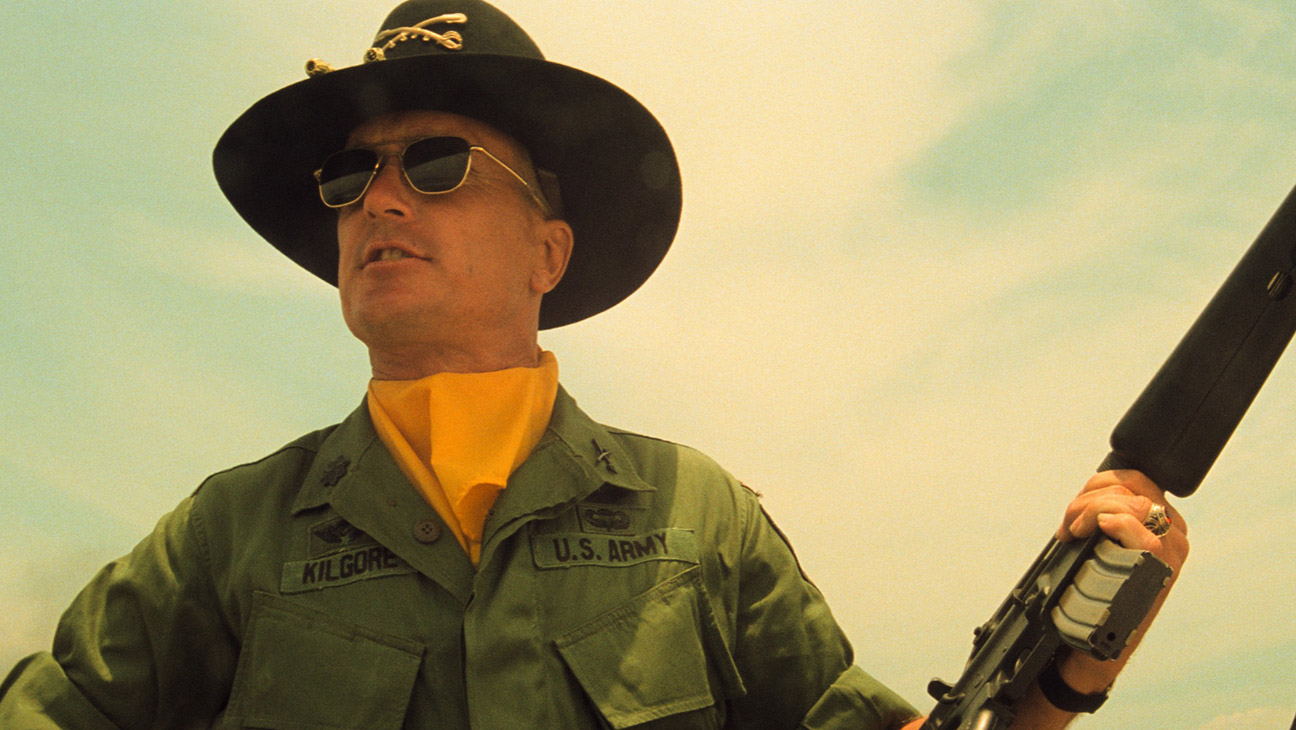
In another Coppola classic, Apocalypse Now, Duvall portrayed a man of many words that have turned into some of the most famous lines in film history. To embody the surf-obsessed and fearless Colonel Kilgore, the actor delved into his own past in the military, first as the son of a Rear Admiral in the navy and later as a private first class in the army, which he ditched to study acting in New York.
Duvall did plenty of research to build the Kilgore character, basing his performance on officers he served under at Fort Bragg and choosing a cowboy hat to mimic how members of the air calvary in Vietnam sometimes wore mementos from the American West. But it’s the actor’s delivery that everyone remembers, brilliantly going from hot to cold as he lambasts his troops during a bombing campaign, then kneels beside them to calmly state: “I love the smell of napalm in the morning” — a sinister line considering the mass death happening all around them, but also perfectly true to character.
The same year Apocalypse Now was released, Duvall played another bigger-than-life military man in The Great Santini, which was shot after the Coppola film and feels at times like a spinoff story for Colonel Kilgore. As the titular antihero and contender for worst screen father of 1979, Duvall embodied a Lieutenant Colonel in the U.S. Marines who settles with his family near a base in South Carolina, where he conducts training sessions and rules over his four children like he’s about to send them off to battle.
There are some classic Duvallian moments in The Great Santini, a movie I recall well because it was one of my dad’s favorites (don’t ask). In the opening scene, Santini — whose real name is “Bull” Meechum — gets wasted at an officer’s dance and fake vomits Campbell’s Soup all over the floor, then has his platoon lick it up in front of all the horrified guests. In what’s probably the film’s highlight, the Colonel plays a long one-on-one basketball game against his oldest son (Michael O’Keefe) that turns so violently competitive, he nearly takes his kid’s head off.
Like Kilgore, Meechum is a professional soldier and all-around tyrant with a voice that resounds like a bullhorn. But Duvall also reveals his weaknesses at key moments, showing how he actually tries hard as a father yet can’t help confusing training soldiers with rearing his own children.
Weakness also characterizes the role that earned Duvall his only Oscar for best actor. As the broken country singer Mac Sledge in Bruce Beresford’s Tender Mercies, he became so small on screen that his character almost disappeared amid the Texas flatlands where he washes up after another catastrophic drinking binge. Ditching alcohol and a successful music career to stay on as a handyman at a roadside motel run by a beautiful widow (Tess Harper), Sledge hardly utters a word for the first half of the movie. When he finally speaks, and eventually sings again, it’s with utter grace and sincerity. Duvall was perhaps never better than as a severely wounded man who finds enough inner strength to restart his life, letting go of the two things he loves — music and whiskey — to last another day.
Fans of the star surely have other characters to add to the list, whether big or small or some of both. (I have to confess that I’ve never seen his famous performance in Lonesome Dove, which aired on CBS when I was 12 and earned the actor a Golden Globe.) In his later years, Duvall seemed to say yes to anything, from solid A-list dramas like The Road and Crazy Heart to blockbusters like Gone in 60 Seconds, Deep Impact, The 6th Day and Jack Reacher.
He played it big again one last time in The Apostle, a role he was born to inhabit — and ingeniously did so at the ripe age of 66, in a movie he also wrote and directed. As a Pentecostal preacher with major anger issues, causing him to kill his wife’s lover with a baseball bat at…a Little League game, Duvall portrayed a character who was like an aggregate of all the men he’d played before — flawed and crazy men with good hearts, men who meant well but had a terrible way of demonstrating it. Using his roaring baritone as both a weapon and a healing device, he ultimately gets under our skin in a series of fiery sermons he delivers like monologues accumulated throughout his long career.
Duvall’s brilliance was not only in his versatility, but in the way he could make larger-than-life men like the preacher or Kilgore suddenly seem tiny, undercutting their belligerence with vulnerability or tenderness. And he could make tiny men like Mac Sledge or Tom Hagen stand tall through what they held back, finding strength and stature in their restraint. One memorable late role in which he did the latter was as NYPD Captain Burt Grusinky in James Gray’s crime thriller We Own the Night, in which he played a thoughtful Hagen-like patriarch who gradually loses a handle on his two sons, then dies in spectacular fashion during an ambush on a rain-soaked expressway.
He only had a few lines in that movie, but it was enough to make him an anchor for the drama. The thing about great screen performers like Duvall is that, whether they played it big or small, the scene was often centered on them. It’s the secret that a select few have managed to grasp — especially those who came up alongside him, including the actor’s former roommates, Dustin Hoffman and Gene Hackman. Each had his own alchemy for drawing our attention. In Duvall’s case, it was about reining in the beast or unleashing it, rip-roaring through scenes or vanishing within them. Barking orders as bombs dropped or receding unforgettably into the dark.