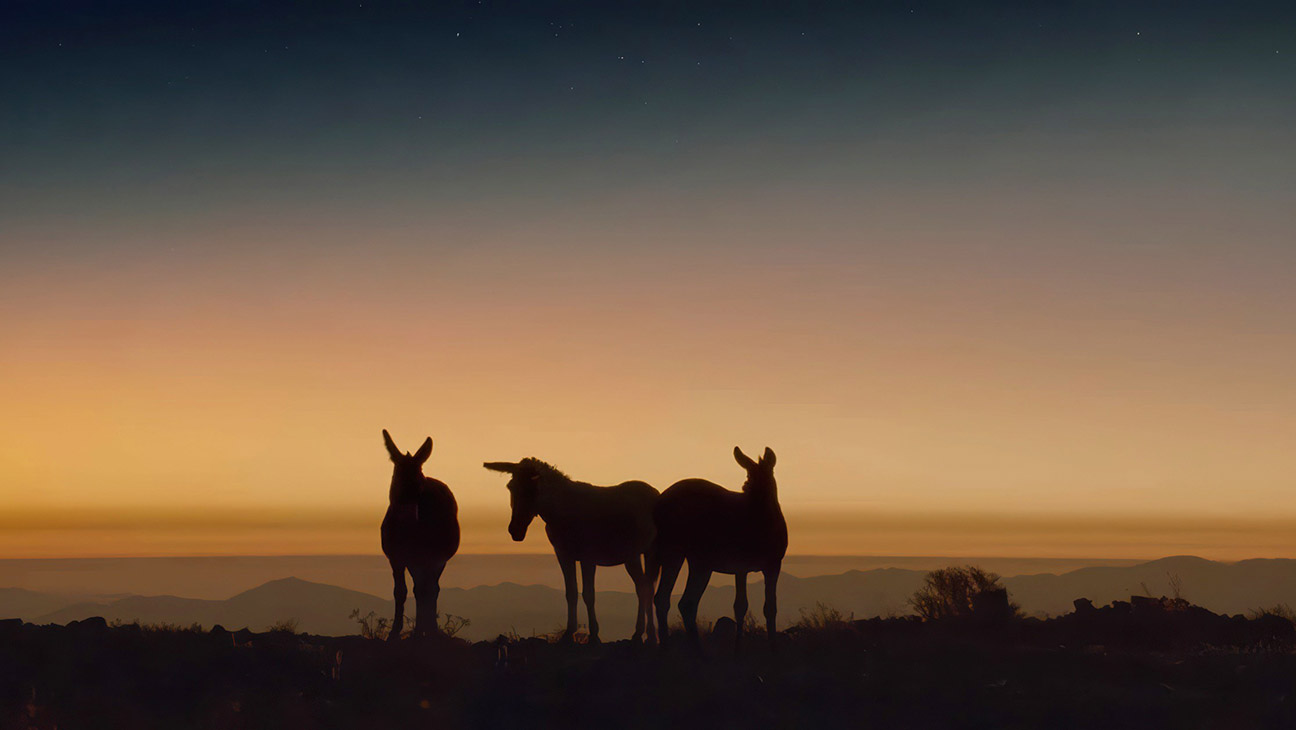
Alison McAlpine’s short film Perfectly a Strangeness has no stars (except in the nighttime sky) and no dialogue as it portrays three donkeys slowly, yet steadily, traversing mountains before discovering a mountaintop astronomical observatory in Chile’s Atacama Desert.
But to the surprise of the Montreal filmmaker, her surreal journey into our cosmic universe has earned her an Oscar nomination in the best documentary short category for Perfectly a Strangeness.
The film uses music, the clippity-clop of hooves and twitching furry ears for her three donkeys — Palaye, Ruperto, Palomo — to surf critical acclaim on the film festival circuit to the upcoming Academy Awards.
“It was such a mad idea,” McAlpine tells The Hollywood Reporter about what she calls a conversation between the donkeys and the giant radio telescopes of an apparently abandoned observatory.
“There were so many magical moments in the process that convinced me it was worth pursuing this mad idea,” she adds.
In a follow-up to McAlpine’s 2017 documentary feature Cielo, which was also shot in Chile’s Atacama Desert, her cameras follow the simple, sauntering gait of the donkeys to allow audiences to take in vast mountainous terrains by day and by night the marvels of the Milky Way filling the Atacama Desert sky.
McAlpine, who knows the light pollution that keeps most people from seeing starlit galaxies at night, recalled the first time she saw the cosmic movements in the Atacama Desert nighttime sky.
“It’s visceral. I laid on the ground and I felt strongly that I was inside this universe, I was inside the sky and it was so extraordinarily beautiful,” she recounts.
Her cameras did interior shots at the nearby Paranal Observatory run by a consortium of European astronomers at around 2,635 meters above sea level.
“I wanted the guts, to feel the power of the observatory,” the director says of her footage of domed-roof telescopes and radio dishes to allow audiences to contemplate the infinite and unknown of outer space.
“When the sun goes down and the stars come out, their eyes go to the universe and they feel like they dance, and we push that in the film,” McAlpine added of the “big metallic beasts” she calls the radio telescopes.
But Perfectly a Strangeness also remains fixated on its calm and curious donkeys, which includes their deep-welled eyes revealed to McAlpine in early nighttime footage.
“They were like galaxies inside with colors and planets and that was fascinating,” the director recalls.
McAlpine also learned as her cameras rolled that donkeys will not be rushed, including during one scene where she wanted the animals to climb a ridge.
“Of course, they went up the hill their own way. So this was a kind of hybrid for me between doc and fiction, because we were trying to direct them, but also be in the moment with them,” she explains.
And McAlpine admits to seeing just a little bit of herself as a now Oscar-nominated director in the quietly tenacious, yet humble beasts of burden that feature in Perfectly a Strangeness.
“If I really believe that this film needs to be in the world, I will stay with it. There’s nothing exceptional in that as filmmakers have amazing challenges. But I’m very particular about cinematic quality, both in picture and sound,” she insists.