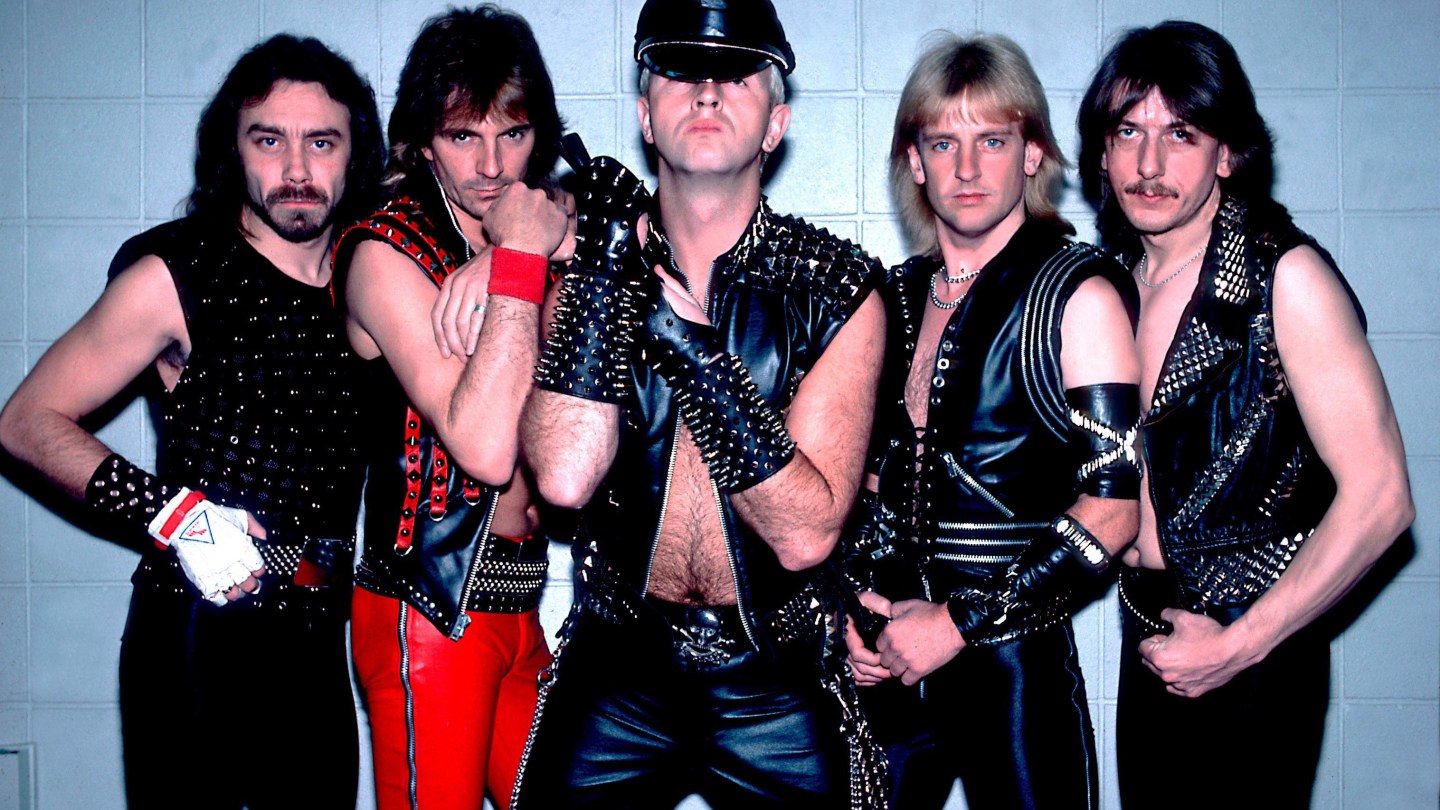
It is easy, oh so easy, to mock heavy metal. For 40 years, This Is Spinal Tap, Rob Reiner’s glorious spoof of metal’s OTT excess — all volume knobs, spandex and cartoonish sexism — has remained the pop-culture framing of the genre.
The directors behind The Ballad of Judas Priest know this well. Instead of dodging the jokes, they own them.
The doc opens with comedian and Tenacious D frontman Jack Black delivering, straight-to-camera, a mock serious reading of the lyrics to Priest’s “You Got Another Thing Comin’” from its 1982 album Screaming for Vengeance: “One life, I’m gonna live it up… I’m on the top as long as the music’s loud!”
Judas Priest frontman Rob Halford even references Spinal Tap‘s immortal “turn it up to 11” line. “Oh, god, I’ve done it now,” he quips.
“No one likes to take the piss out of heavy metal more than metal heads,” says Sam Dunn, co-director of The Ballad of Judas Priest, “They love Spinal Tap, love Wayne’s World. There’s a self-awareness there — the community knows how outrageous it can be.”
That sense of metal as a broader, more self-reflective culture is embodied by Dunn’s co-director, Rage Against the Machine co-founder Tom Morello — a Black, leftist activist musician better known for anti-authoritarian anthems (“Take the Power Back,” “Killing in the Name”) than leather studs and spandex.
Morello convenes a “Judas Priest Roundtable” at the legendary Rainbow Bar and Grill on the Sunset Strip — bringing together Darryl McDaniels of Run-DMC, Scott Ian of Anthrax, Smashing Pumpkins frontman Billy Corgan, and Lizzy Hale of Halestorm — to argue that metal, long caricatured as white, macho and politically reactionary, has always been more diverse, and contradictory, than its reputation suggests.
The goal of The Ballad of Judas Priest is not to mock metal, but to praise it, part of Dunn’s decades-long project of rehabilitating the culture of metal through documentaries.
The old-school headbanger — “I grew up in Victoria, B.C., I was a teenager in the ’80s. Judas Priest, [Iron] Maiden, Metallica and Slayer were my music” — Dunn returned to his first love after finishing a graduate degree in anthropology. “I wanted to write a serious history of metal, and a friend said, ‘Why not a documentary?’” he recalls.
Beginning with Metal: A Headbanger’s Journey (2005), Dunn’s 20-year journey has included docs on Rush, Iron Maiden, Alice Cooper and now Judas Priest.
“In our first film, we stuck the flag in the ground and said Black Sabbath created the sound of heavy metal. But Judas Priest was the first band that really created the idea of a heavy metal identity and a heavy metal community. They made it about being part of a tribe — on stage and in the audience — and that was something new.”
Premiering at the Berlin Film Festival Feb. 15, the doc traces the history and impact of the pioneering British rock band. But its emotional through line is Halford’s personal struggles as a closeted gay man at the center of a genre perceived as “overwhelmingly male, and brutally heteronormative.”
The documentary “is really a story of self sacrifice in a lot of ways,” Dunn says, “of a man who was prepared to sacrifice his happiness, his full expression of who is as a person for the betterment and advancement of his band.”
While always accepted by his band mates — “he was our chum, part of our family,” recalls Judas Priest bassist Ian Hill — Halford only came up publicly in an interview with MTV in 1998.
“My first reaction was it’s going to blow something up,” Billy Corgan recounts in The Ballad of Judas Priest. “I felt afraid for him, and afraid for the band. And then something amazing happened…nothing.”
“I think the reaction to Rob coming out of the closet revealed that the metal community is much more open minded than what outsiders saw it as,” says Dunn. “By the 90s, Rob Halford was our metal god. We didn’t care what he did in his private life of what he and Judas Priest had created — a metal community where all us nerds in black could find a home.”