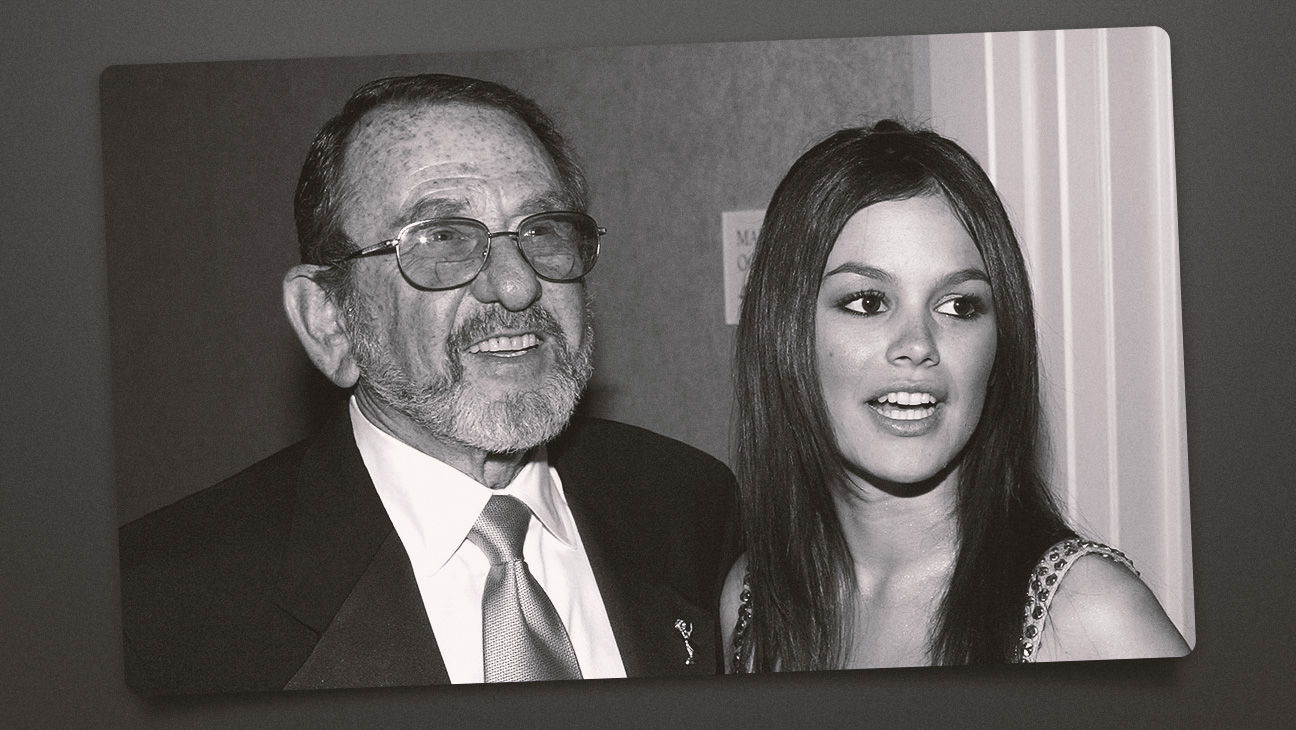
Bruce Bilson, the Emmy-winning director who worked on such series as The Andy Griffith Show, Get Smart and Hogan’s Heroes as a member of a four-generation Hollywood family, has died. He was 97.
Bilson died peacefully Friday at his home in Los Angeles, his daughter, producer Julie Bilson Ahlberg (The Fog of War), told The Hollywood Reporter.
In a career that spanned five decades and nearly 400 jobs, Bilson did lots of shows for Lucille Ball and Desi Arnaz’s Desilu production company early on. He directed more than 100 episodes of half-hour comedies before helming his first hourlong show, a 1972 installment of ABC’s Alias Smith and Jones.
Bilson went on to guide multiple episodes of The Patty Duke Show, Please Don’t Eat the Daisies, The Doris Day Show, The Odd Couple, Love, American Style, B.J. and the Bear, Barney Miller, The Fall Guy, Hotel, Dinosaurs, The Sentinel and Viper, among many other series.
He also directed the last episode of a Ball-starring sitcom, ABC’s Life With Lucy, in November 1986.
Survivors also include his son, screenwriter Danny Bilson (The Rocketeer, Da Five Bloods), and a granddaughter, actress Rachel Bilson (The O.C., Hart of Dixie).
Starting with the Sheldon Leonard-directed first episode, Bilson served as the first A.D. on 58 installments of The Andy Griffith Show during the legendary comedy’s first two seasons (1960-62) before he quit to go on the road with another CBS series, Route 66.
From 1965-68, he handled 22 episodes of NBC’s Get Smart during its first four seasons. He won his Emmy in 1968 — at the Hollywood Palladium on his 40th birthday — for directing the third-season episode “Maxwell Smart, Private Eye,” which featured call-outs to The Maltese Falcon. (That was fitting: Bilson had played a bellboy in the 1945 Humphrey Bogart film Conflict.)
However, Bilson said his favorite episode of the spy spoof was the 1966 second-season installment “Rub-a-Dub-Dub … Three Spies in a Sub,” which borrowed a submarine from the 1966 Frank Sinatra movie Assault on a Queen.
Bilson also worked on the last four seasons of Hogan’s Heroes from 1967-71, helming 25 episodes of that CBS comedy.
As every TV director knows, Bilson often showed up for work as an outsider, hired to oversee casts and crews that had become a “family.”
“They don’t know who you are, you’re coming into their nest, their home,” he explained in a 2008 chat with Stephen J. Abramson for the TV Academy Foundation website The Interviews. [They tell you], ‘Don’t mess with it, we’ve got it working good.’ So you had to prove yourself every time you went to a new show.”
The oldest of three boys, Bruce Leonard Bilson was born in Brooklyn on May 19, 1928. Just before he was 4, his British-born father, George, moved the family to Los Angeles to take a job running the trailers department at Warner Bros. His mother, Hattie, wrote short films at RKO when her husband moved to that studio to produce those shorts.
When he was 14, Bilson began working as an extra on films like Henry Aldrich, Boy Scout (1944).
He graduated from John Marshall High School in 1946, and at UCLA, he took classes in theater, editing and camerawork. After graduating in 1950, he entered the U.S. Air Force for a two-year stint that included a stay in Burbank (of all places) training photo units.
Bilson spent two seasons as an editor on the Groucho Marx-hosted NBC game show You Bet Your Life, then was accepted into the Directors Guild. That enabled him to helm episodes of the 15-minute exercise program show It’s Fun to Reduce in New York and L.A.
After serving as a second assistant editor on Sincerely Yours (1955), starring Liberace, and second assistant director on the syndicated The Liberace Show, he hooked up with Desilu physical production head Argyle Nelson. Soon, he was working on My Favorite Husband, Our Miss Brooks, The Life and Legend of Wyatt Earp, I Love Lucy, December Bride, Make Room for Daddy/The Danny Thomas Show and Whirlybirds.
Bilson was there when The Andy Griffith Show — a spinoff of The Danny Thomas Show that was filmed at Desilu — filmed its main title opening in Franklin Canyon above Beverly Hills. “When they were whistling and about to throw that rock in the lake, I’m the one who said, ‘Roll it,’” he noted.
Outdoor scenes in the fictional North Carolina town of Mayberry were filmed at the Desilu-owned Forty Acres backlot in Culver City, where Tara in Gone With the Wind once stood.
“All that life in Mayberry was my gang,” he said. “There were a bunch of old extras that nobody used, like little old ladies. They were my stock company. They would do anything for me, mow a lawn way in the back or carry shoes to the shoemaker. That was my contribution.”
He said that after the show’s first season, the crew chipped in and bought young Ronnie Howard a swing set.
During a hiatus, he served as the first A.D. on the second-season finale of Route 66 in 1962. Producers asked him to return for its third season “and wise or not, I chose to do it.” That gig, however, lasted just a year.
Hired by Andy Griffith Show director Bob Sweeney, Bilson made his helming debut in 1964 on an episode of the CBS comedy The Baileys of Balboa, then directed half of the third-season episodes of ABC’s The Patty Duke Show in 1965-66.
He joined Get Smart in the middle of the first season and learned that stars Don Adams and Barbara Feldon “each had a favorite side, Adams wanted to look right and Barbara wanted to look left.” And since Feldon was taller than her co-star, “she would sort of stand with crooked ankles.”
Bilson also directed episodes of Barefoot in the Park, Bewitched, That Girl, The Mary Tyler Moore Show, The PartridgeFamily, Bonanza, Green Acres, M*A*S*H, The Brady Bunch — he did the Joe Namath episode — The Love Boat, Dallas, Wonder Woman, Dynasty, Emergency!, The Six Million Dollar Man, Alice, Knight Rider and Hunter.
He directed for The Flash, Viper and The Sentinel, three shows son Danny co-created — he “was very good to his old man” — and worked often for producers Aaron Spelling and Glen A. Larson. (He also famously got fired from Sanford and Son, all because Redd Foxx didn’t like that he snapped his fingers on the set.)
Bilson also helmed the 1974 and 1979 TV movies The Girl Who Came Gift-Wrapped and Dallas Cowboys Cheerleaders and the films The North Avenue Irregulars (1979) and the Namath-starring Chattanooga Choo Choo (1984).
In addition to his kids and granddaughter Rachel, he’s also survived by his wife, actress Renne Jarrett, whom he wed in 1984 (she starred on the 1970-71 NBC series Nancy); stepson Drew and his wife, Liz; other grandchildren Hattie, Rosemary, John, Sidney, Suki and Bowie; and great-grandchildren Briar and Everly.
His first wife was Mona Whiteman; they were married from 1955 until their 1976 divorce.
“When I was starting out, I thought my camera work was awful, and I tried to make it more interesting,” he said in his TV Academy interview. “As I got older and more experienced, I learned to tell the story with the actors first, cameras second.”