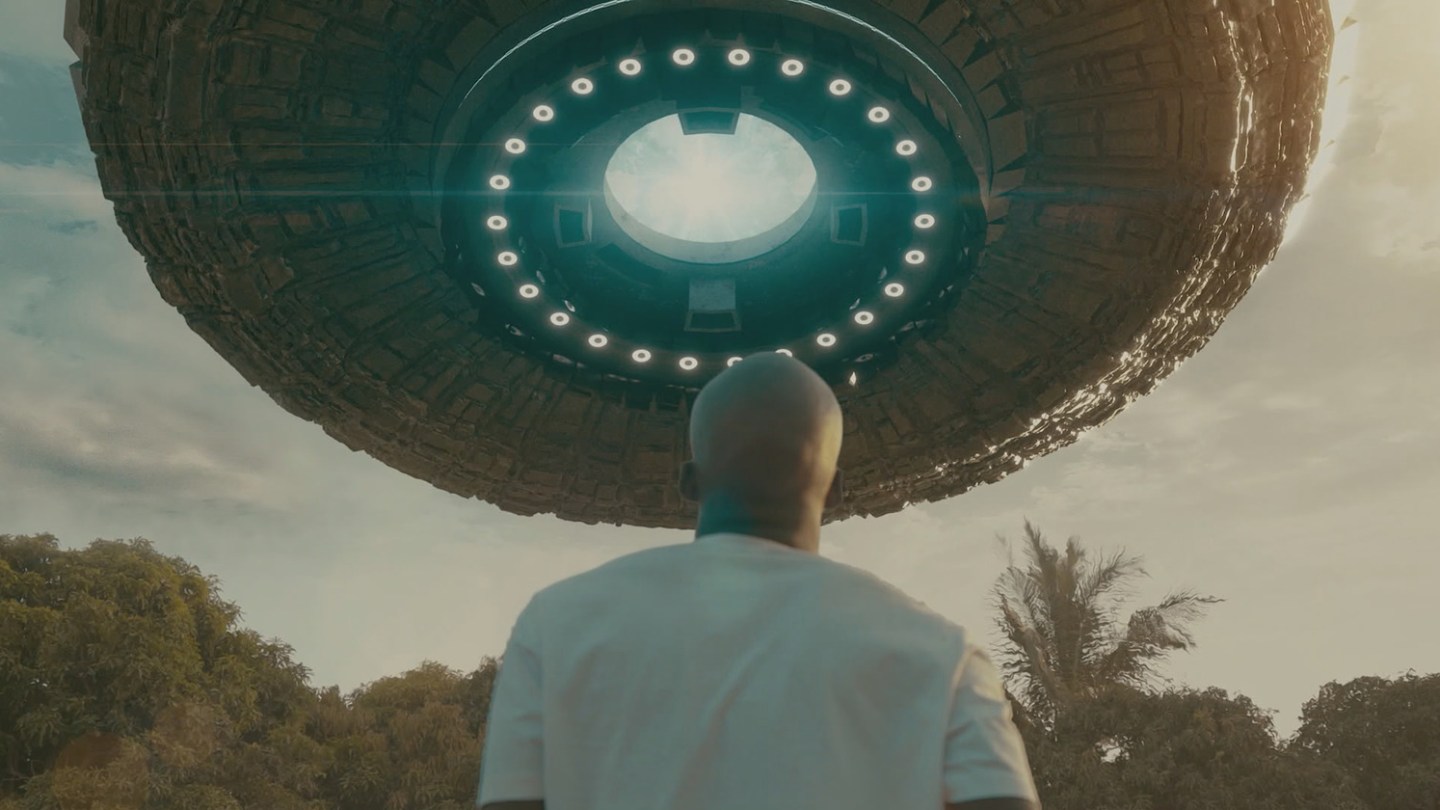
Another week, another cacophony of discourse about whether AI-generated filmmaking is actually creativity, and whether creative people can still find a place in a marketplace where too many viewers are willing to settle for weightless visual slop.
It’s hard to imagine a context in which Crocodile, a new documentary credited to Pietra Brettkelly and The Critics, could be more inspiring.
Crocodile
Inspiring, despite some questionable storytelling choices.
Filmed over the course of a 13-year odyssey for a collective of young, initially untrained writers, actors, visual effects artists, editors and producers operating out of a rough neighborhood in the Nigerian city of Kaduna, Crocodile chronicles a remarkable story of persistence, imagination and self-determination. It’s a narrative marked by personal tragedies, professional triumphs and a level of adversity that is simultaneously unique and familiar to countless independent filmmakers.
Crocodile is not always a remarkable documentary, though occasionally it is. While I enjoy unstructured, more vérité documentaries and I usually resent an excess of narrative hand-holding, Crocodile is one of those rare cases in which I probably would have appreciated a little more structure and a little more hand-holding.
The choice that Brettkelly and her editors have made was to thrust viewers into the world of The Critics, leaving it for us to make crucial discoveries on our own. But what I discovered, more often than not, was that the questions that kept coming up — some extremely basic and many deeply complicated — frequently distracted me.
Brettkelly joined forces with The Critics in 2019, well into that 13-year journey. When they were all younger than 11, a group of siblings and cousins began making short films using one of their father’s cellphones. Based on their own interests and sensing a genre gap in the burgeoning “Nollywood” film industry, they concentrated their attentions on science-fiction and superhero films.
I know that, incidentally, exclusively from the film’s press notes. We see hints of those early films, which are both crude and bursting with ingenuity. But by the time Brettkelly catches up with them in the documentary, the collective has already given itself a name and grown to nine members, the oldest either in their late teens or early 20s — we aren’t told — and the youngest no older than 9.
Perhaps sensing that she’s already late to the party — The Critics’ YouTube channel has 50,000 followers as the film starts — Brettkelly installs herself as a fly on the wall and lets things play out.
One member, Richard, sits down in front of the camera and begins as a very typical documentary-style talking head, saying his name, age and primary position, as if that’s a thing that will happen with the full group, but nobody else does it. As a result, by 100 minutes later, I learned the name of three other Critics. Godwin seems like the leader, but his interest might be more geared toward a career in music. Raymond is the logical second in command and the one who gets frustrated when Godwin becomes more and more distracted. Then there’s Rachael, an absurdly precocious 9-year-old who acts — well! — in some of the first films we see them making and later gets to try her hand at directing.
There are at least five other members who are never formally introduced, names possibly said in passing. Sensing there are stretches that require at least a modicum of steering, Brettkelly gets one or two of the older guys to do somewhat jarring off-camera narration/summation, in which the speaker is identified in subtitles in some instances and not others. The narration never wholly spells out what’s happening, but it forms thematic connective tissue (and cheats the format of the documentary in ways that purists will disapprove of).
So when I lament not being clear on basic things, I mean “names” and “ages” and “relationships.”
But I was curious about technology. In one scene, J.J. Abrams sends The Critics a fancy digital camera, and they’re overjoyed, but by the time Brettykelly gets to them, they’d already upgraded from just an iPhone, but how far? What are they using for their effects? I began this review by differentiating between what The Critics do and AI filmmaking, but for all I know, they could utilize some AI program to assist in special effects. Plus, when it comes to knowledge, they have a really solid understanding of representation and its responsibilities, conversations that sound like they could happen in a college classroom. Are they entirely self-taught?
Then, I was really, really curious about money. Presumably, a YouTube channel with their reach gets some revenue. Presumably a lot of their equipment comes via donations like the Abrams package. But at some point, they seem to rent a building as almost studio space and while it isn’t a “studio space” if Tyler Perry Studios is your standard, it isn’t nothing. Heck, they have a business manager.
The business manager, a lawyer, causes one of the film’s moments of darkness, another thing that absolutely raises more questions than answers. Over the course of the doc, that’s the lowest low, though Godwin’s potential departure provides some drama, as do the regular power outages, which even interrupt their Zoom with gift-giving J.J. The plot, such as it is, is mostly their gradual ascension, with highlights including a trip to Lagos, a trip to Germany and an outdoor screening for their neighborhood.
Interspersed with the documentary-style footage generated by their own filming and Brettkelly’s filming, Crocodile makes smart use of scenes from The Critics’ movies, which grow increasingly assured over time, without losing the DIY aesthetic. Sometimes the scenes are just showing us the end product of whatever they’re working on, but more frequently the scenes show how their actual lives inform the adventures in their sci-fi mini-epics.
Since one of the documentary’s big questions — one that The Critics debate — regards what is necessary to be a “Nigerian filmmaker,” Crocodile leaves no doubt that even if The Critics are making an unauthorized Star Wars sequel or paying tribute to The Joker, everything they do passes through a prism that’s unique and distinctive and Nigerian. Whatever frustrations I felt at being denied information or the arbitrary and unexplained leaps through time, that’s the message that makes Crocodile so powerful.