Legendary production designer Jack Fisk, who has worked with Terrence Malick (Badlands); his late, great high school pal, David Lynch (Mulholland Drive); Brian De Palma (Carrie); Paul Thomas Anderson (There Will Be Blood); Alejandro González Iñárritu (The Revenant); and Martin Scorsese (Killers of the Flower Moon), was a natural fit for Josh Safdie’s Marty Supreme, for which he received his fourth Oscar nomination.
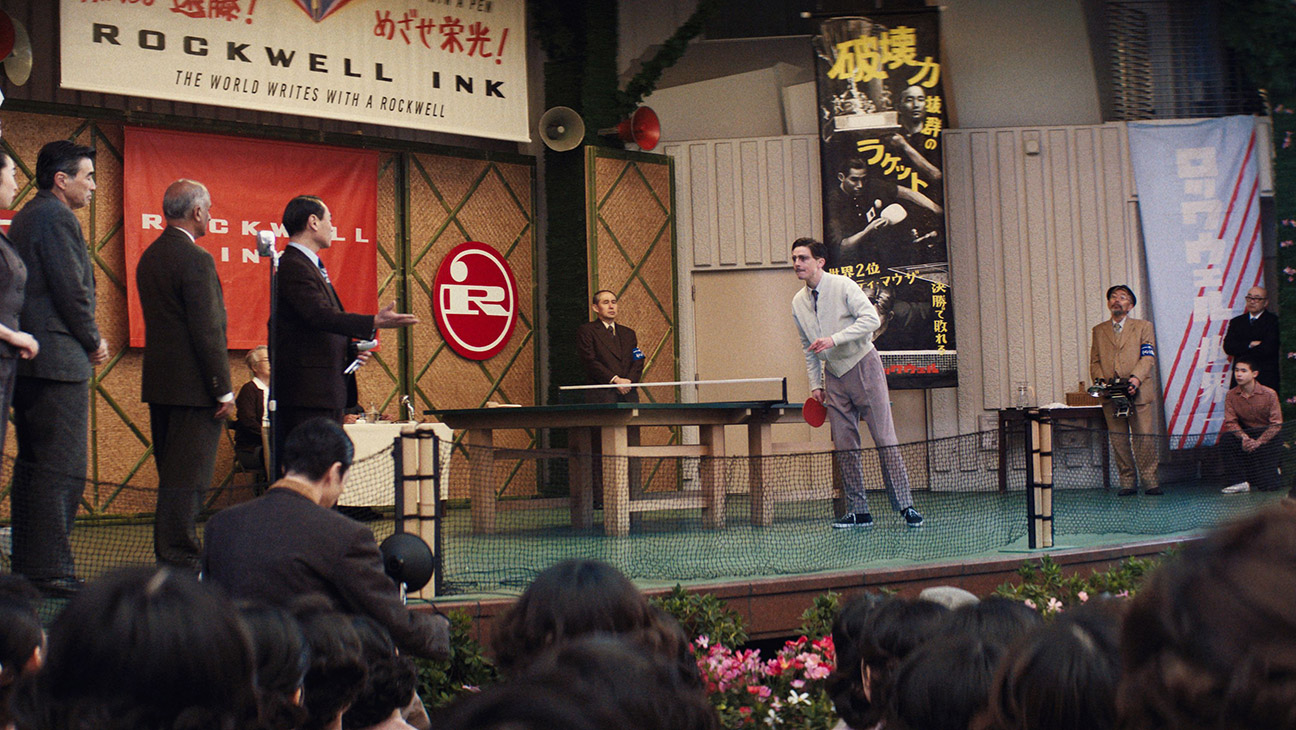
The 80-year-old Fisk chased Timothée Chalamet’s titular table tennis prodigy from New York’s Lower East Side, recreating its tenement houses, shops and street vendors in the early ’50s, to his climactic match in Tokyo, filmed on location at a park/cultural space that matched the period authenticity.
As always, the search for period detail to capture an authentic, lived-in look was in service to the character’s relationship with his environment. “Working on Marty, his life was his tenement on the Lower East Side,” said Fisk. “And then this place where he’d go to play ping-pong. And then he jumped over to England and met an actress [Gwyneth Paltrow] and ended up in a house on Fifth Avenue and then, finally, in Japan. So it was like a trip. But I needed to find the core of his foundation and this world before we took him out of it.”
Fisk found working with Safdie invigorating because his enthusiasm spilled over into every aspect of filmmaking. “I felt like I had a partner in the art department because he would do little drawings on his phone with his finger and then send them to me,” Fisk explained. “And it was just a sort of excitement that we had visiting locations and talking about the possibilities and looking at research together.”
Fisk, who lived in New York in the ’60s, was already familiar with the look of the era. But it also helped that he was drawn to Marty’s obsessive, narcissistic quest for table tennis stardom. “I was talking to Timothée about it recently, and I said, ‘You know, there’s a little Marty in all of us,’” Fisk recalled. “Especially when you’re starting out young and you think you can do anything.”
In the beginning, Safdie and Fisk exchanged photos of period street photography and the director turned him on to the short 16mm, color documentary, Orchard Street, about the famed Lower East Side neighborhood from experimental New York filmmaker Ken Jacobs. This helped them capture the lively, “Sunday-open” atmosphere, which served as a central hub for the production.
One of the key locations on Orchard was the shoe store where Marty worked. “It was a clothing store right down the middle of the Lower East Side, one of the busiest shopping areas,” said Fisk. “And next to it was a brand new hotel, so we had to disguise that. But the store was so beautiful and the curved glass going into it. We ended up having to strip it out, and the ceiling was falling, so we had to put reinforcements on that and literally load out tons of clothing that had probably been there for 40 years.”
This provided a clean palette for the recreation of muted, period-accurate tones with subtle, textured colors set against the deep wood grains, which complemented the 35mm Kodak film stock. “Adam Willis, the [set] decorator started finding chairs and stools and other set dressing that informed some of the color, and then we tool a lot of the color actually from the walls of the place,” Fisk suggested. “When you start looking behind the switch plates and behind a piece of wood, we’re discovering how people lived back then. It seems like now everything is white or neutral, but it wasn’t like that before. People painted colors, and, so, working in the tenement house and the shoe store, we continually investigated what the [Orchard Street] movie guide had given us in the location and in our 1930s color charts. You never want to look at the 1950s because most of the places were painted 20 years earlier. That’s the whole thing about doing a period film: You’re not doing a year; you’re doing an era.”
Another central location was the table tennis pool parlor that Marty hung out in. For this, Fisk and the art department recreated Lawrence’s Broadway Table Tennis Club, a staple of the era for playing and gambling, and the first Black-owned business in that area of New York. The building no longer exists; however, Fisk had access to the blueprints and Time Life pictures, thanks to Sara Rossein, Safdie’s wife and executive producer.
“Lawrence had the second floor of this building and it used to be an indoor golf course,” Fisk explained. “He took it over, so they had murals and landscapes and we recreated those and also the cigarette machines, the Coke machines and the elevators. But we also found some 16mm film, and I saw how red the floor was and how blue and dark the walls were.”
Meanwhile, the final shoot in Japan came about out of necessity when they couldn’t find enough Japanese extras to bus into Buffalo. “The studio [A24] said to shoot the rest of the film and we’ll send you to Tokyo for a week at the end,” said Fisk. “I started working with an art department in Tokyo and we were able to get together the concept and some of the graphics before I even showed up.
“I got there a week early where we could finalize stuff,” he continued. “We picked the best location, which was Ueno Park, and then we started gearing all the graphics and the design to that location [using bamboo towers covered up with Japanese graphics]. I had so much fun and the crowd was really excited. I thought the Japanese part turned out as strong but different than the rest of it, which was very appropriate for the film.”