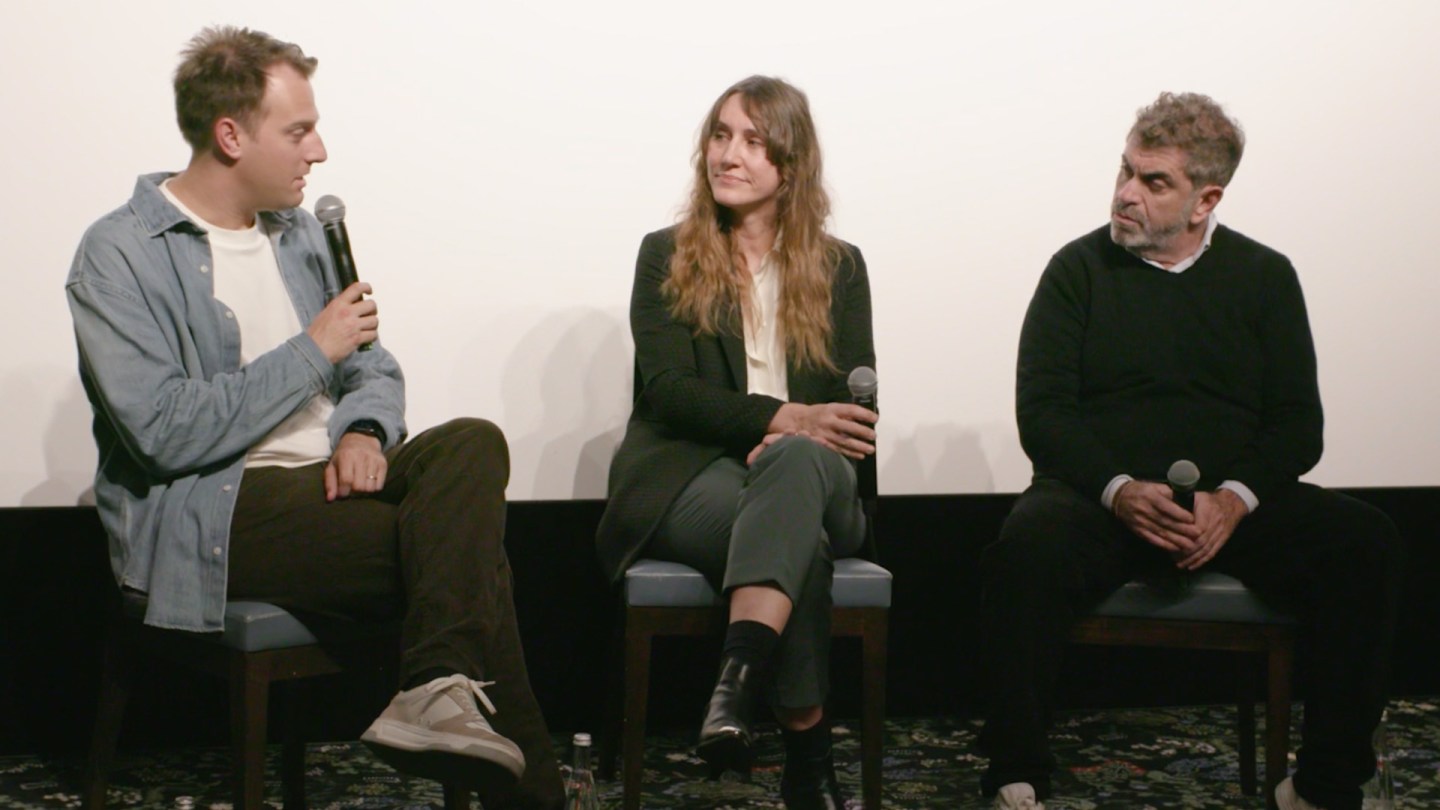
When they began making The Six Billion Dollar Man, a provocative documentary re-examining the political legacy of and legal battles faced by Julian Assange, director Eugene Jarecki and producer Kathleen Fournier (The House I Live In) held differing perspectives on their subject. Jarecki felt he’d “betrayed” the polarizing WikiLeaks founder, fading from his initial admiration of the man for speaking truth to power, while Fournier was less enamored. Like many, she had given credence to allegations against Assange of sexual assault and 2016 election tampering, both of which he’s denied. Therefore, making their film was “this whole journey of unpacking and really understanding the mythology that went into this entire saga,” Fournier said before a packed house at a THR Frontrunners screening last month.
The Six Billion Dollar Man goes against the grain, insofar as public opinion has moved against Assange to some degree, at least since the early days of WikiLeaks, which exposed corruption at the highest institutional levels. The film combines archival footage with original interviews with players in Assange’s grand saga — he was granted asylum in Ecuador until 2019, when he was found guilty of violating the United Kingdom Bail Act and sentenced to prison in the U.K. — while arguing that an immense propaganda campaign was waged against him over several years.
During the making of the movie, rumors swirled about Assange being extradited to the U.S. “Everybody on his team said to us, there’s no way he will ever go to the U.S. If he gets extradited, he’ll end his own life,” Fournier says. “So we felt this tremendous, crushing pressure to get the story and to said it out quickly.” The movie was supposed to premiere at the Sundance Film Festival, but at the eleventh hour, Jarecki and Fournier learned that Assange’s legal team had negotiated a plea bargain and he was being released. So they held the movie back to recut it, capturing the new footage on the fly, before premiering it in Cannes.
The film contains fresh revelations about Assange and the legal efforts against him that ought to complicate the way many view him. Jarecki, for one, recognizes Assange is still not a guy that everyone will be warm to — but as he told the Frontrunners audience, he hopes that the focus returns to the substance of what Assange has done and continues to do.
“Whether one finds him prickly, whether he’s a dick, whether he’s lovable, I could care less from the perspective of what he’s done with his personhood,” the director said. “WikiLeaks was, at the end of the day, a safe haven for people to be able to tell us what we need to know about what their institutions are doing. Like him or not, [Assange] gave years and years of his life and would’ve kept giving years — if he hadn’t kicked America’s ass.”