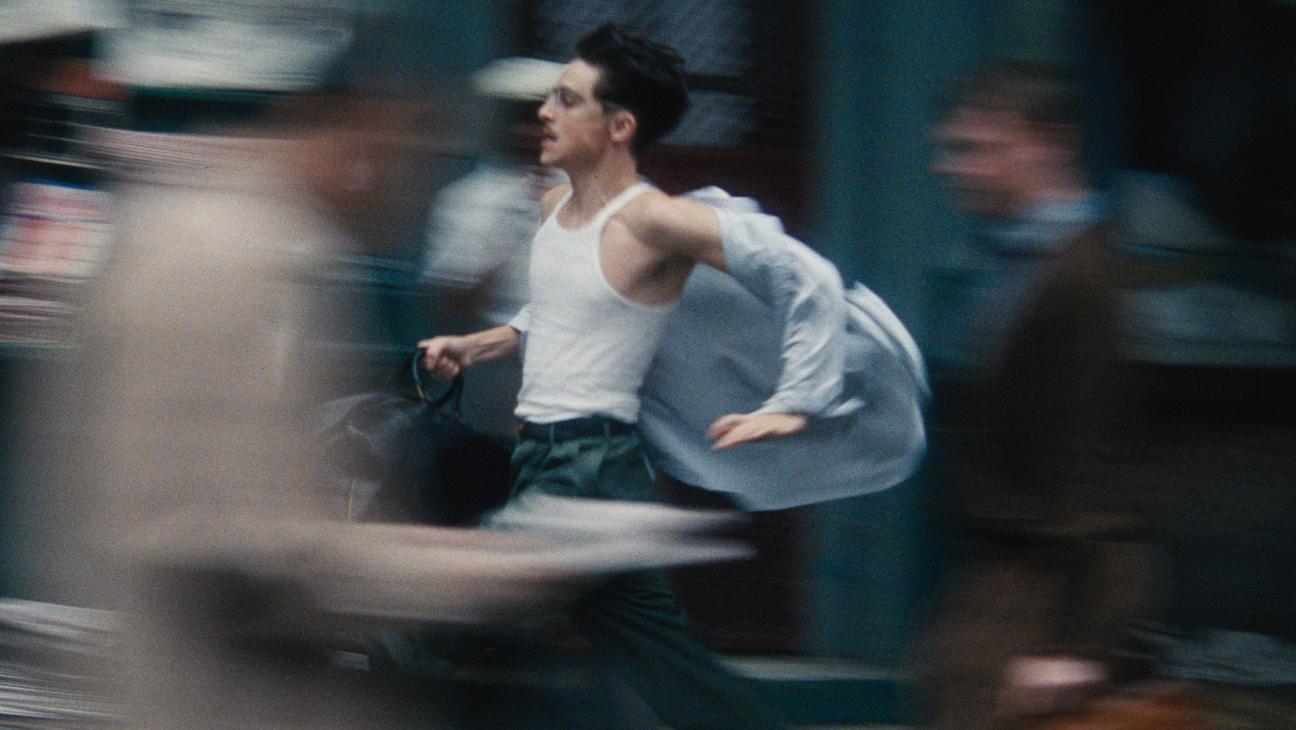
Marking the first time since his 2008 solo debut that Josh Safdie has directed a feature without his brother and longtime collaborator Benny, Marty Supreme turns out, paradoxically, to be his most Safdian movie to date. Propelled by a hot-wired Timothée Chalamet as a cocky operator aiming for global table tennis glory, this genre-defying original is an exhilarating sports comedy, a scrappy character study, a thrumming evocation of early ‘50s New York City — plus a reimagining of all those things. Think of it as Uncut Gems meets Catch Me If You Can and maybe you’re halfway there.
Josh Safdie has long self-identified as a Martin Scorsese disciple and you can feel a thrilling be-bop energy akin to that of Mean Streets or Goodfellas coursing through this film’s veins. But Marty Supreme also bears the stamp of a gifted auteur carving out his own space with his own signature and his own deep connection to New York past and present. While Marty’s adventures in self-manifestation take him to London, Paris, Sarajevo, Tangier, Cairo and Tokyo, Safdie’s hometown is where the movie’s heart is.
Marty Supreme
Kaleidoscopic, kinetic and madly idiosyncratic.
There’s swaggering confidence in the filmmaking to match that of the title character, along with adrenalized visuals, fine-grained production design and scrupulous attention to casting, down to the background players. These are not faces out of Central Casting, but more like figures come to life from the street photography of Diane Arbus, Louis Faurer or Ruth Orkin. Cinephiles will draw comparison with avant-garde filmmaker Ken Jacobs’ 1955 documentary short, Orchard Street.
One of the movie’s key conversation starters will be its audacious use of music, from Daniel Lopatin’s shimmering orchestral score to needle drops that evoke both the 1950s setting and the 1980s vibe of the filmmaking. Any midcentury period piece that opens and closes with Tears for Fears — respectively “Change” and “Everybody Wants to Rule the World” — is not doing things the orthodox way. (The music cue for Peter Gabriel’s “I Have the Touch” is exhilarating.) As much as Lopatin’s ping-ponging percussive flights, the blasts of synth-pop fortify the idea of Marty as a volatile dreamer who sets himself no limits as he barrels toward the future.
While the movie is fictional, Safdie and regular co-writer Ronald Bronstein drew inspiration from the life of Marty Reisman, a Jewish New York table tennis prodigy in the 1950s who strove to make ping pong a worldwide phenomenon, commanding equal respect to other sports.
The Chalamet character is named Marty Mauser, introduced in 1952 toiling in the Lower East Side shoe shop of his Uncle Murray (Larry “Ratso” Sloman), and having furtive sex in the stockroom with his childhood sweetheart Rachel (Odessa A’zion), despite her having since married. In an amusing title sequence that typifies the movie’s irreverent sense of humor, Safdie splashes the biological results of that workplace tryst onscreen in microscopic detail, accompanied by Alphaville’s anthemic “Forever Young.”
Given the kid’s natural salesmanship, Murray wants to make his nephew store manager, but Marty just wants to collect the salary he’s owed and fly to London to compete in the championship table tennis tournament. When his uncle is AWOL at closing time, Marty tries fast-talking his colleague Lloyd (Ralph Colucci) into giving him the cash out of the office safe, and when that doesn’t work, he pulls a gun out of Murray’s desk. Whether his desperado move is robbery or due payment collection, it will come back to bite him in the ass in a hilarious scene much later.
From his first moments onscreen in a performance of Duracell Bunny physicality and motormouth pushiness, Chalamet conveys the sense of a shameless young man willing himself toward greatness with a combination of chutzpah, amorality and unshakeable self-belief.
In addition to Rachel, Marty has a believer in his best pal, taxi driver Wally (Tyler Okonma, aka rapper Tyler, The Creator). Wally also serves as his occasional grifting partner at Lawrence’s Table Tennis Club, named for its avuncular owner (former NBA star George Gervin).
But his needy, overbearing, hypochondriacal mother, Rebecca (Fran Drescher), disapproves of him bailing on a steady retail job to pursue a fakakte dream of sports stardom in a sport nobody cares about.
No sooner has Marty hit the ground in London than he somehow talks his way out of the shabby dorm accommodations and into the Ritz, where the table tennis federation stay. He talks a big game with reporters before taking on the Hungarian current champion Béla Kletzki (Géza Röhrig, from Son of Saul), promising, “Look, I’m gonna do to Kletzski what Auschwitz couldn’t.” When they look shocked, he adds, “It’s alright, I’m Jewish. I can say that.”
While at the Ritz, he also encounters Kay Stone (Gwyneth Paltrow), a former 1930s movie star who brushes off his professed admiration for her screen work by joking that she stopped acting before he was born.
But Marty is never easily put off. His gift of gab persuades her to bail on a promotional event for the pen company owned by her tycoon husband Milton Rockwell (Kevin O’Leary) and come watch him play in the semi-finals. Kay sleeps with Marty despite knowing he’s an opportunist — his gaze over her naked shoulder at the mirror during their first time in bed together speaks volumes.
Rockwell and his business cronies turn up in the audience to watch Japanese dynamo Endo (Koto Kawaguchi) wipe the floor with Marty. But the kid’s showmanship impresses Rockwell enough to offer him a gig in Japan in a series of matches against Endo to promote his pens. Marty, however, is indignant that he’s expected to lose every time, rather than dishonor the national hero. He walks away, instead trading trick shots with Kletzki as a halftime novelty act on the Harlem Globetrotters tour.
This is all basically the setup for a picaresque odyssey in which Marty tirelessly chases his dream, shrugging off humiliations and hostilities, and eventually reconsidering Japan on his own terms. Heavily pregnant Rachel is furious when he resurfaces after eight months without contact, and while her schlubby husband Ira (Emory Cohen) believes the baby is his, she grabs onto Marty as her escape route. Becoming a father doesn’t exactly fit Marty’s grand plan, but Rachel proves a match for him in craftiness and persistence.
Some uproarious set pieces illustrate Safdie’s brilliance at orchestrating fast-paced chaos while still giving the material room to breathe. The most notable is an interlude that begins in a New York dive hotel where Marty literally lands in the orbit of Ezra Mushkin, a crook played with gnarled seediness by Abel Ferrara in one of many inspired casting strokes.
Ezra makes the mistake of trusting Marty to take his beloved dog to the vet after an accident, leading to a crazed sequence of events involving both Wally and Rachel at different times, including a hasty escape from a bowling alley, a gas station fire, a runaway dog (perhaps the surreal pinnacle of cinematographer Darius Khondji’s vividly textured work), a disastrous scam attempt and a shootout in the wilds of New Jersey during which Rachel risks going into early labor. (Look out for Penn Jillette in a bonkers cameo.)
That a part of all this plays out to the hypnotic mantra of Public Image Ltd.’s “The Order of Death” is just one instance of Safdie shaping the tone with decades-spanning pop-cultural playfulness.
Kay re-enters the story when she’s rehearsing a Broadway play (her co-star and director played by Fred Echinger and David Mamet, respectively) and Marty saunters into the theater looking for her husband. But Rockwell doesn’t want anything more to do with the arrogant self-promoter; only Kay takes an interest in him, which endures even after he attempts to rip her off. What Marty is forced to do to get back under Rockwell’s aegis is a jaw-dropper.
In this section especially, Paltrow does some of her best work. Playing a woman who has traded personal fulfillment for material comfort and security as a trophy wife in a loveless marriage, she taps into a melancholy, fractured grace that recalls her role in The Royal Tenenbaums. She sees Marty for exactly what he is yet seems dreamily attracted to his relentless drive, perhaps a wistful reminder of her own surrendered aspirations. It’s a lovely performance.
Chalamet never holds back on Marty’s abrasiveness, making the character a borderline — OK, maybe bona fide — a-hole, even with those closest to him. Nevertheless, he’s an oddly charming underdog with an internal engine that seldom slows down. His gnawing hunger for recognition makes him the perfect emblematic character for New York City itself, a town fueled by brash ambition. The degree to which audiences buy Marty’s redeeming transition into sweetness and vulnerability in the closing scene will likely be all over the scale.
As he did with Uncut Gems, Khondji deftly syncs the electric visual language to the hyperactive rhythms of Bronstein and Safdie’s editing, mirroring the work of Lopatin’s wide-ranging wall-of-sound score. The DP shows a particular knack for picking out the most extraordinary faces in crowds packed with them. Arguably the most invaluable contribution behind the camera is the granular period recreation of the great veteran production designer Jack Fisk, both on soundstage sets and New York locations. It’s like flipping through a gorgeous photography book of the city in bygone days, high and low.
Safdie wrangles a massive ensemble cast that mixes seasoned actors with nonpros to seamless effect, including real-world ping pong champions like Kawaguchi. Okonma makes a sparky acting debut, as does O’Leary of Shark Tank fame, playing, well, a shark who responds badly to defiance, and Isaac Mizrahi is a hoot as the publicist on Kay’s show. But the breakout performance is the marvelous A’zion. In a 180 from her role on I Love LA, she makes Rachel’s intoxication with the slippery Marty initially seem thankless but steadily reveals the pluck required to keep up with him.
Not every thread is spun out into something narratively substantive — Marty’s idea of orange ping pong balls to stand out against white uniforms is a lot of buildup for one admittedly funny sight gag — but as a kinetic portrait of a life in perpetual motion, Marty Supreme is a wonder. Calling something “a wild ride” is one of the most hackneyed quote-whore favorites — see also: “What a ride!” “The thrill ride of the summer!” and “A nonstop rollercoaster ride!” — but for this wraparound sensory experience, it’s a neat fit.