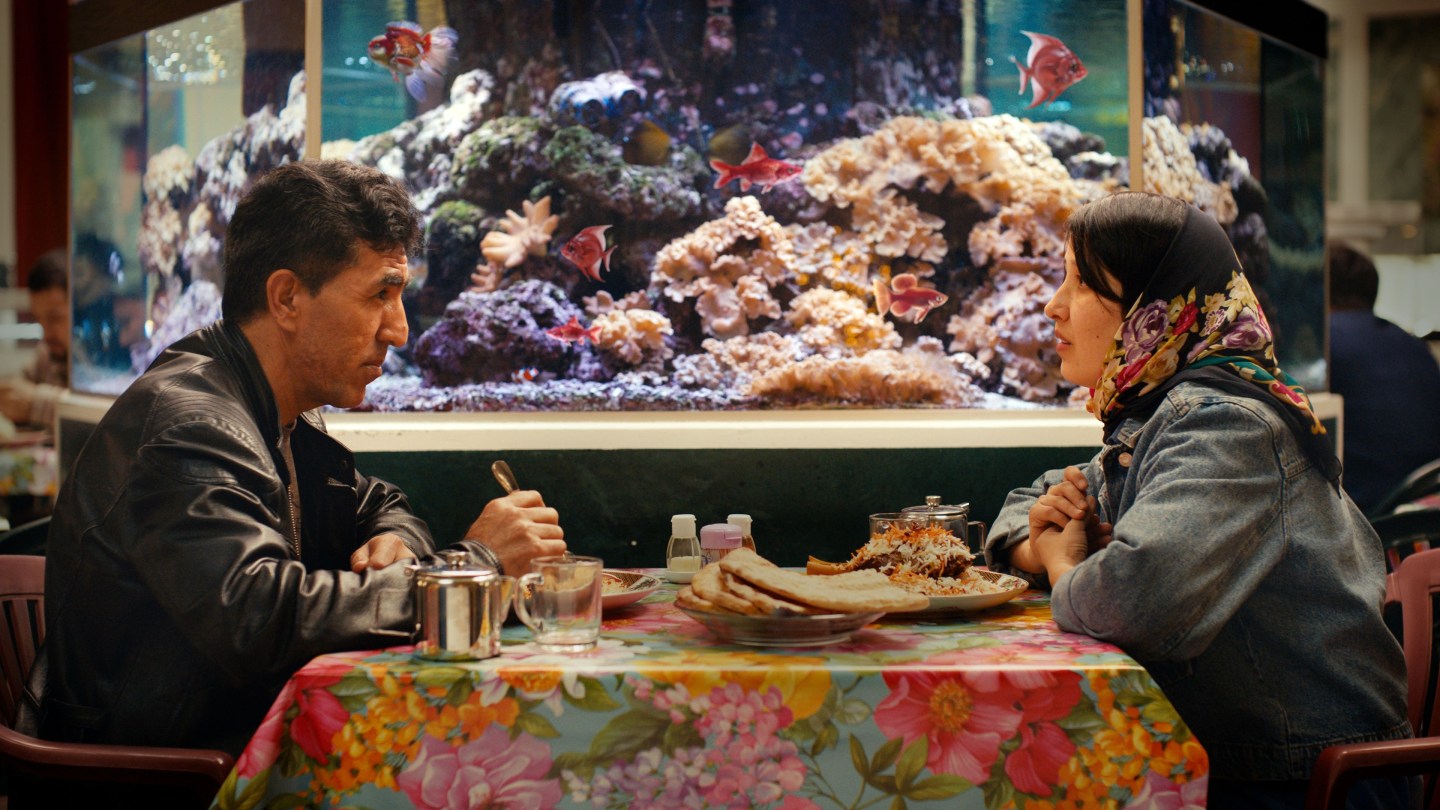
Afghan writer-director Shahrbanoo Sadat says that she made No Good Men as a reaction against the predominance of films about her country seen through the harsh lens of war. But calling it a “political rom-com” does a disservice to this engrossing though lumpy mix of workplace observation, anti-patriarchal social realism, spiraling alarm over the return of an oppressive regime and romantic melodrama rife with cliché and contrivance. Much of the comedy appears to have been lost along the wayside in a movie that’s inarguably well-intentioned, even admirable, but struggles to pin down exactly what it wants to be beyond that.
Perhaps a vestige of the humorous touch Sadat originally intended survives in the title and credit sequences. Up front, joyous party music plays over slow-motion shots of luscious succulents in bloom, opening to reveal more vulval imagery than a Georgia O’Keefe retrospective. The sentimental closing scene cuts abruptly to a cactus so phallic that only its green hue and armor of needles distinguish it from the hefty rubber vibrator brought back from America by glamorous ex-pat Anita (Torkan Omari) as a divorce gift for the protagonist.
No Good Men
Absorbing but dramatically diffuse.
Those bookends might look more at home on a sex farce, which is not even close to what No Good Men is, despite its climax with a passionate kiss that’s a slap in the face to restrictive Taliban morality dictates. The film is partly inspired by TOLO TV, Afghanistan’s leading private news channel, where seven staffers were killed in 2016 from the blast of a Taliban suicide bomber. While most of its news reporters, producers and editors fled the country in 2021, within days of the fall of Kabul, TOLO continued broadcasting, albeit with a veto on any content deemed “contrary to Islam.”
Sadat stepped into the film’s lead role three weeks before shooting when the actress chosen after a long and difficult casting process got cold feet. She plays Naru, a camera operator at Kabul News, who has moved back in with her parents while warily negotiating separation from her lazy, cheating husband Samir (Masihullah Tajzai). She fears that if she pushes too hard for divorce, Samir will take custody of their 3-year-old son Liam (Liam Hussaini).
Frustrated by her duties shooting “women’s programming” and tired of rolling her eyes at the retrograde gender roles being pushed — the heavy-handedness of a male guest’s response to a traumatized female caller is cringe-inducing — Naru begs the news division chief (Yasin Negah) to put her on more hard-hitting content. He refuses, but when the station’s star news reporter Qodrat (Anwar Hashimi) needs a cameraman at short notice to film a hard-to-get interview with a Taliban commander, Naru talks her way into the assignment.
Qodrat seems as blatantly sexist as every other Afghan man at first, calling his boss to insist he needs a “proper cameraman” before reluctantly agreeing to use Naru. When her headscarf momentarily slips off, the interviewee uses that violation of Taliban law as an excuse to end the interview without answering a single question. Qodrat says nothing in the van afterwards, but when he drops Naru off with her equipment on a busy commercial street to shoot Valentine’s Day vox pops, the “stay in your lane” implication is clear.
However, Naru surprises her news colleagues by coming back with a wealth of good material in which women speak candidly about their husbands’ tendency toward hostile, abusive or at best dismissive treatment of them. This preconditioned behavior, passed down from one generation of men to the next, is the movie’s key underlying theme.
Just in case that’s not clear, Naru, Anita and prim colleague Layla (Fatima Hassani) have a frank conversation about Afghan men’s shortcomings while giggling over the dildo gift, which is funny until it veers into the didactic.
When Qodrat’s regular cameraman is injured on assignment due to the poor-quality bullet-proof vests provided by the station, the reporter agrees to take Naru to cover a breaking news case about a group of men accused of gang rape. Her ability to get emotional testimony from the victims in silhouette interviews is key to the piece’s success, something Qodrat readily acknowledges rather than taking sole credit.
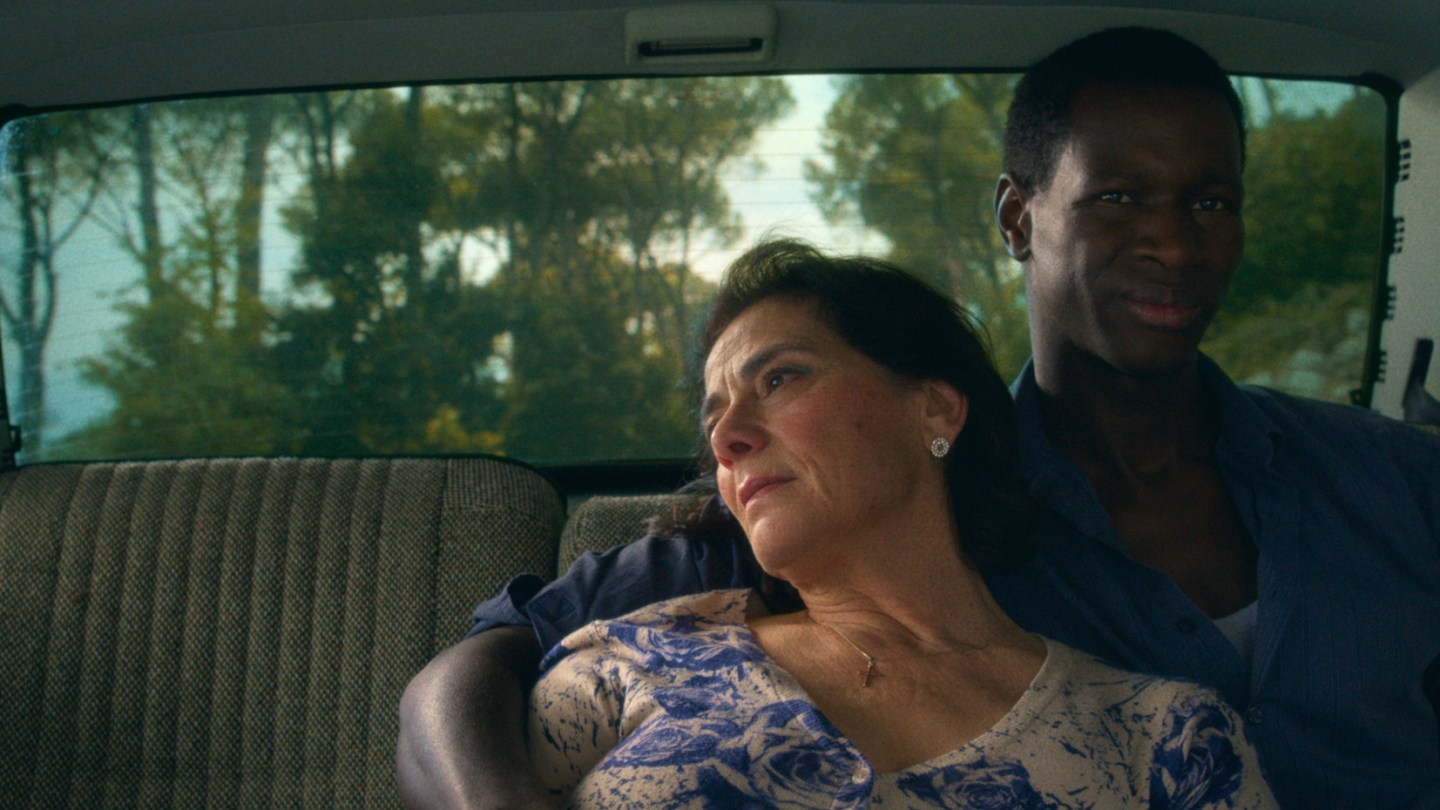
A working relationship based on mutual respect develops, intensifying after Qodrat intervenes to help Naru out of a volatile situation with Samir. But even as romantic attraction grows between them, so do fundamental differences in their attitudes about gender roles. Outspoken Naru says Qodrat and his generation are too passive, while the reporter, who is 20 years older than her, says 30-ish Naru and her generation live in a bubble, obstinately blind to the practicalities of living in Afghan society.
There’s potential for effective drama in Sadat’s portrait of the relative freedom of living under an elected government for almost two decades, and the many ways in which women remained excluded from those freedoms. Likewise, in the shifting terrain as the shadow of returning Taliban rule encroaches. But the movie drifts into hackneyed melodrama that sits awkwardly against the gritty canvas of terrorist incidents, sniper attacks, bombings and police checkpoints.
Even when the stakes are heightened after violence interrupts the news chief’s wedding festivities, the will-they-or-won’t-they sexual tension between Naru and Qodrat, who is married and has three children, trivializes the very real paralysis gripping Kabul and the country at large as province after province gets taken by the Taliban. A quick news clip of President Biden announcing the withdrawal of U.S. troops after 20 years in Afghanistan points up America’s clumsy role in reopening the door to the Taliban.
Sadat, who lives in Germany, was among the hundreds of thousands of people that fled the country in 2021. That personal experience allows for some sharp first-hand observation of the climate of fear that returned as fundamental human rights came under threat, and how even before that political upheaval, few women were granted the same rights as men.
Hashimi, who plays Qodrat, was a business news producer at the same Kabul TV station where Sadat worked from 2009-2014. They have remained close friends and she credits his unpublished 800-page memoir as the inspiration for her five-part film series about Afghanistan, of which No Good Men is the third installment.
It follows her 2016 feature debut Wolf and Sheep, an exploration of life in the country’s mountainous rural center, weaving together ethnographic docudrama with fables; and 2019’s The Orphanage, about a Bollywood-obsessed teenage boy in late 1980s Kabul under Soviet-backed communist government, where reality eclipses fantasy.
Like those films, No Good Men was shot outside Afghanistan, with production designer Pegah Ghalambor doing a convincing job of recreating Kabul during a time of transition. Another plus is regular DP Virginie Surdej’s textured depiction of street life and of the chaos of a sea of people flooding the airport to flee the country.
Performances are solid, especially from Sadat and Hashimi, whose relaxed rapport counters the tensions that frequently bubble up, though the romance could have used more heat. Ultimately, however, the movie is undermined by wobbly plotting and inconsistent tone.