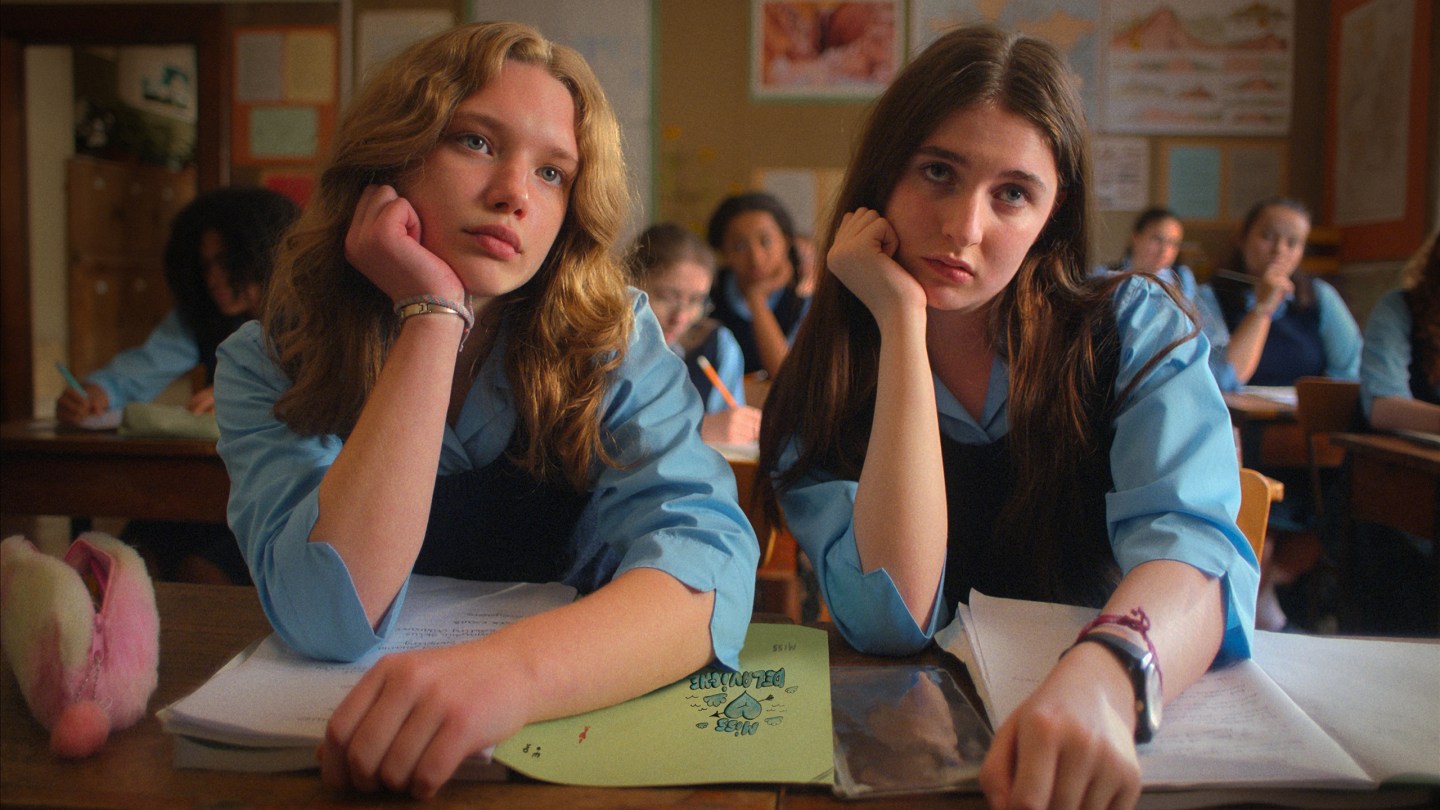
It’s great to have a best friend when you are a teenager. Minna and Flic, who attend an English girls’ boarding school in the debut feature from director Molly Manners (In My Skin, One Day) based on a script by Miriam Battye (Succession, The Woman in the Wall), are actually so close — and so synchronized in their thoughts and movements — that they grapple with academics, boys, friendship, and other challenges of growing up as a tight unit. One day though they embark on a special school project that could well turn out to be the biggest challenge of their young lives: Falling in love.
So, the two friends audition together for a school performance of William Shakespeare‘s A Midsummer Night’s Dream, and how they go about their special school project echoes elements of the famous story by the Bard: they decide to fall in love with the first person they see. That person is — as teased in the movie’s title — their geography teacher.
Audiences will find out how all this plays out when Extra Geography world premieres in the World Cinema Dramatic Competition of the Sundance Film Festival on Jan. 23.
The film’s two protagonists are portrayed by Galaxie Clear and Marni Duggan in their debut performances, which will likely convert many a viewer into instant fans. And the teacher who is the object of the girls’ affection is played by Alice Englert (Beautiful Creatures). Sarah Brocklehurst is the producer behind Extra Geography, which is based on the short story of the same name by Rose Tremain. HanWay Films is handling sales.
“Extra Geography is a very British high school movie about girlhood and the teenage friendships that shape us as women,” says Manners. “I wanted to explore this time in a woman’s life and dive into the emotional intensity and exhilaration of these relationships on the big screen — to shout about how these early female friendships are love affairs in themselves and to show how deeply formative they can be. Life-defining even.”
Manners talked to THR about casting her two young leads, moving from TV to film (she won a BAFTA in 2022 for the BBC Three series In My Skin) and the film’s female-led creative team.
What is it like to complete your debut feature and get it into Sundance?
It feels incredible. We are very excited as a team and excited for people to see the film. It’s exciting to get to be part of that, and also to take the girls out to Sundance with us.
One of the many things I loved about Extra Geography is the playful tone, this mix of awkwardness and self-involvement. How did you, as a creative team, achieve that?
I think that emerged very naturally. The film is an adaptation of a short story by Rose Tremain that is very short, very evocative, and very bold. So I think that had this ripple effect. Miriam’s adaptation built this world out and added a lot more, including in terms of the use of language, the humor and the drawing of the characters.
Miriam brought a lot of her own experience to it. That resonated with me and then woke up parts of me and my own experience of early female friendships. The boldness in the use of language is something I noticed — it is really out there in places. That’s how it was when I was growing up. There was a lot of fear about how you’ll appear. So, they use academia as their love language, almost.
I then wanted to bring the very intimate moments out in it. So, the tone emerged naturally. There’s a whole body of amazing American high-school movies, and this feels like a very British, slightly warped version of one of those.
You mentioned intimate moments. Can you expand on that a bit?
I was trying to look at the intimacy between girls at this age, this platonic but also slightly maternal love, and the way in which they interact. It felt really interesting to explore that. Lots of different things [flowed into that], but I hope that the film is just a very true picture of a very teenage lens on it all. These girls have such a specific dynamic because they just need each other, but they’re also slightly competitive.
How difficult was it to find two stars who could bring all those different layers to Extra Geography, including elements that may not be verbalized but can be felt by the viewer?
That was at the heart of the casting process, because the language is so bold, but they are also quite naive. They want to become worldly, but they’ve got no access to the real world. So, we had to find the right actors who are brilliantly bold and super funny, but are not necessarily even aware they’re being funny at times.
Finding people who you really believe those words in their mouths was what Lucy Pardee, our casting director, and I were looking for. She is incredible and very well versed in finding unknowns by trolling the country top to bottom, including drama clubs, drama schools, and all that. We saw so many talented young actors and did recalls, and actually had several rounds.
And then you found Marni Duggan as Flic and Galaxie Clear as Minna. How did they develop their great chemistry?
When we found Marnie, we felt she embodied the character, and we just totally believed it. She had such pitch-perfect humor. And then we found Galaxie, who was also able to inhabit Minna and have this very layered intrigue that she brought to the character.
It was very important for us to do chemistry reads because the girls have to immediately be best friends, and we wanted to find that very natural chemistry. Galaxie and Marni just had that in spades with each other and also in their characters.
Can you talk a little bit about Shakespeare as an invisible character in Extra Geography, so to speak? He is present throughout, but obviously not as a character.
I feel the film works if you know Shakespeare and A Midsummer Night’s Dream, and it works if you don’t know it, which was really important. In the short story, the book is mentioned, and the idea of falling in love with the next person they see comes from that.
But in the adaptation, that thread has expanded into a theater production, with boys coming into the school. So there’s a whole other element and added this extra layer of this very female environment that a male gaze comes into. And it also adds a slightly mythical, comedic and absurd layer.
I was intrigued by the theme that the movie touches on that we all often try to play roles in life and struggle with authenticity…
Yeah, how do you convince yourself? A lot of the joy and comedy of the film comes from the fact that they believe they can master love almost as an academic subject. ‘We’re going to fall in love with the next person we see and go through the motions of doing that.’ It’s really interesting to hear that you relate to that. In adult life, sometimes, you can do things and go through the motions, but you don’t actually feel it. The film plays with that.
And, without giving any spoilers, it comes back to the real love story at the heart of the film, which is between the two girls, their friendship and how formative early friendships are. These are massive relationships, but they’re not explored that much on screen.
What did the fact that Extra Geography is set in the early 2000s mean for the production?
It [allowed us to enjoy] the different language, the lack of mobile phones. It’s just all very analog, so it’s naturally got a bit of nostalgia to it.
Women held a lot of key creative roles on the production…
It was very naturally female-led, but we were not exclusively women. A lot of the heads of departments (HODs) were female, but we also have male HODs. For me, it was just about who the story really resonated with. I think when you’re making a film like this, and you have to put so much yourself into it, so much passion, it’s all about who has that passion and who do these themes resonate with.
How much did you want the female leads to interact with the young male actors once they joined the set?
The boys’ arrival did change the dynamic a little bit since we went from working with the girls on a lot of just two-person scenes. And sometimes I would keep the [girls and boys] separate just so that everyone didn’t get too familiar with each other. I wanted to try and keep a bit of an awkwardness between them.
What was it like moving from the TV director’s chair to the film director’s chair?
My directing process and how I work with actors and all of the creatives involved is very similar in TV and film. There’s a slightly different feel when you’re making an independent feature, because it doesn’t yet have a home, and you often have a smaller team working on it. But what goes with that is just an incredible passion. Anyone who’s committing to making the project with you is just so into it. That is really deeply felt, and I felt that from every single person with whom I was working. And I hope that this is felt in the film as well.
Will we get to see more movies directed by you, and do you have a next project?
I don’t have anything that I’m doing next yet. I’m reading scripts. And I’d love to make another film.