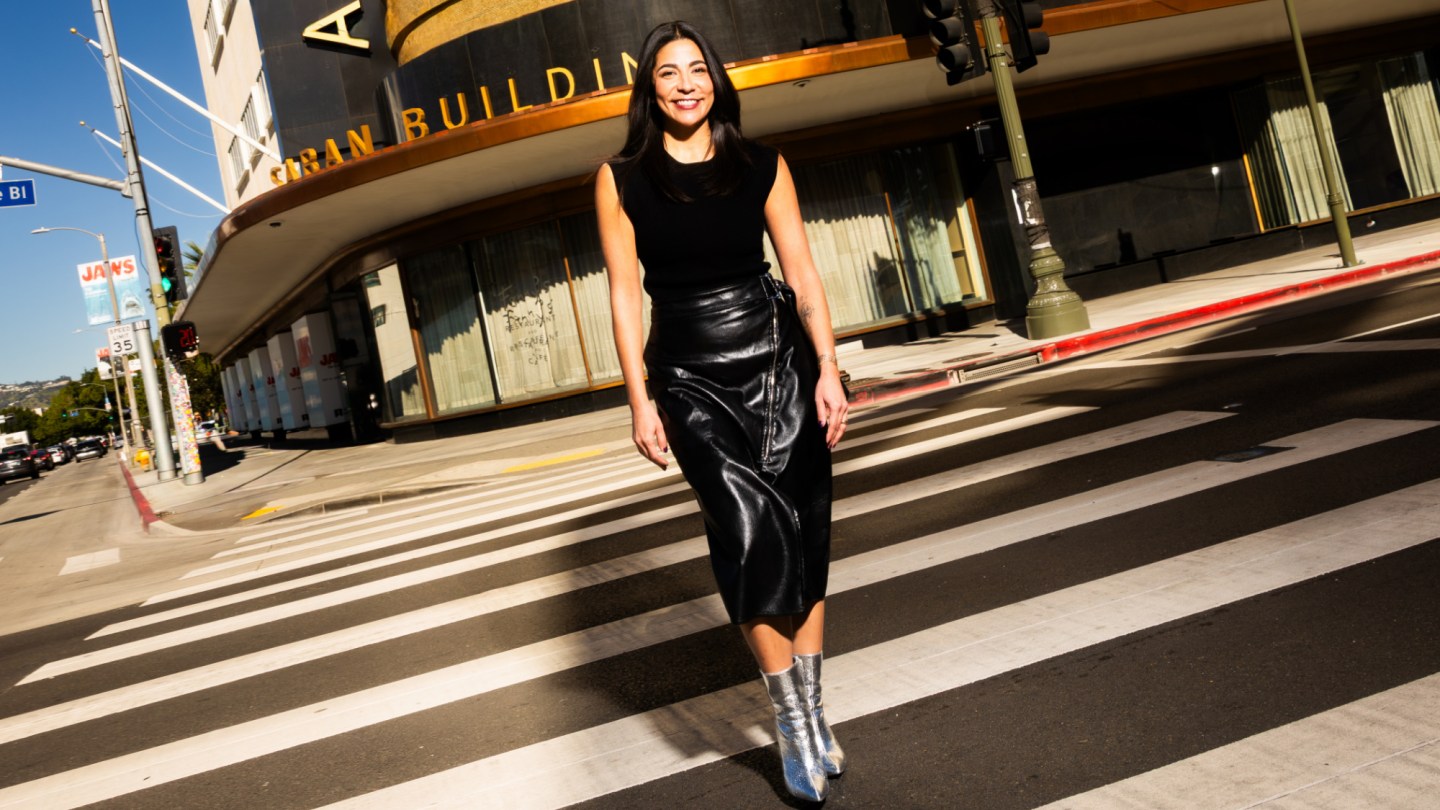
On Jan. 13, the Academy of Motion Picture Arts and Sciences announced that Amy Homma, the Academy Museum of Motion Pictures’ director and president, will henceforth also oversee the Academy Collection, which includes some 52 million film-related items held within the Margaret Herrick Library and the Academy Film Archive, ranging from an original script of Citizen Kane to a pair of the ruby slippers from The Wizard of Oz. It’s all part of an effort to better organizationally link all aspects of the Academy’s history and preservation efforts, the Academy says.
Homma, a 41-year-old wife and mother of two, was born in Chicago to a Jewish mother and a Japanese father. Her dad, who owned a landscape architecture company that sometimes worked on local film productions, once brought his daughter to the set of Uncle Buck to meet John Candy. But where she most enjoyed spending time was at the city’s arts and culture institutions. She went on to get her B.A. in art history from the University of Wisconsin-Madison and her M.A. in teaching from GWU, and then spent six years cultivating younger audiences for the Smithsonian’s Hirshhorn Museum before becoming acting deputy director of the Smithsonian Arts and Industries Building.
In 2019, Homma came to work for the Academy Museum, initially as VP education and public engagement; then chief audience officer; and, since July 2024, director and president.
Why did you leave D.C. in 2017? And how did you wind up in LA in 2019? The Academy Museum didn’t open until 2021.
We needed a change. We sold our home, put our belongings in storage, took one suitcase and bought a one-way ticket to Hong Kong. We had friends that lived there that were getting married, so that was stop number one. From Hong Kong, we went to Bali, then Japan. Then I received an email from the director of the Academy Museum at the time [Kerry Brougher]; they wanted to talk to me about building out their education and public program strategy. So I came out to LA, saw the Academy Museum when it was under construction, and became really curious, because to open a museum of this size and scale about film in the city of Los Angeles is a once in a lifetime opportunity, and it was incredible to imagine what could be done here. When the opportunity came through, I said, “All right, family, we’re going to LA!”
When the Museum opened in 2021, many were outraged that there was little inside about Hollywood’s Jewish founders. Then, in May 2024, the Museum debuted its first permanent exhibition, “Hollywoodland,” which was supposed to address those concerns, but left many further upset at the way it characterized those founders. You didn’t become the Museum’s director until shortly after that, but you were already working at the Museum, so I imagine you had a view of what was going on. How did that go wrong?
It’s not that anything “went wrong,” it’s that we can do better. When you’re listening to a lot of different experts and perspectives from the beginning, your output is stronger. And so for the past year-and-a-half, I’ve been listening to a lot of different constituents — community members, filmmakers, exhibition advisory groups. It’s listening to a plurality of perspectives that helps us understand where there is sensitivity and where there’s further consideration or conversation needed.
How would you describe what’s been done to address the concerns raised at the outset of “Hollywoodland”?
I invite everyone to come see “Hollywoodland,” because our visitor survey shows it’s now one of the top-rated experiences that we offer week after week — it’s always in the top five. It’s rich in history, not just about the film industry and studio system and Jewish founders, but also about Hollywood and Los Angeles as a city. We added original objects and documentation from our Margaret Herrick Library that show some of the nuance of the artistic achievement and merits of our Jewish founders.
Many early visitors found the Museum to be too “woke” — that you couldn’t read a description about, say, a Western film without an accompanying statement that Native Americans had been treated unfairly.
Museums should be timeless and timely. I fully respect and acknowledge that not everyone wants to have the same experience. Some want to come and lean into contextualizing histories and narratives that maybe they didn’t know; others want to come and feel like they can escape into something joyful. We have to be all of those things at the same time. It’s a balance. It’s almost like a Rubik’s Cube, looking at our exhibition lineup: “How are we balancing the scales on the stories that we’re presenting? How are we ensuring that all communities feel represented?”
The Academy Museum Gala, a Museum fundraiser, has become the Met Gala of the West Coast, and generates a lot of money. But overall, does the Museum make or lose money?
We’re not a for-profit, not a corporation, not a company and not about making profit every year. We’re about bringing in enough resources to pay for what we are doing.
What aspects of the museum generate the most money?
We’re incredibly diversified. On one side, we have earned revenue: that includes ticket sales, rentals — studios rent out our theaters for premieres or FYC screenings — retail and our restaurant, Fanny’s. On the other side is contributed revenue: that’s individual giving, foundation grants, corporate sponsorships and Museum membership, which is also growing.
When the Museum opened, there was programming about several filmmakers who are significant, but who I doubt one in 100 people on the street had even heard of. Under your watch, we’re seeing exhibitions on Barbie and Jaws and things that have broader appeal.
I personally love a lot of things that happen to be very popular. And I love that we can package all of the scholarship, rigor and expertise that we have internally — between our Museum, Library and Archive — but lead with, say, the horror genre. How can we get people to learn more about lesser-known titles by putting the umbrella forward that it’s all about horror? It’s more about how we are packaging things. Let’s not present something that immediately creates a niche; let’s present something that has a wider lens of opportunity, access and understanding, and then bring people in to learn more.
How is business at the moment?
We just had the strongest holiday season since the Museum opened. We had queues of people who were trying to get into the museum to go up and see our exhibitions. So we’re seeing how successful we are in this new direction.
Who else at the Academy influences what goes on at the Museum?
Our Academy Museum board of trustees is chaired by Olivier de Givenchy [managing director and west region head of J.P. Morgan]. That board — which includes seats for the current Academy president, who is Lynette Howell Taylor, and treasurer, Simon Kilmurry; the Academy CEO, Bill Kramer; and the Academy Foundation president, Kim Taylor-Coleman — has fiduciary responsibility, and they are my bosses. I report to them, and they provide critical guidance as we think strategically about how to continue the success that we’ve seen at the Museum and further grow it. For example, it’s very important to Kim, who’s a casting director — and it’s very important to me — that we shine a light on casting directors, especially with the presentation of the first casting Oscar this year. So after that award is given, we are going to present material in our Spielberg Gallery about the art of casting.
The Academy recently struck a deal with YouTube to broadcast the Oscars starting in 2029. Will that deal also have implications for the Museum and Collection?
I’m very excited about the promise of making more people around the world aware of the treasures of the Collection through digitizing efforts — putting digital content on YouTube. The Academy — through the Oscars, of course, and through the Academy Museum — is going to be building audience through our partnership with YouTube. And that means more people watching the show, experiencing our exhibitions and being able to access the Collection.
What do you like to do outside of work?
I love spending time with my family, watching movies in theaters and at home, and going to other museums.
What’s your favorite film of all time?
The film that I have watched the most because of how much I love it is Funny Girl.
What are your favorite Oscars moments that you remember watching in real time?
I loved the one-handed pushups [by City Slickers’ Jack Palance], when Bjork wore the swan dress and the year that Everything Everywhere All at Once won.