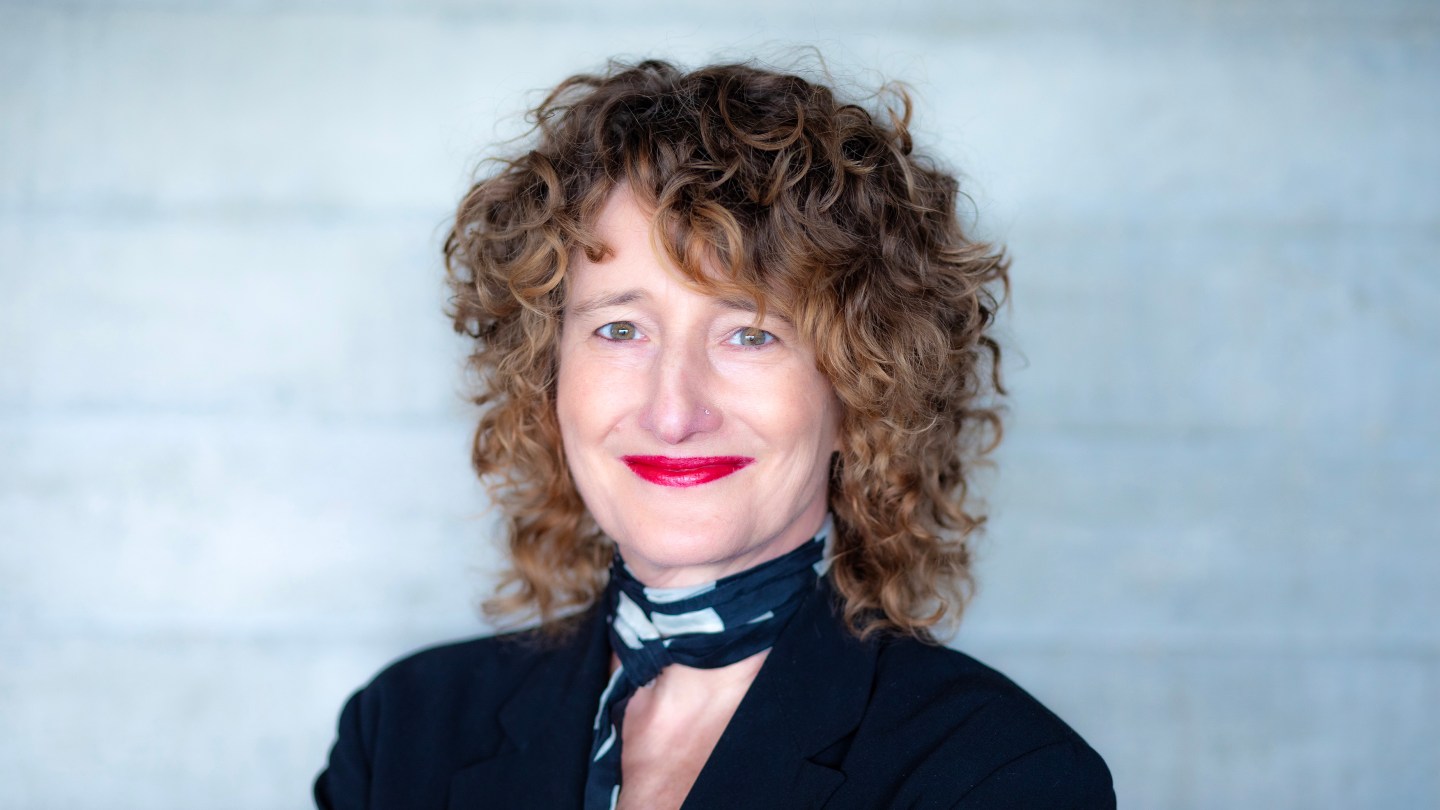
As the Berlinale enters its 78th edition, festival director Tricia Tuttle is using her second year in charge to reassert Berlin’s position within a contracting independent film marketplace, emphasizing scale, breadth and sales potential at a time when distributors are increasingly risk-averse.
The 2026 competition lineup, unveiled on Tuesday, sees Tuttle focusing on indie arthouse and Berlin-familiar names, favoring a strong contingent of European and world cinema titles — Kornél Mundruczó’s At The Sea and Karim Aïnouz’s Rosebush Pruning, Warwick Thornton’s Australian Western Wolfram, Markus Schleinzer’s Austrian period drama Rose, starring Sandra Hüller — over studio titles (of which there are none this year). “It’s about getting back to the legacy at the festival,” says Tuttle. “This lineup feels very authentically Berlin to me, but it also has high points that I hope will really interest the marketplace.”
Speaking to The Hollywood Reporter, Tuttle about Berlin’s role in supporting the “indie film ecosystem,” the challenge of “cutting through the noise” of award season, and why the studios at the moment are “nervous” about launching bit titles on the festival circuit.
What does this lineup say about the identity you want the Berlinale to have?
Well, I think I spoke about it a lot last year. We have always thought of cinema as a very broad church, with space for people who are looking for different things in their cinema: Direct political cinema, films that are less directly political but more intimate, dramas, comedies, thrillers. I believe every film is political in some way, but that breadth is something I’ve always loved about the festival.
We have a history of [avant garde sidebar section] Forum as an independent section alongside Competition, and while there were sometimes crossovers, what was really terrific was the way those sections created poles that together contained everything cinema can be. I really want to get back to that.
I love all kinds of cinema, and I think the marketplace needs a festival that plays all kinds of cinema. We are an audience festival, with 340,000 tickets sold last year, but we are also one of the most important film markets in the world [with the European Film Market]. Those two things create lots of different textures and tones in the festival, and balancing them in a way that really serves the films and filmmakers is what I wanted to do.
This lineup feels very authentically Berlin to me, but it also has high points that I hope will really interest the marketplace. We have films that haven’t sold yet coming to us, and I hope and expect them to sell. It’s important that we help launch films into the marketplace. I really believe there are many films here, some obvious and some less so, that adventurous distributors can find eager audiences for.
You’ve said that one of the crises facing independent cinema is how difficult it is for films to sell and find distribution. What role do you see the Berlinale playing in that ecosystem?
We’re part of a small handful of festivals that can really drive that. There are probably five or six festivals that play a crucial role in ensuring there is space for discovery and for nurturing the next generation of talent. By nurturing, I mean making sure the industry has a place to discover filmmakers and that filmmakers have access to a platform like the Berlinale. That’s so important for building awareness with audiences and with the industry. We have more than 2,000 journalists from all over the world here, and that’s incredibly precious.
We’re a big festival that can do many things. We screen more than 200 contemporary features, and we have strands dedicated to discovery, like Perspectives, which give filmmakers an opportunity to break through. Not every festival has that. The Berlinale also has breadth: journalists may come for Competition and the Special Galas, but there are also places to go deeper and discover films you won’t necessarily see at every other major festival.
Last year you had some high-profile studio premieres, including Bong Joon Ho’s Mickey 17 and Richard Linklater’s Blue Moon. But no studio titles this year. What conclusion should we draw from that?
It’s a fair question, but you’re really talking about two very high-profile films last year. Outside of those, I think this year’s lineup actually has more breadth and diversity and is closer to what we usually do. Of course, anyone would want a Richard Linklater or Bong Joon Ho film in their lineup in any year. We have strong relationships with the studios: We work with Disney, Amazon, Universal, Sony, Netflix. Those relationships are solid.
But when it comes to films like Mickey 17, this is less about the Berlinale and more about what’s happening right now. The biggest films in that crossover arthouse-commercial space didn’t launch at festivals this year. There’s a nervousness in a very difficult marketplace: nervousness about reviews coming out long before release and about controlling the way films of that scale are launched because there’s so much at stake. Outside of awards season, we’re just not seeing that many of those films.
I think it started a bit with Joker: Folie à Deux [which premiered in Venice in 2024 to horrible reviews and quickly bombed at the box office]. We’ve seen more reticence since. That may be the moment we’re in. Film festivals remain a vital part of the ecosystem, but there’s no magic bullet. We’re part of a fabric, and that fabric needs to work together to get to a new normal where risk-taking doesn’t feel quite so frightening.
How does the timing of the Berlinale, in the middle of awards season, affect the festival and the attention these films receive?
It’s a challenge. It’s a very noisy period of the year, with a lot going on. That said, it’s a good spot for us, especially because of the market. In leaner years, the market has been a real engine for the festival. What I hope we’re doing now is bringing the market and the public side of the festival closer together and being more conscious of how they work in tandem.
Awards season does feel like it’s taking up more and more of the year, and that’s hard for audiences too, because only a small handful of films get sustained attention. But it works. Last year we had great coverage, a strong program, 340,000 admissions, another 110,000 industry admissions, nearly 20,000 delegates including press. It does work, but we have to cut through the noise. I feel that last year’s program directly led to an even more coherent and vibrant lineup this year, particularly in competition, where there really is something for every kind of cinema fan.
You mentioned wanting to align the official program and the European Film Market more closely. What does that look like in practice?
This year is a good example, even though it makes it sound like we control this more than we do. We have many Competition films being handled by excellent sales agents, with multi-territory rights available and real sales potential. That attracts a lot of attention and benefits sellers across the market. It’s not so much about design as it is about a virtuous circle: the more interest we generate from buyers, the more we can support a wider range of films in the festival. Distributors may worry that many things aren’t working, but they’re always looking for interesting titles, and the more we can provide, the stronger this platform becomes for those films further down the line.
Are you also thinking more consciously about genre, about putting films front and center that distributors are actively looking for?
Yes. Animation is a good example this year. We haven’t had much animation in the program recently, and now we have an animated film in competition [Yoshitoshi Shinomiya’s anime A New Dawn] and the EFM has launched an Animation Day. That’s something we want to build on. We’re also refocusing on documentaries. There are many strong documentaries in the festival, and it’s been great to see how Berlinale documentaries have gone on to do well later in the year, like My Undesirable Friends last year or [eventual Oscar winner] No Other Land the year before.
We’re also echoing what’s happening in the market. We have the World Cinema Fund and the co-production market, which invest in projects at an early stage, and it’s always rewarding when films that began their life there come back to the festival. Thinking about how we can help build stronger roots is really important to us.
How concerned are you about political issues dominating the conversation around the Berlinale this year?
Every festival director gets those questions, largely because the news agenda so strongly dominates culture now. There’s less space for pure discourse around film and art than there used to be, so everything gets refracted through the news. That will happen. But I feel that the temperature around the festival has cooled, and I’m grateful that people are writing about the films. Many of the films have strong points of view, and filmmakers will bring those to the festival, and that’s vital. But it’s good that there seems to be room for a broader conversation as well, and I think that will make my job easier this year.
Finally, are there one or two hidden gems across the sections that you’d encourage people to seek out?
One film I’d particularly highlight, from a European filmmaking perspective, is Theodora Ana Mihai’s Heysel 85. It’s a multi-country co-production about the 1985 Heysel Stadium disaster involving Liverpool and Juventus supporters. It’s a really well-written, well-acted ensemble film, and I think with the right distributor it could do very well, because it’s still a historical tragedy that resonates strongly.
In Panorama, Anna Roller’s Allegro Pastell, starring Luna Wedler, is a Berlin-set young adult story with terrific performances. I think Anna is really going to surprise people with that film. And in Generation, George Jaques’ Sunny Dancer, with Bella Ramsey and a strong ensemble cast, is a smart, sassy, grown-up film for young audiences that I think will really land. Those are a few gems outside of competition.