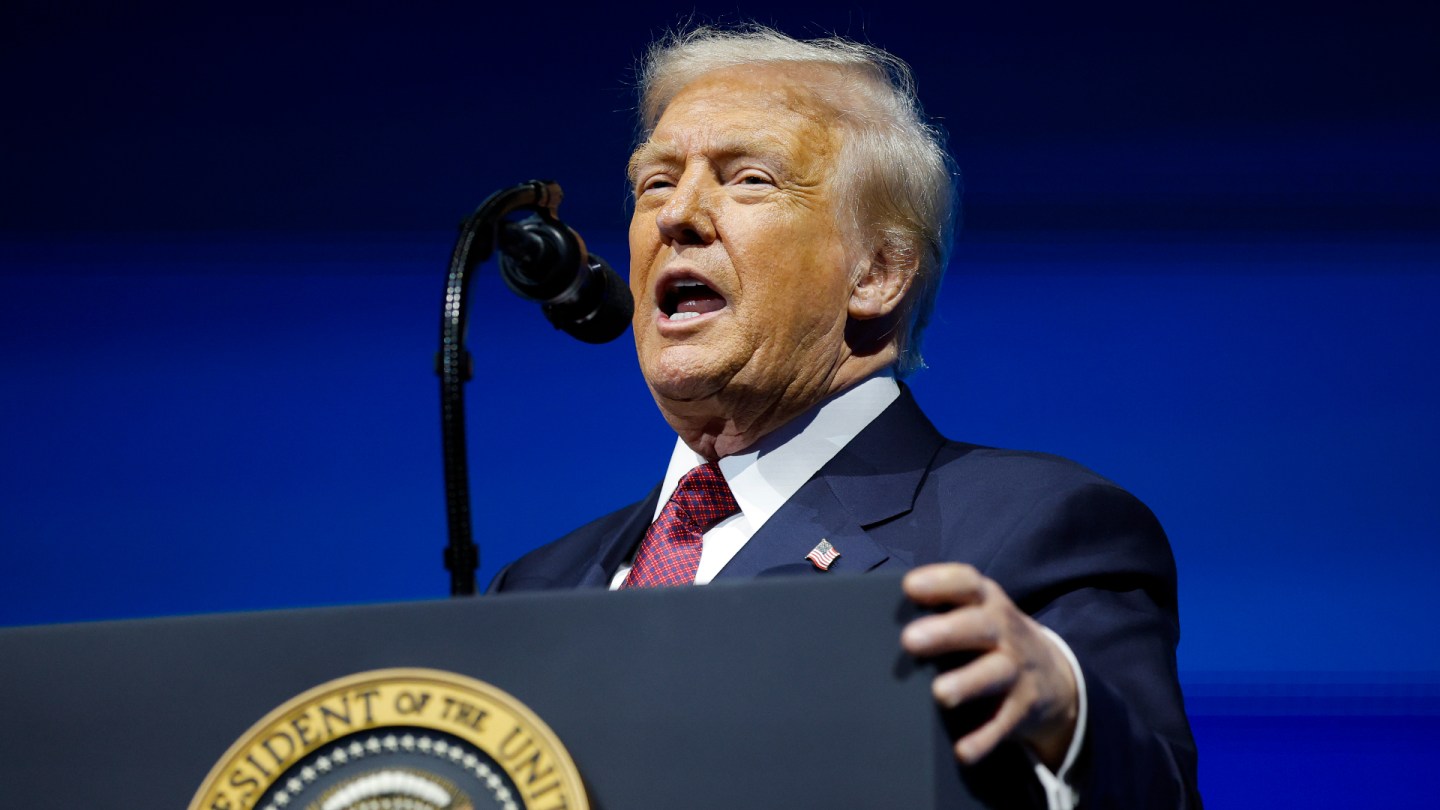
The topic of a Thursday panel at the Content London industry gathering signaled a debate of big and big-picture issues: “TV under Trump 2.0. How has the business changed and what happens next?” A preview read: “Over the past year, Donald Trump’s return to the Oval Office has shaken almost every aspect of the international content business. The de-funding of public media, M&A uncertainty, DEI rollbacks, an anti-copyright approach to AI regulation and promises to repatriate U.S. production have all generated headlines in 2025 and raised urgent questions about the future of the business.”
Stephen Segaller, vp programming at The WNET Group, the PBS affiliate in New York City; Simon David Miller, an AI creator and founder of New Forest Film; media investment banker and ABP Advisory managing director Hasham Khan; and consultant Kristin Jones, who is also building her own content slate comprised the panel.
“This is not a ‘Donald Trump is bad panel’,” emphasized moderator Jordan Pinto, North American editor of C21Media, also sharing that he had a difficult time finding panelists willing to publicly discuss such issues. “This panel is being recorded, but there will be no deceptive or misleading editing. No one is going to get sued for a billion dollars, and no one’s going to be mysteriously stepping down from their positions afterwards,” he also quipped.
WNET’s Segaller was asked how the $1.5 billion cut to PBS and international aid was affecting the public broadcasting landscape in the U.S. He pointed out that PBS lost $550 million for the fiscal year, representing 15-20 percent of the total public TV budget, which has led to PBS’ decision to not continue co-funding WNET’s American Masters and Secrets of the Dead from around mid-2026. As a result, WNET is looking to pivot and find new funding sources to sustain operations and avoid the collapse of long-running series.
“What I’m trying to think of right now, with my expert colleagues, is: how do we turn what looks like a mortal risk into an opportunity to pivot … and figure out how, in a world where there is no longer PBS funding for some of our series, are we in fact liberated to do business with other platforms, other outlets, other distributors, other sources of funding?” Segaller shared. “Because these two series that are now at some risk have been running 39 and 23 years, respectively, and I don’t want to be the guy who presides over the collapse of either of them. So we’re looking for new partners, more co-production, more AI-enabled cost reduction, all of those things, because we’re not dead yet.”
Jones, an American based in London, was asked about Trump’s impact, whether from tariff threats or otherwise. In terms of the decline of U.S. co-productions with U.K. and other international players, “the pullback came about a year earlier” than Trump’s return to the White House, especially around the dual Hollywood strikes, she said.
Khan said volatility has been a key factor in the mergers, acquisitions and financing market, but his business has had its strongest year to date in 2025. He said his focus is on working with clients who can be in the “must have” rather than “nice to have” bucket of potential deals to ensure attractive valuations.
Miller discussed his take on where AI regulation seems to be going in the U.S. The trend there for AI tools seems to be along the lines of “we are allowed to learn” but not to copy copyrighted material, he argued. He concluded that “a tidal wave of change” was coming that will “utterly democratize” content creation and change the creative industry and the jobs in it.
The auction process for Warner Bros. Discovery and the Paramount-Skydance deal also came up during the session. “I work in the non-commercial part of the industry in the U.S., but anybody with their eyes open has already seen that the U.S. corporate elite and the companies that represent the elite have decided that they have no choice but to accommodate whatever this current administration wants them to do,” Segaller argued. “So the Paramount takeover [by Skydance] was made possible, and anybody can conceive that these events were not unrelated, when CBS decided to settle a lawsuit everybody with a brain regarded as utterly preposterous.”
Segaller told the London audience that the overall political climate in the U.S. was combative. “The president and the cabinet and all the people who have been hired to run this administration have a big, vigorous, one might even say vindictive approach, and they’re hunting for trophies,” he offered. “They want to put trophies up on the wall and say, ‘We killed those people.’ … It’s been very unpleasant.”
But the WNET executive expects PBS to stick around, emphasizing that it would be the seventh most popular channel in the U.S. when excluding YouTube and streamers. “I don’t think public service broadcasting is going to evaporate,” he concluded. “We are about trust and service.”
Khan was asked about Trump’s content tariff threats, highlighting that a 10 percent baseline tariff has to be seen as having an indirect effect, for example, by reducing consumer confidence and spending, including by marketers, while a possible 100 percent tariff on “foreign” movies would force studios to produce in-house. But he highlighted that defining the origin of content in a world of patchwork productions remains a major issue facing such a proposal.
Concern and worry about possible measures does cause uncertainty and cautiousness, though. “Overall, it’s not doom and gloom. Has it had an impact? Yes,” Khan summarized his big-picture takeaway. “Does it have an impact? Absolutely. I’ve seen [it with] producers in my own client list.”
Could Trump’s crackdown on entertainment industry issues impact the appetite for U.S. content abroad? “Not necessarily,” Jones said. “With the proliferation of streamers, so many companies make more local stories,” providing competition for U.S. fare in terms of audiences’ attention. But she continues to believe in consumers’ appetite for U.S. content around the world. “It just has to be good and interesting and good for them,” she emphasized.
Read more Content London coverage:
Can Hollywood Stay in Hollywood? A Panel (in London) Debates
Vice Studios Head on Growing Scripted, Eyeing to Take ‘Gangs of London’ Franchise to Other Cities
What the Baywatch and Dance Moms Reboots Have to Do With Windowing Being “Back Big Time”
Why Peaky Blinders Travels and Fox Is Happy to Be the Missing Link for U.K. Series: TV Execs Talk Scale and Universality
EbonyLife’s Mo Abudu on Why Mainstream Players “Haven’t Actually Invested That Much in Diverse Content”
The Adolescence Formula: Writer Jack Thorne, Director Philip Barantini on Whether the Global Success of Their Show Can Be Re-Created
Studio Ramsay Global Creative Chief Is Cooking Up Shows “With and Without Gordon” to Ensure Growth
BBC Studios Productions CEO Touts Dancing With the Stars’ TikTok, YouTube Success, Ghosts