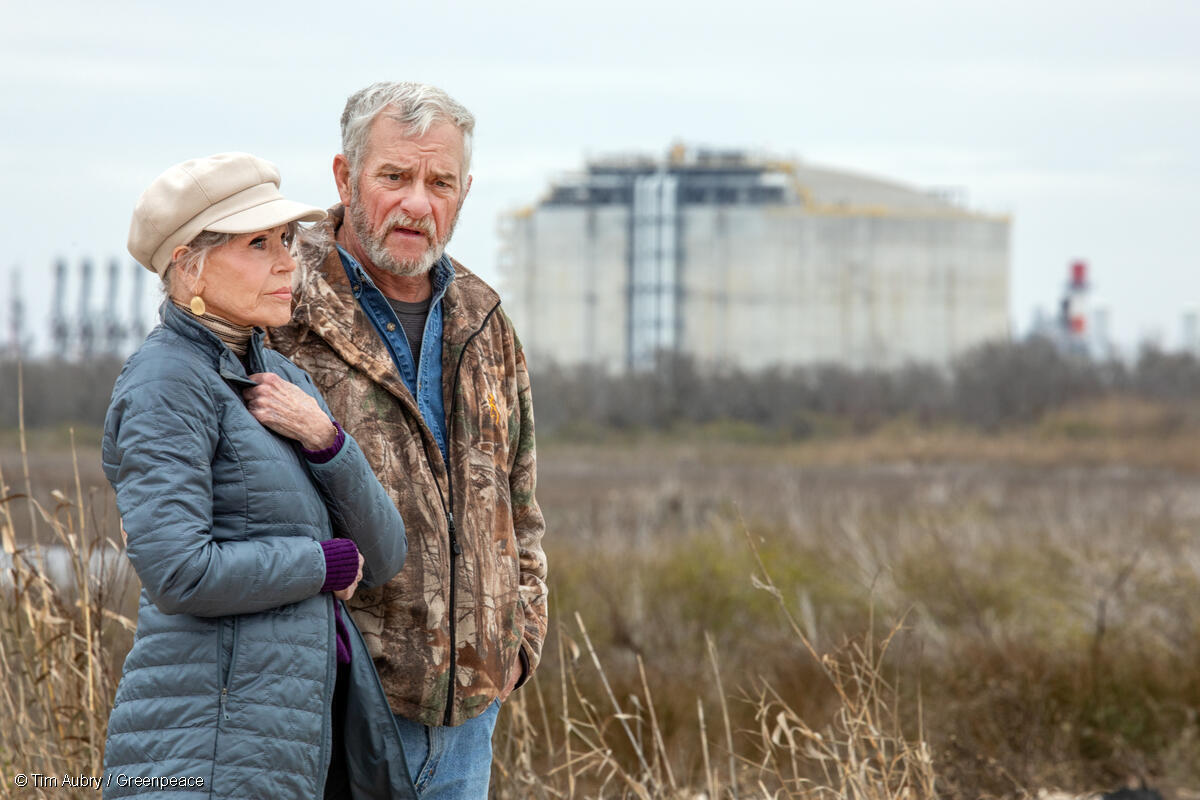
Jane Fonda’s latest role is one she’s been playing for over half a century: Activist.
In Gaslit, a new documentary premiering Thursday at the Santa Barbara International Film Festival, the actress explores the environmental toll of the liquefied natural gas boom in Texas and Louisiana. The film, which was financed and produced by the environmental group Greenpeace, tracks the consequences of the in-demand fuel, sometimes called LNG, on local communities and environments. The export of liquefied natural gas has been linked to high greenhouse gas emissions and health risks for nearby communities.
On a prolonged road trip, Fonda joins two self-described “methane hunters” in West Texas to observe otherwise invisible emissions with an optical gas imaging camera. She meets with a cattle rancher who sold a property that had been in his family for generations after he claims nearby oil extraction polluted its water. She chats with community organizers who argue that cancer rates have skyrocketed in their areas due to nearby industry. Actress Connie Britton and musician Maggie Rogers appear at certain stops, lending their incredulity to what they’re seeing.
It’s just the latest example of environmental advocacy from Fonda, who in 2019 launched regular climate change protests in Washington called “Fire Drill Fridays” – an event series at which she was arrested several times. In 2022 she founded a Political Action Committee (PAC) dedicated to defeating candidates who are allied with the fossil fuel industry.
In an interview with The Hollywood Reporter, the actress discussed why the film homed in on liquefied natural gas, the effect that President Donald Trump’s Environmental Protection Agency has had on communities she covered and how celebrities can be effective as activists in 2026.
How did you become involved with this film?
I’ve been a climate activist for quite a number of years, and in 2019 I joined up with Greenpeace to do what we called Fire Drill Fridays. It was starting in 2019, with Greenpeace’s help, that I became aware of the fact that the most climate damaging work was happening on the Gulf of Texas. It was potentially the greatest concentration of substances that would damage the atmosphere — what they called [a] “carbon bomb.” And it was happening because of fracking that was going on in the Permian Basin.
The fracking, which began under [former President] Obama, it’s very destructive. It pollutes the ground, the water and the air and releases a huge amount of methane. This is then piped down to the Gulf where it is turned into liquid, frozen to [less than] minus 200 degrees Fahrenheit and then put into ships. And all along that way there’s leaking and then it’s shipped to places around the world. It’s destroying local communities and it’s destroying the atmosphere and it’s the number one problem in the world right now. We managed to pressure Biden into calling for a pause in the export [approvals] of this LNG, liquified natural gas. Do you remember when Trump had a gathering of fossil fuel CEOs at Mar-a-Lago before he was reelected? He [reportedly] said, if you give me a billion dollars, I will remove all the regulations. The number one thing they wanted was to remove the pause on the export of liquified natural gas. This is what they are all for, this is where they’re going to make their money, at the expense of Americans. So we decided to do a film to explain to people what is going on.
You’ve been a climate activist for quite some time. Did anything particularly surprise while making this film?
I learned so much. I mean, starting at the very beginning, the extent to which methane is leaking absolutely rocked me. I had no idea. There’s this activist named Sharon Wilson who has a camera that you can look through and you can see what the naked eye can’t see, like gas. When I went down there, Sharon took me out to where there were these huge tanks. You look at the tanks and it’s like, what’s the problem? No problem: Sunny day, beautiful blue sky. And then you look through the camera [and there are] hundreds of feet high billowing clouds of methane. Now methane, [advocates] said, well, methane doesn’t last as long as carbon dioxide and stuff, no, but it’s 80 percent more damaging to the climate over a 20-year period. So in terms of the climate crisis, 20 years is important. We don’t have a lot of time to try to rectify what’s happening. So that’s one thing I realized was how terribly damaging methane is and how much fracking causes it to leak into the atmosphere.
The film also features Connie Britton and Maggie Rogers. What do you think those celebrities brought to this project and the issue?
Well, they’re both environmentalists and they’re both very good friends of mine. What we all hoped, and they hoped, was,that they bring more eyeballs. Connie, for years, she was in that huge hit Friday Night Lights. She was embedded in that world, and so I really wanted her to come back and to see it through the eyes of the people whose lives are being destroyed. And it really had an effect on her. Maggie is Gen Z, and I wanted to encourage young people who might be followers of hers to want to watch. She’s such a soulful person.
How has President Donald Trump’s second administration affected the possibilities for the communities that you covered in the film?
I mean they [activists in these communities] felt that they had the EPA, the Environmental Protection Agency, that they could possibly get help from. I will have to say it wasn’t super good the help they were getting, but now it’s zero. They have nowhere to turn now except public pressure, I think. And it’s desperately needed and that’s why the film I think is really important.
What will distribution look like for a film like this? Where are you planning on taking it and having it be seen?
We’re still grappling with that. It may require an impact-type campaign, which is local people on the ground having house parties and things like that. It’s not entirely clear right now.
What’s next for you when it comes to climate activism?
I have my 5-year-old Jane Fonda Climate PAC because after years of protests and marching and books written and articles and blah, blah, blah, and we haven’t seen the progress that’s commensurate with what the science is calling for. And we certainly haven’t gotten policies, not under Democrats, even. And we realized that the main reason is because so many elected officials from all parties take money from the fossil fuel industry, and so they’ll defend the fossil fuel industry. And so we decided strategically the thing to do was to focus down ballot because on the federal level, there’s very little we can do right now. These positions have an amazing amount of power when it comes both to climate mitigation, building resilience, hardening communities, cities and towns. We’re electing climate champions. And when you’re a climate champion, what we find is you also believe in fairness, in economic equality, you care about all the issues that are important to human welfare. And it’s interesting too because we’re not making an effort to only elect women [but] most of the candidates are women and 70 percent women of color, and they’re so brave. It’s really wonderful. That’s my main climate work, but when something related to the Gulf happens and I’m needed, that’s where I go.
You’re so involved with activism on the climate and issues of free speech. What kind of celebrity activism at the moment can actually be effective?
It can totally be effective. People on the far right denigrate us and say, well, we’re just coastal elite, or what do we know? We’re out of touch. Actors are not so out of touch. We deal with human beings of all kinds. I mean, we play roles of people who are rich, people who are poor. We get to know what it feels like to be struggling, and we are usually people with great empathy, and so we care. And when we speak, it matters. Courage is courageous and we can help it metastasize. We can model courage. We should be as brave as the characters we play. And so actors, musicians, any person in the public in the limelight has a great role to play right now. We can make such a difference and history will know who stands up and who doesn’t. History records, that kind of thing. And so it’s important for us to speak out and I’ve been doing it since I was 33.
This interview has been edited for length and clarity.