A singular, inventive and touchingly intimate documentary, director Anna Fitch’s Yo (Love Is a Rebellious Bird), co-directed and edited by Banker White, recounts the life of Yolanda “Yo” Shea, a free-spirited Swiss immigrant born in the 1920s whom Fitch (in her 40s now) was close friends with right up until Yo’s death. Although this tender portrait — told with puppetry, collages, nearly animated still photographs and candid film footage taken while Yo was alive — is limned with grief, it’s ultimately a deeply joyful work, crafted with painstaking care and precision.
Both Fitch and White appear in front of the camera a fair bit here, but their presence never feels self-indulgent, and they certainly never upstage the star of the show, Yo herself. It’s just that, as Anna’s voiceover implies, a bit of contextualization is needed to understand how these two women from very different generations came to be such good friends. Turns out they had lots in common: Both were only children; both artists, although Fitch trained as an entomologist at first (she’s made several nature documentaries featuring bugs, and caterpillars get a major supporting role here); both weren’t from California originally, although that’s where they ended up living; both became mothers; both have strikingly full heads of wavy hair, and so on.
Yo (Love Is a Rebellious Bird)
Takes flight and soars.
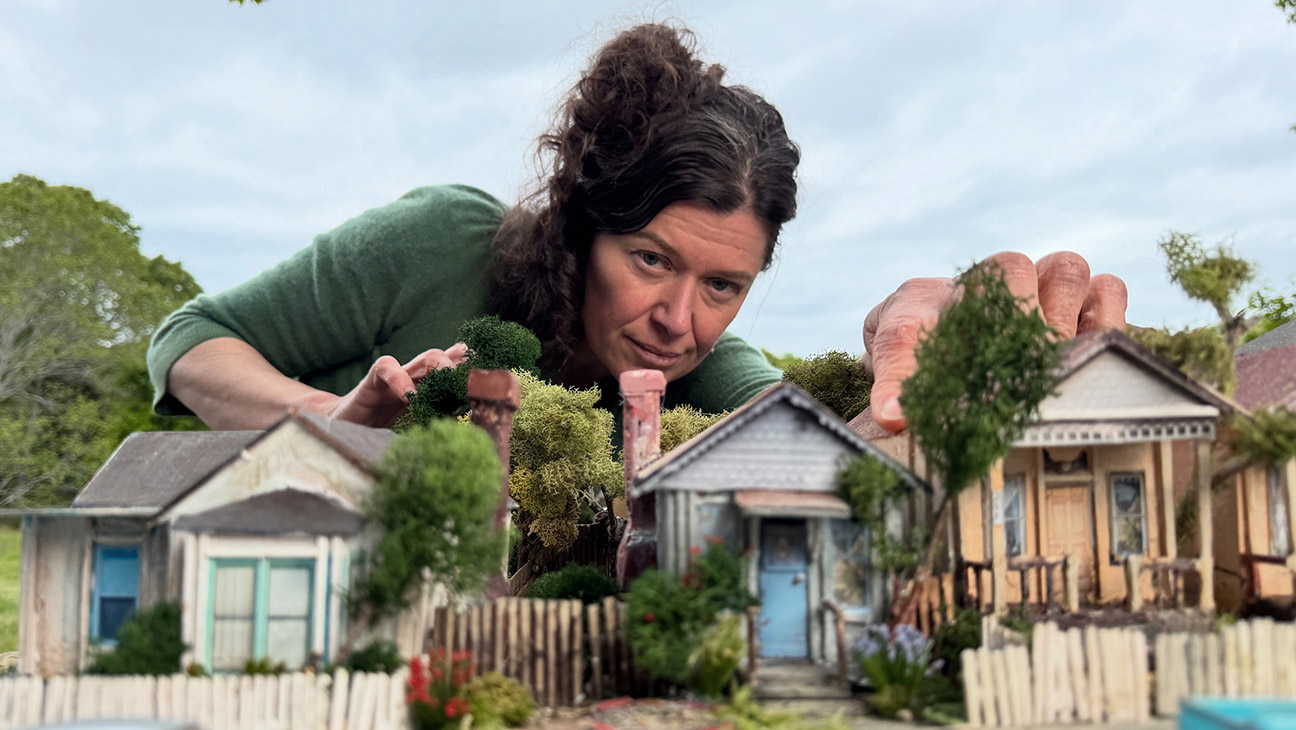
The whimsical listing of parallel experiences major and minor has a (slightly faux) naïve, recitative quality, as if we were looking at things through the eyes of a child. That suits the artless, unfiltered way Yo describes her life, spending a fair amount of time recollecting her own childhood. Meanwhile, 1/3 scale sets that Fitch builds of Yo’s dinky little house, and the even smaller models of 19th Street in Pacific Grove where that house was located, obviously evoke dolls’ houses, just a little bit bigger and constructed to facilitate filming sequences inside them re-enacting scenes from Yo’s last years. Everything inside this tiny, pastel-colored, seaside bungalow where Yo lived is recreated in miniature, down to the blankets on her bed, the fireplace and perhaps (although I can’t entirely confirm this last one) the ounce-sized bags of weed Yo smokes her way through, having been a pothead most of her adult life.
But before we get to an accounting of her druggy years, including a fateful acid trip that changed her life, we learn about her childhood in Italian-speaking Switzerland being raised by conventional parents apparently baffled by the weird, naturally rebellious kid they’d raised. At one point, as we hear Yo talking about her early years, the film cuts in luridly Technicolor footage from a 1955 German children’s film, Der Struwwelpeter, directed by Fritz Genschow, an adaptation of the classic folk tale about a tonsorially unkempt character who cuts off the fingers of disobedient children who don’t cut their nails or comb their hair.
Those clips go very well with the mildly eerie atmosphere that counters the notes of sweetness throughout — apt given that Yo was clearly a complicated character, loving toward her four children but also angry, fearless and determined to pursue her own truth, even if that meant making herself homeless to spend a long time hitchhiking up and down Highway One, the children left behind with her ex-husband. One anecdote about attending her own mother’s funeral and the reception afterwards, and getting so stoned with her husband’s brother she decides to have sex with him in her late mother’s bed, sort of sums Yo up — perhaps in a not entirely flattering way.
And yet it’s hard not to admire and warm to this unflinchingly honest, eccentric woman, especially the one we meet in her last years, worn thin by age but still beautiful, with a beady, impish gaze. A proper hippie to the end, she has no embarrassment about letting Anna film her naked in the bathtub while she chats away to a visiting helper.
She takes delight in so many things, even things that frighten her, like birds, a phobia she’s had since childhood but that doesn’t stop her from putting out nuts for a demanding blue jay she’s befriended. At one point, she remembers telling a guidance counselor as a teen that she didn’t want to work with children because she didn’t like them, even found them frightening. And yet she had those four kids, met here now in their own late middle age, and she’s affectionate and grandmotherly when seen bouncing Anna and Banker’s own infant daughter, who later insists on sharing her copy of Pat the Bunny with Yo as the latter lies in a hospital bed.
We learn that Yo went to art school in the end, and became close friends with artists of her generation, including Dadaist scultptor Jean Tinguely. But what’s interesting is that the film never tries to make out that Yo herself is a historically significant character. She’s just someone the filmmakers knew, loved and spent time with. But based on what we see here, she was remarkable in her own right — in many ways no less deserving of the documentary treatment than anyone else, a formidable woman and an indomitable spirit.
White’s jaunty editing ensures the proceedings roll merrily along, and yet the richness of detail in every frame makes this feel longer than its lean 71-minute running time, but not at all in a negative way. A varied smattering of classical music cuts, ranging from Bach fugues to snatches from Carmen and Madame Butterfly and a smidge of minimalist maestro Terry Riley, add a touch of formal dignity that complements the narrative.